Posted in GRC
The FAA Grounded America. What Failed Before the Communications Did?
Victor Font — Keynote Speaker | Strategic Technology Leader | Fractional CIO | IT & Cyber Governance Expert | Published Author | FedRAMP Readiness | Board-Level Advisor | Digital Transformation | Enterprise WordPress/Formidable Forms
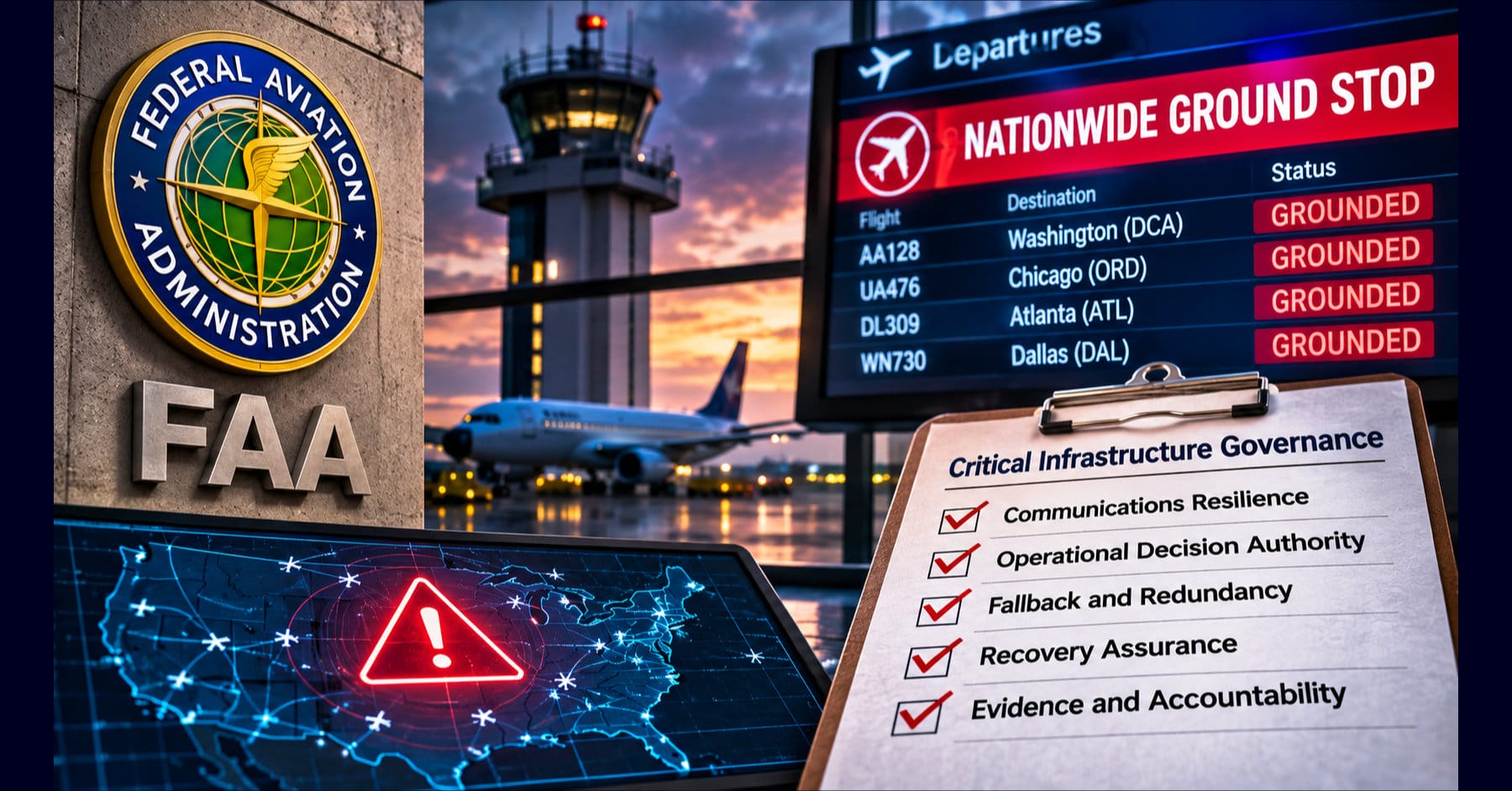
The FAA's November 13 nationwide ground stop is becoming a much more consequential governance story.
Reporting now links the disruption to telecommunications equipment installed during an infrastructure modernization effort. The resulting network problems affected communications at 17 of the FAA's 22 high-altitude air traffic control centers.
But the question extends beyond the equipment.
When engineers replace a critical highway, they often build and test the new route while keeping the existing road operational.
Why shouldn't a comparable principle guide the modernization of essential communications infrastructure?
My latest Cyber Governance Center analysis examines parallel migration, blue-green deployment, failure-domain isolation, vendor accountability, and the evidence required before authorizing high-risk infrastructure changes.
The investigation has not established that a particular safeguard was missing or that required procedures were violated. Those questions remain open.
The larger governance issue is whether modernization decisions were supported by demonstrable operational assurance.
Modernization is an activity. Resilience is an outcome.
And the distinction matters when millions of people depend on the infrastructure.
https://cybergovernancecenter.com/faa-ground-stop-communications-resilience-governance/
2 reactions · 4 comments
Comments
Victor Font: One question continues to stand out from the FAA ground stop: Why could a localized telecommunications problem affect communications across 17 air traffic control centers? When replacing critical infrastructure, organizations should evaluate whether the new environment can be tested alongside the existing one, whether failures can be isolated, and whether rollback procedures have been verified. Th
Schomer: This is the right question, and it's the one that gets skipped most often in modernization: was resilience demonstrated, or just assumed? Parallel migration isn't a luxury. You build the new route while the old one still carries traffic, you prove the new one under real load, and you keep a rollback that actually works under pressure. 17 of 22 centers at once tells you the failure domain was share
Victor Font: Schomer Schomer, you've captured exactly what concerns me about this incident. The scale of the disruption suggests a shared failure domain, and that should prompt serious examination of how the migration was designed, tested, and authorized. Your off/on pair, control run, and evidence log illustrate that the same engineering discipline applies whether we're changing a single security control or r
Schomer: Victor Font An assumption documented as a plan" is the exact right phrase for it, Victor. Too many change boards sign off on a rollback step just because it exists on a checklist, without ever proving it works under degraded conditions. In critical infrastructure, an untested fallback isn't a safety net—it's just delayed downtime. Great piece on this—framing modernization around demonstrable assur