Beyond the Leak Site: What the Azazel Case Reveals About Ransomware Attribution Independent Threat Research…
Mario M. — Independent Threat Researcher | Ransomware Intelligence & OSINT
Beyond the Leak Site: What the Azazel Case Reveals About Ransomware Attribution
Independent Threat Research | 12 October 2026
Introduction
Ransomware data leak sites are a valuable source of threat intelligence. They provide visibility into victim claims, extortion activity, and the public operations of ransomware groups.
However, the identity displayed on a leak site does not necessarily represent every actor involved in an intrusion.
This distinction becomes particularly important within ransomware-as-a-service (RaaS) ecosystems, where platform operators, affiliates, and extortion activities may operate under different identities.
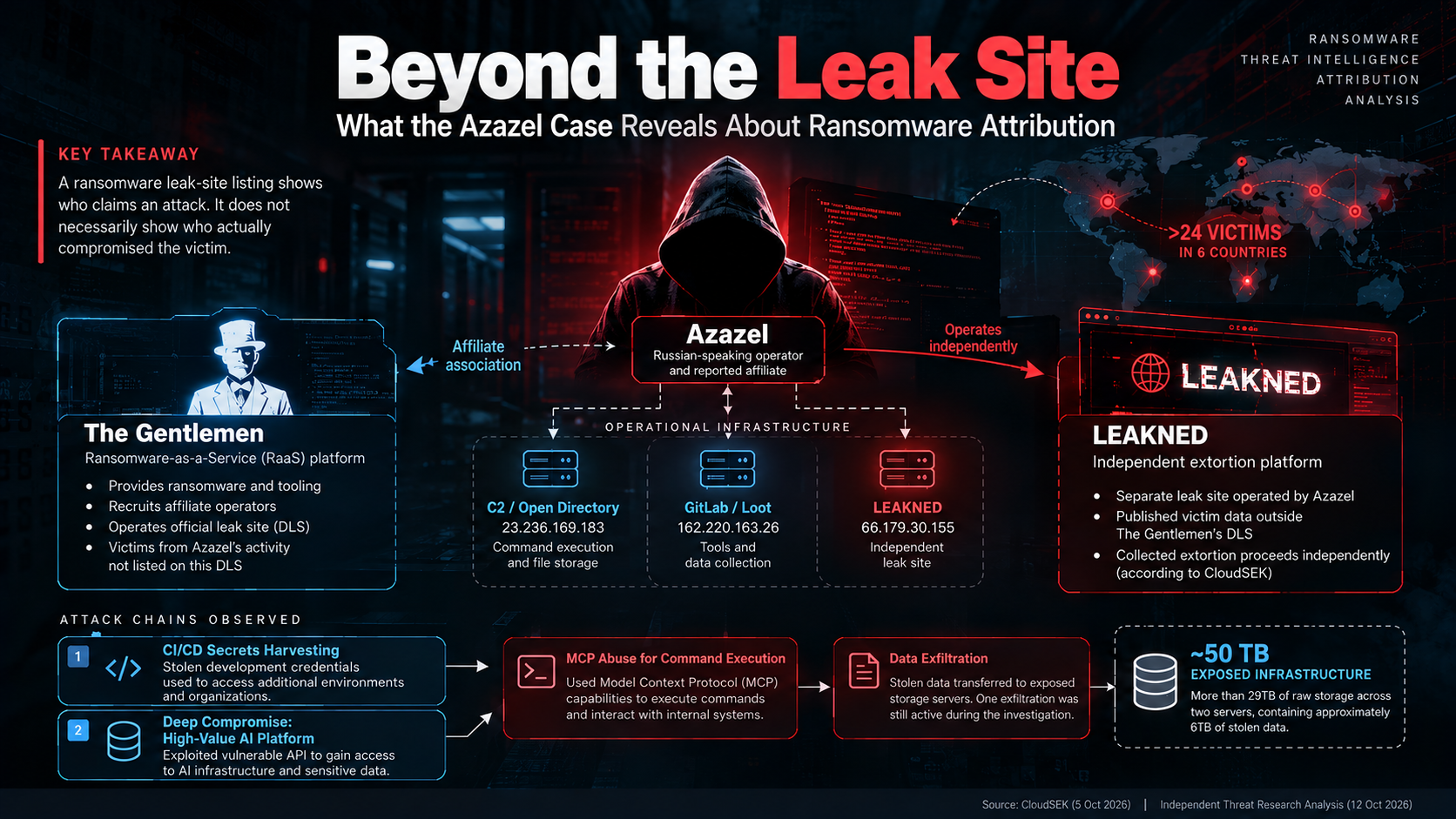
CloudSEK's investigation into a threat actor known as Azazel, published on 5 October 2026, provides a documented example of this challenge.
The case illustrates how an affiliate associated with an established ransomware operation can maintain a separate extortion platform, potentially creating visibility gaps for researchers monitoring only the parent group's leak site.
The Gentlemen, Azazel, and LEAKNED
According to CloudSEK, Azazel is a Russian-speaking operator associated with The Gentlemen ransomware group.
The investigation identified an unusual operational arrangement.
Azazel reportedly used The Gentlemen's tooling, infrastructure, and negotiation channels while simultaneously operating an independent data leak site called LEAKNED.
CloudSEK documented more than two dozen affected organizations across six countries, with stolen information distributed across attacker-controlled infrastructure.
Rather than publishing the identified victims on The Gentlemen's official leak site, Azazel used LEAKNED as a separate extortion platform.
CloudSEK also assessed that the operator retained extortion proceeds outside the established RaaS revenue-sharing arrangement.
The financial relationship has not been independently verified in this analysis. Nevertheless, the documented separation between the ransomware ecosystem and the public extortion identity is significant.
It demonstrates why an affiliate relationship should not automatically be interpreted as centralized control over every stage of an attack.
Infrastructure and Operational Separation
CloudSEK identified three infrastructure nodes serving different operational functions.
The first supported command-and-control activity and file transfers from victim environments.
The second served as an operational staging environment, hosting tools, scripts, and collected information.
The third supported the LEAKNED publication platform and long-term data storage.
The reported infrastructure had more than 50 TB of combined raw storage capacity across the dedicated staging and archive servers. This figure represents infrastructure capacity, not the total amount of confirmed stolen data.
The separation of these functions is relevant to the attribution assessment.
Infrastructure used to execute an intrusion, store stolen information, and publicly conduct extortion may belong to different operational components, even when those activities are associated with the same ransomware ecosystem.
Two Distinct Attack Chains
CloudSEK documented two different operational approaches.
Chain A — CI/CD Secrets Harvesting
The first involved the collection of credentials and secrets from GitLab CI/CD environments and repository histories.
Exposed tokens, database credentials, API keys, and SSH keys provided access to additional systems.
In one documented example, a single GitLab environment created exposure across two otherwise unrelated organizations.
This illustrates how compromised development infrastructure can extend the impact of an intrusion beyond the initially accessed organization.
Chain B — High-Value AI Platform Compromise
The second operation involved a sustained compromise of an AI-related platform.
CloudSEK reported initial access through an API endpoint that fetched user-supplied URLs without adequate validation, enabling access to internal resources.
The subsequent activity included credential recovery, access to monitoring infrastructure, examination of Kubernetes-related configuration, and large-scale data exfiltration.
The researchers also documented the use of Model Context Protocol (MCP) capabilities for command execution within the compromised environment.
Importantly, the documented MCP activity should not be confused with the initial access mechanism.
These two attack chains demonstrate different intrusion methods associated with the same operator. They should not be treated as a single universal technique used against every victim.
The Attribution Problem
The Azazel case highlights three identities that threat researchers should distinguish.
Ransomware platform operator
The organization responsible for maintaining ransomware technology, supporting infrastructure, and affiliate services.
Intrusion operator
The actor responsible for gaining access, conducting operations, collecting information, and potentially deploying ransomware.
Extortion identity
The name, communication channel, or leak-site infrastructure used to pressure victims and publicly claim responsibility.
These identities may overlap, but they are not necessarily interchangeable.
CloudSEK specifically reported that organizations compromised by Azazel using The Gentlemen's tooling appeared on LEAKNED rather than on The Gentlemen's official leak site.
This creates an important analytical distinction.
An incident associated with a particular ransomware ecosystem may not appear under that ecosystem's publicly recognized extortion identity.
What Leak-Site Monitoring Can Miss
Monitoring ransomware leak sites provides useful visibility into publicly claimed incidents, but it is not a complete record of ransomware activity.
A leak-site entry primarily documents a public claim by an actor.
It does not independently establish the complete intrusion chain, the specific operator responsible, or the relationship between the individuals and infrastructure involved.
Likewise, the absence of a victim from a particular group's leak site does not necessarily exclude involvement by an affiliate associated with that group.
The Azazel/LEAKNED investigation provides a concrete example of this limitation.
Researchers relying exclusively on The Gentlemen's official DLS could have missed victim claims published through Azazel's separate extortion platform.
This does not establish how widespread the practice is across the ransomware ecosystem. It does, however, demonstrate why DLS monitoring alone cannot provide complete operational attribution.
Analytical Assessment
The central finding of this review is that ransomware ecosystem affiliation and direct operational responsibility should be evaluated separately.
The CloudSEK investigation supports an assessment that Azazel maintained a distinct extortion identity while using resources associated with The Gentlemen.
However, several questions remain unresolved from the perspective of independent public-source analysis:
- The complete financial relationship between Azazel and The Gentlemen.
- The degree of awareness or control exercised by the RaaS administrators.
- Whether similar arrangements exist among other affiliates of the group.
- The extent to which separate extortion identities can be systematically linked to their underlying ransomware ecosystems.
These limitations matter because attribution is not simply a question of identifying a ransomware brand.
It requires examining the relationship between malware, infrastructure, intrusion activity, communications, and the identity publicly claiming responsibility.
For threat intelligence researchers, this suggests a practical approach: record the ransomware family, suspected intrusion operator, and extortion identity as separate analytical fields whenever the available evidence supports that distinction.
Conclusion
The Azazel/LEAKNED case illustrates a significant limitation of ransomware intelligence based exclusively on public leak-site monitoring.
An affiliate may operate within an established RaaS ecosystem while maintaining a separate public identity for extortion.
As a result, the name appearing on a leak site may describe only one component of a larger criminal operation.
Reliable attribution requires more than identifying who claimed responsibility.
It requires determining what the available evidence supports, which relationships remain uncertain, and where visibility ends.
A leak-site claim is an intelligence starting point, not a complete attribution.
---
Sources
Primary research
CloudSEK TRIAD — Caught in 4K: The Gentlemen Files (5 October 2026)
https://www.cloudsek.com/blog/caught-in-4k-the-gentlemen-files
Research methodology
This article is an independent analytical review of publicly published threat intelligence. Technical findings concerning Azazel and LEAKNED are attributed to CloudSEK. The discussion of attribution limitations represents an analytical interpretation of those findings.
No independent forensic investigation, direct access to victim environments, or validation of attacker-controlled infrastructure was performed.
5 reactions · 8 comments
Comments
Schomer: Great analysis, Mario. This case perfectly highlights why flattening threat intelligence into a single 'Ransomware Group' data field is a major analytical trap. Tracking the Ransomware Platform, the Intrusion Operator, and the Extortion Identity as three distinct, modular entities is the only way CTI teams can avoid massive visibility blind spots. Excellent breakdown of the operational reality beh
Mario M.: Schomer Thanks for the thoughtful comment. That's exactly the distinction I wanted to highlight. A leak-site claim tells us who is publicly taking responsibility, but not necessarily who conducted the intrusion or controlled the underlying infrastructure. Keeping those relationships separate, and linking them only where the evidence supports it, gives us a much more accurate picture of ransomware
Schomer: Exactly, Mario. It's the difference between tracking a PR front and tracking actual server footprints. When we separate those fields, we can start clustering the intrusion operators based on things like their unique staging habits, C2 setups, or exfiltration configurations—even if they jump to a completely different RaaS platform or leak site next month
Mario M.: Exactly. Those operational patterns can provide valuable continuity when ransomware brands or leak sites change. The important part is correlating multiple independent indicators rather than relying on a single shared tool or infrastructure detail. Similarities can point us toward a connection, but they shouldn't automatically become an attribution.
Schomer: Spot on, Mario. Conflating infrastructure similarities with absolute attribution is where legacy CTI teams stumble. Operational habits and server footprints tell us how an actor moves, not necessarily who they are. That is exactly why our pipeline maps these indicators into modular STIX 2.1 relationship graphs asynchronously. By treating infrastructure nodes, intrusion behavior, and the PR front a