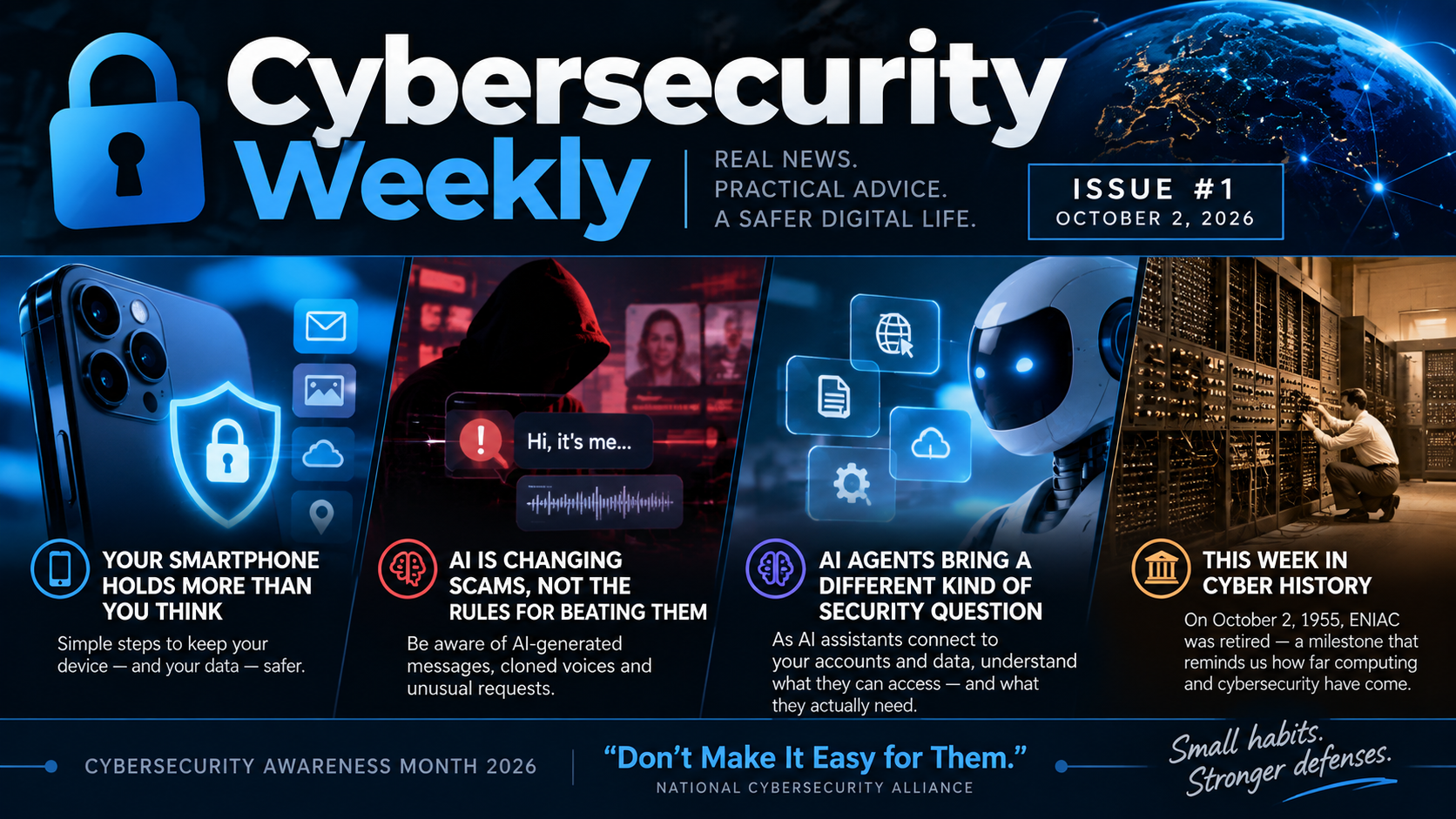
🔐 Cybersecurity Weekly - Issue #1 | October 2, 2026
Mike M. — Technical Support Specialist
Cybersecurity Awareness Month begins: small habits, stronger defenses
October is Cybersecurity Awareness Month , and the 2026 theme is fitting: “Don’t Make It Easy for Them.” The National Cybersecurity Alliance recommends starting with four basics: strong passwords and a password manager, multifactor authentication, recognizing scams, and keeping software updated.
Cybersecurity does not have to mean becoming a security expert. Often, a few small precautions are enough to make you a much less attractive target.
Cybersecurity Awareness Month - National Cybersecurity Alliance
📱 Your Smartphone Holds More Than You Think
Phones have quietly become the keys to our digital lives. Email, banking, photos, authentication apps, saved passwords, travel information and account-recovery tools may all be accessible from one device.
This week, the SANS Institute highlighted the risks of a lost or stolen smartphone and five protections worth checking now: use a strong screen lock, enable device tracking and remote wiping, turn on automatic updates, install apps from trusted sources, and keep automatic backups enabled.
What you can do: Take five minutes this week to confirm that Apple's Find My or Android's device-finding feature is enabled. Then verify that your phone is backing itself up. Losing a phone is bad enough. Losing everything stored on it doesn't have to be part of the package.
Read the SANS OUCH! guide: Your Smartphone: A Gold Mine for Cybercriminals
🤖 AI Is Changing Scams, Not the Rules for Beating Them
Artificial intelligence is making familiar attacks faster and more convincing. Criminals can use AI to create personalized phishing messages and realistic cloned voices or video impersonations. The FBI has previously warned that these techniques can be used to impersonate family members, coworkers and other trusted people.
The technology may be new, but one of the best defenses is wonderfully low-tech: verify unusual requests another way. If someone claiming to be a relative urgently needs money, call them using a number you already know. Families can also establish a private word or phrase to help verify one another during suspicious calls. SANS is highlighting exactly that family conversation during the first week of Cybersecurity Awareness Month.
What you can do: Talk with your family before the scam arrives. Agree that unexpected requests involving money, passwords, verification codes or emergencies will always be independently verified.
SANS: Four Conversations to Have With Your Family This October
🧠 AI Agents Bring a Different Kind of Security Question
AI is also beginning to do more than answer questions. AI agents can interact with files, websites, APIs and other tools to perform tasks for people.
That capability creates an important security question: What should an AI system actually be allowed to do?
Cloud Security Alliance research describes risks including excessive permissions, prompt injection and agents being tricked into misusing tools or credentials. The lesson extends beyond businesses. As AI assistants become more connected to our accounts and data, users should pay attention to what information and permissions they grant them.
What you can do: Treat an AI service like any other application requesting access. Before connecting email, cloud storage or other accounts, ask whether it actually needs that access. Avoid giving any application more permission than necessary.
Cloud Security Alliance: AI Agents, Architecture and Security Controls
🕰️ This Week in Cyber History: ENIAC Signs Off
On October 2, 1955 , ENIAC was shut down for the final time after roughly a decade of operation. The enormous early electronic computer occupied about 1,000 square feet and could perform approximately 5,000 operations per second.
Today, a device that fits in your pocket possesses capabilities that would have been almost unimaginable to ENIAC's creators. That progress also explains something fundamental about modern cybersecurity: computing stopped being something that happened inside special rooms and became something woven into everyday life.
Seventy-one years after ENIAC went dark, protecting computers increasingly means protecting people .
Computer History Museum: ENIAC Retired, October 2, 1955
🛡️ One Thing to Do This Week
Don't try to “fix cybersecurity” all at once.
Pick one account you care about and make it harder to steal. Give it a unique password or passkey, enable multifactor authentication, check its recovery information, and install any waiting updates on the device you use to access it.
Then help someone else do the same.
Stay aware. Stay curious. Don't make it easy for them.
#Cybersecurity #CybersecurityAwarenessMonth #CyberAwareness #OnlineSafety
4 reactions · 0 comments
Topics: #cybersecurityawarenessmonth, #cyberawareness, #cybersecurity, #onlinesafety