Unplugged has never meant unhackable. In 1945, Soviet schoolboys presented the U.S. Ambassador in Moscow…
Lara B. — Building Cyberr
Unplugged has never meant unhackable.
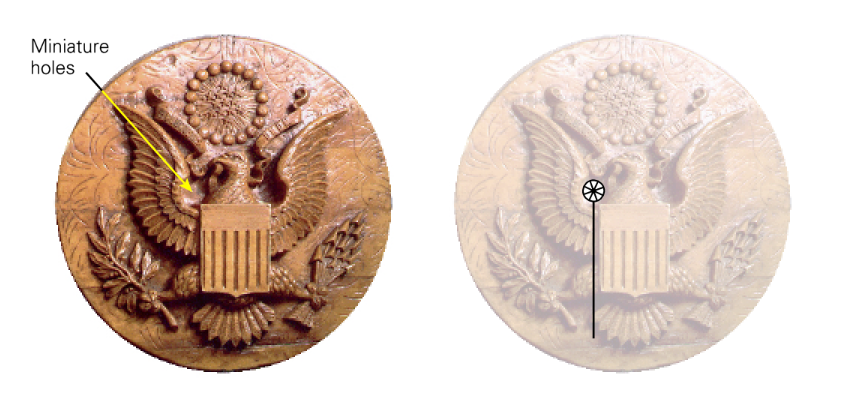
In 1945, Soviet schoolboys presented the U.S. Ambassador in Moscow with a hand-carved wooden replica of the Great Seal of the United States, which hung on his office wall for seven years!!!! before American intelligence realised it was a listening device. When they finally took it apart, they found no battery, no wires, no electronics of any kind - just a piece of what looked like scrap metal.
What it actually was: a passive cavity resonator that only activated when the Soviets beamed a specific radio frequency at the building from a van parked outside.
The Ambassador's voice vibrated a paper-thin membrane inside the seal, which altered the reflected signal just enough to reconstruct the audio on the other end. No power source, no footprint, and no way to detect it with any sweep technology that existed at the time.
The Americans didn't find it for seven years and only then because British intelligence accidentally intercepted the Soviet operators listening in.
That device, known as The Thing, became the foundation of what security researchers now call air-gap jumping: stealing data from computers that have never touched the internet, using heat differentials between machines, hard drive indicator lights flickering in patterns too fast for the human eye to catch, and cooling fan speeds tuned to broadcast acoustic frequencies that a nearby phone can receive and decode.
The Soviets didn't plant a bug. They built the blueprint.
3 reactions · 0 comments