Posted in Threat Intelligence
🚨 PHP2Shell: A Reminder That Visibility Matters More Than Ever Imagine a security flaw hiding inside…
Ahmad T. — Threat Intelligence and Research Analyst
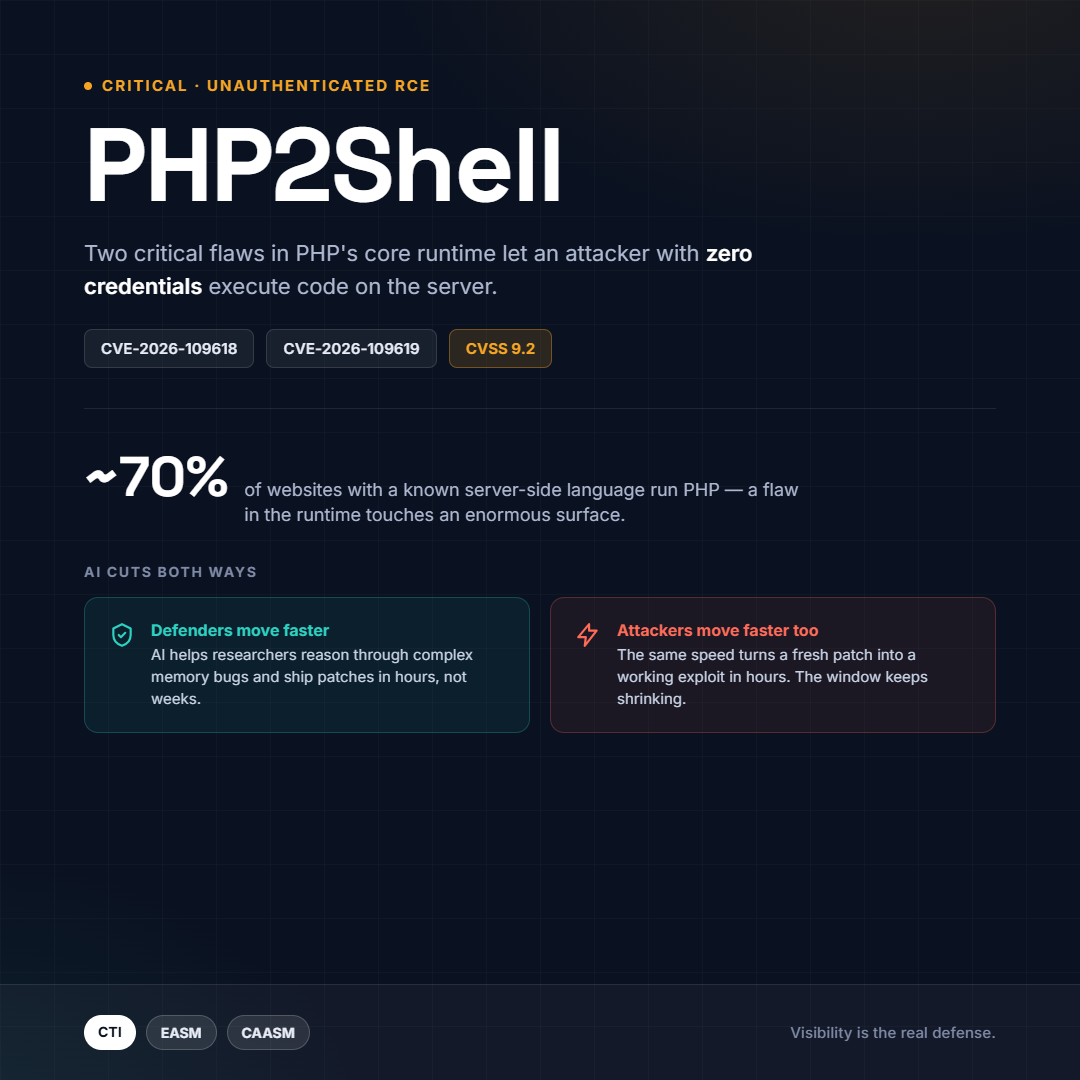
🚨 PHP2Shell: A Reminder That Visibility Matters More Than Ever
Imagine a security flaw hiding inside software that's quietly run the web for decades. Not a new app. Not some obscure plugin, but one of the core technologies behind a huge share of the internet.
That's the story behind PHP2Shell.
PHP is a server-side language used to build and run websites and web applications. It powers platforms like WordPress, Drupal, and Joomla, plus countless business sites and online services. Estimates put its footprint at roughly 70% of websites, but that doesn't mean 70% of the internet is vulnerable. It shows how much surface area one flaw in PHP itself can touch.
The flaw beneath the applications:
On October 21, 2026, the PHP project disclosed two critical bugs in its core runtime: CVE-2026-109618 and CVE-2026-109619. Both scored 9.2 (Critical), and neither requires a login to exploit.
Both trace back to how PHP handles memory. One is triggered by a crafted upload or form submission that leaves PHP working with data that wasn't fully set up. The other lets leftover data from one request get read by the next request on the same server, even from a different user.
Put together, this could let an attacker run their own code on the server with no credentials at all, opening the door to stolen data, defaced sites, or a foothold into connected systems.
Why this is really about visibility, not just patching.
Finding the vulnerability was only ever half the problem. The harder half is knowing where that technology actually lives: which servers, which forgotten apps, which old VM nobody's touched since 2019.
That's why quarterly scans and slow patch cycles aren't enough anymore. What matters is whether an organization knows, continuously, where it's exposed.
🔹CTI tells you a flaw like this exists, who's using it, and how fast.
🔹EASM tells you which of your internet-facing assets are actually running the vulnerable code, including the ones no one remembers.
🔹CAASM ties it together internally, across cloud and on-prem, so "we patched it" means patched everywhere, not just where someone happened to look.
A forgotten domain. An old VM. Any one of these can quietly undo an otherwise mature security program.
The next major security challenge probably isn't finding the vulnerability. It's finding every place it lives before someone else, human or AI, does it first. That's not a patching problem. It's a visibility problem.
6 reactions · 1 comments
Comments
Schomer: Spot on analysis, Ahmad. The tracking nightmare with CVE-2026-109618/19 isn't just identifying the primary web servers; it’s mapping the shadow VMs and legacy middleware where unauthenticated memory corruption triggers before any standard agent or boundary control even registers the session state. Because traditional CAASM/EASM cycles still rely on a discovery delta window, a zero-click exploit ca