What cybersecurity IS? It's not attributable only to “security of IT” Cybersecurity is a "coordinated…
Marco I. — Chief Innovation Officer & Chief Information Security Officer
What cybersecurity IS?
It's not attributable only to “security of IT”
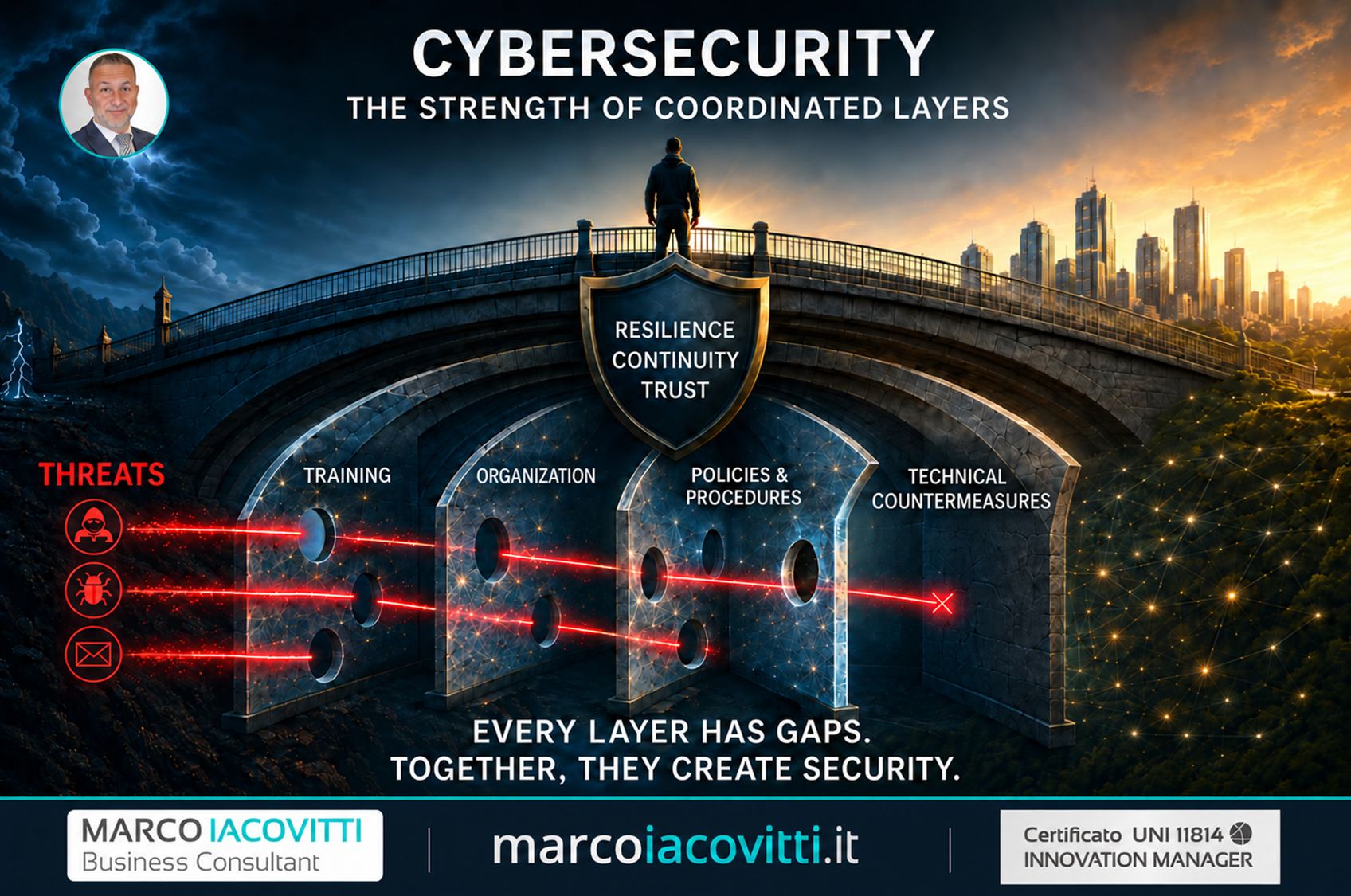
Cybersecurity is a "coordinated system" of layers that could be, rateher, are surely imperfect but absolutely complementary each other.
Each layar has it's hole (passages) like a slice of "Swiss Chees".
The sum of slices, placed next to each other, make as a single layer without holes which we can define as something very close to safety (in cybersecurity there isn't toatl safety, beacuse don't exist zero risk).
Like a stone bridge, cybersecurity represents the crossing from dangerous environment to resilient and orgnaized enviroment.
This bridge rest on different pillar (the slice of Swees cheese) which one contribute to create stability and continuity:
• Training
• Organization
• Policy & Procedure
• Technical Countermeasures
As in the picture, exist many type of threats and threat-actor: human adversary, malware and malicious code, phishing and email-borne attacks — the three most common initial access vectors.
Threats first encounter training, then organizational measures, policies and procedures, and finally technical countermeasures. Each layer can contain gaps, but the gaps should not align, so more layers with gap could be appear like a one one unique layer without gap.
Awareness reduces human error.
Governance defines responsibilities and repeatable behaviour, documented procedures guide action.
Technology prevents, detects and contains malicious activity.
In summary, security does not depend on a single product or control.
It emerges when people, rules and technologies reinforce one another, so that the failure of one safeguard is compensated for by the others.
Operationally, the picture argues against single-point security investments. A firewall alone, or an awareness campaign alone, leaves an aligned corridor of holes. The defensive value comes from the fact that the gaps of one layer are covered by another, and from periodic verification that they have not drifted into alignment — which is exactly what internal audits, vulnerability assessments and tabletop exercises are for.
• Attack paths: red laser trajectories that travel horizontally through the defensive layers, showing that an attack does not stop at the first control but seeks a continuous line of holes across all of them.
• Layer 1 — Training: awareness and human capability, the first barrier because most intrusions begin with a user action.
• Layer 2 — Organization: roles, responsibilities, governance structures and the assignment of accountability.
• Layer 3 — Policies & Procedures: the formal rules that make behaviour repeatable and auditable.
• Layer 4 — Technical Countermeasures: the technological controls that block what the previous layers did not intercept; here the attack is finally stopped.
• Holes in each barrier: residual weaknesses ( untrained employee- unassigned role- obsolete procedure - unpatched system).
Their presence is normal; their alignment is what causes an incident.
• The central shield inscribed RESILIENCE — CONTINUITY — TRUST: the outcome the layered system is designed to produce, positioned on the keystone of the bridge because it is what holds the structure together.
• The Man, figure standing on the bridge: the decision-maker, whose ability to cross safely depends on the layers below, not on any single tool.
6 reactions · 1 comments
Comments
Schomer: Excellent visualization, Marco. The 'Swiss Cheese' model is a great way to map out enterprise defense-in-depth, but it reveals a critical operational vulnerability: if an adversary leverages automated zero-click threat paths, they don't guess where the holes are—they find the aligned corridor instantly. Stacking imperfect application-layer slices creates a heavy, passive monitoring stack that only