Posted in Security Awareness
Your Security Controls Are Teaching Employees How to Bypass Them
Victor Font — Keynote Speaker | Strategic Technology Leader | Fractional CIO | IT & Cyber Governance Expert | Published Author | FedRAMP Readiness | Board-Level Advisor | Digital Transformation | Enterprise WordPress/Formidable Forms
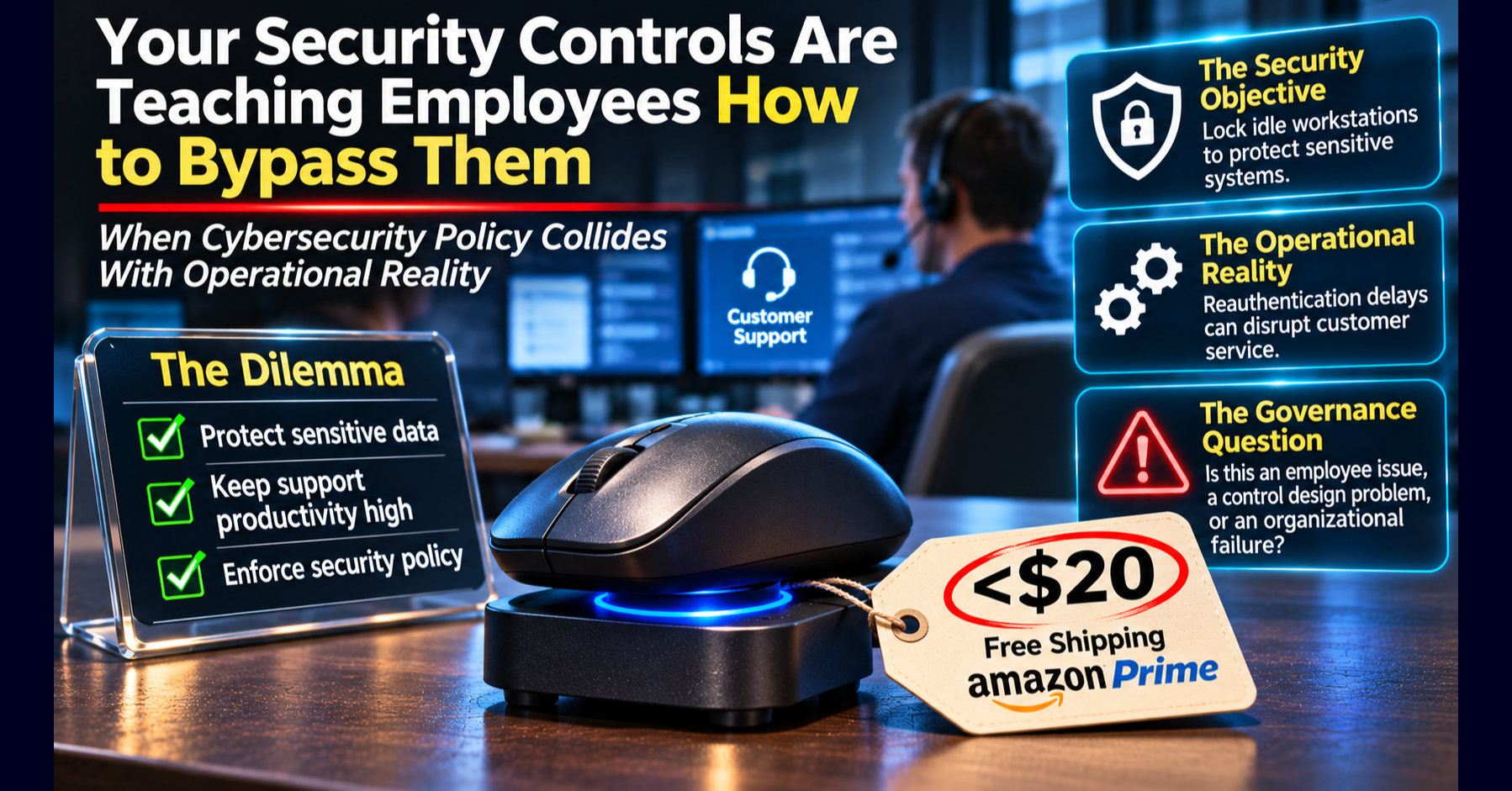
When Cybersecurity Policy Collides With Operational Reality
Yesterday, I witnessed something that should concern every CISO, cybersecurity governance professional, and executive responsible for enterprise risk.
I was visiting an acquaintance at his home when something caught my attention.
Out of the corner of my eye, I noticed his computer mouse moving.
Nobody was touching it.
I looked more closely.
The mouse was resting on a small electronic device that was physically moving it.
Naturally, I asked what it was.
He explained that he works remotely as a technical support agent for a large financial investment firm. His employer enforces a strict workstation inactivity policy. When the system detects no activity for a prescribed period, it locks and requires reauthentication.
That sounds like a perfectly reasonable security control.
But there was a problem.
His work involves assisting customers throughout the day. When a new call arrives after a period of inactivity, having to unlock the workstation and reauthenticate into the support environment creates delays.
Those delays interfere with customer service.
So he found a solution.
He purchased a mouse mover.
For less than $20, with free shipping through Amazon Prime, he acquired a device that could prevent his workstation from recognizing that he was inactive.
No hacking skills.
No administrative privileges.
No sophisticated exploit.
Just an inexpensive consumer device performing a simple mechanical function.
And suddenly, an enterprise security control designed to protect sensitive financial systems could be circumvented.
I left that conversation thinking about something much larger than a mouse mover.
What happens when the people we expect to comply with cybersecurity controls discover that those controls interfere with the work we expect them to perform?
Millions in Security. Twenty Dollars to Circumvent a Control.
Consider the investment required to establish and maintain cybersecurity across a major financial services organization.
Identity and access management.
Endpoint protection.
Security operations.
Device management.
Authentication infrastructure.
Regulatory compliance.
Risk assessments.
Security awareness training.
Executive reporting.
Collectively, these capabilities can represent millions of dollars in enterprise investment.
Somewhere within that environment, a security team establishes a workstation inactivity policy.
IT deploys the configuration.
Compliance verifies that the required settings are enforced.
Management receives assurance that the control is operational.
The dashboard may even report 100% compliance.
And an employee defeats the inactivity detection mechanism with a device that costs less than lunch for two.
Millions invested in cybersecurity. Less than $20 to undermine one of its controls.
The problem is not the sophistication of the device.
The problem is what the device reveals about the difference between security configuration and security effectiveness.
The workstation may still have its inactivity policy correctly configured.
The endpoint management platform may still report the device as compliant.
The organization may still pass a configuration-based control assessment.
Yet the control's intended behavior—locking the workstation after genuine human inactivity—may no longer occur.
The device does not necessarily defeat absolute session expiration or every independent authentication safeguard. It exploits a narrower assumption: that mouse activity represents human presence.
And that assumption is exactly where the security model becomes vulnerable.
Is This an Employee Problem or a Governance Problem?
The immediate reaction from many cybersecurity professionals will be predictable.
The employee is violating security policy.
And they have a point.
An employee who knowingly circumvents an established security control is making an unauthorized decision about the organization's risk exposure.
That behavior should not be excused simply because the control is inconvenient.
But stopping the analysis there would be a mistake.
Consider the employee's perspective.
He is expected to respond promptly when customers call.
He is expected to provide efficient technical support.
He is expected to meet operational performance standards.
He is also expected to comply with a security control that may introduce delays between customer interactions.
When those expectations conflict, which one does he prioritize?
In this case, he chose customer service efficiency.
He purchased a device that eliminated the inconvenience from his daily workflow without addressing the underlying conflict between security requirements and operational expectations.
He did not request a formal security exception or seek a change to the authentication policy.
But that raises an important question.
Did he even know there was a legitimate way to raise the issue?
Perhaps the organization has no established process for employees to report security controls that interfere with their work.
Perhaps such a process exists, but employees have never been educated about it.
Or perhaps he simply assumed that raising the issue would accomplish nothing.
We don't know.
And that uncertainty is part of the larger governance problem.
Organizations routinely educate employees about security policies and prohibited behaviors. But do they provide equally clear guidance about what employees should do when those policies interfere with legitimate business operations?
When employees cannot identify a practical, authorized path for resolving security friction, they may create an unauthorized path of their own.
The security control remained visible to management. The workaround remained invisible.
The employee made an unauthorized decision to circumvent a security safeguard. But the organization may have created the conditions that made the decision attractive—and may not have provided an accessible mechanism for resolving the conflict.
Both facts can be true.
Security Friction Is a Governance Signal
Cybersecurity controls impose costs beyond their purchase and implementation.
They consume time.
They interrupt workflows.
They introduce additional steps.
They sometimes create friction between operational performance and security requirements.
Some friction is necessary.
A financial institution should not eliminate authentication safeguards merely because employees find them inconvenient.
But security friction should be understood, measured, and managed.
Consider the difference between two questions.
Question one: Are all remote workstations configured to lock after the required inactivity period?
Question two: How does the inactivity policy affect employees whose work requires rapid access to customer support systems throughout the day?
The first question measures control implementation.
The second examines operational consequences.
A mature governance program needs answers to both.
Because when organizations measure only the first, they may never discover why employees are circumventing the control.
And when the workaround is inexpensive, readily available, and difficult to distinguish from legitimate activity, the temptation to bypass the control becomes even greater.
Security friction that management does not understand becomes a breeding ground for unauthorized exceptions.
The Control May Be Compliant and Ineffective at the Same Time
This is the most troubling aspect of the situation.
Imagine an executive dashboard showing that every managed workstation complies with the organization's inactivity-locking standard.
The metric is green.
The policy exists.
The configuration is deployed.
The compliance assessment confirms the required setting.
Everything appears satisfactory.
But what exactly has been proven?
That the workstation is configured to lock after a defined period without input?
Or that the workstation actually becomes inaccessible when the employee is no longer present?
Those are different assurance claims.
A mechanical mouse mover may allow the first condition to remain true while undermining the second.
The organization has verified a technical setting without necessarily verifying the security outcome.
A security control can be technically compliant, operationally disruptive, and functionally ineffective—all at the same time.
That should concern every executive who relies on cybersecurity compliance reports to understand enterprise risk.
Because the problem extends far beyond mouse movers.
Employees use personal cloud storage when approved file-sharing tools are cumbersome.
They transfer information into unauthorized applications when corporate systems make legitimate work unnecessarily difficult.
They share credentials when access provisioning becomes a bottleneck.
They develop informal workarounds when security procedures conflict with operational expectations.
Not every workaround creates the same level of risk.
But each can expose a gap between how the organization believes its controls operate and how employees actually perform their work.
The Unauthorized Exception Nobody Approved
There is another dimension to this situation that deserves attention.
In a properly governed environment, exceptions to security controls should follow an established process.
The business need is evaluated.
The security consequences are assessed.
Alternatives are considered.
An authorized decision-maker approves or rejects the request.
Compensating controls may be required.
The exception is documented and periodically reviewed.
None of that happened here.
The employee effectively created his own exception.
He determined that the operational inconvenience outweighed the security benefit.
He selected a workaround.
He implemented it without authorization.
And he continued working.
A risk acceptance decision occurred without an authorized risk owner, a documented assessment, or management awareness.
That is not simply a failure of employee compliance.
It represents a breakdown in the organization's ability to govern how its controls are used in practice.
The organization may believe it has established an enforceable security boundary.
The employee has independently redefined that boundary.
And the difference may remain undetected.
The Solution Is Not to Eliminate the Lockout
It would be easy to argue that the financial institution should simply extend the inactivity timer.
That would be an incomplete response.
Workstation locking serves a legitimate security purpose, particularly in environments where authenticated sessions may provide access to sensitive customer information.
The objective should not be to sacrifice protection for convenience.
It should be to determine whether the organization can preserve the security objective while reducing unnecessary operational friction.
That requires collaboration between security, identity management, IT operations, and business leadership.
Could faster, phishing-resistant authentication reduce the time required to resume work?
Could hardware-backed authentication or biometric reauthentication improve the user experience?
Could application session management be redesigned so that unlocking the workstation does not require unnecessarily repetitive authentication?
Could the support workflow be adjusted to accommodate security requirements without delaying customer interactions?
Could management evaluate the actual time lost to authentication and compare it with the security benefits of the existing policy?
These are architectural and governance questions.
They cannot be answered by the security team alone.
Nor should individual employees be left to resolve them through unauthorized workarounds.
The organization must design a security operating model in which legitimate work can be performed efficiently without requiring employees to defeat the controls intended to protect it.
Evidentiary Architecture™ and the Missing Assurance
This example also illustrates an important principle of Evidentiary Architecture™.
Organizations must distinguish between evidence that a control exists and evidence that the control achieves its intended outcome.
A configuration report may demonstrate that inactivity locking is enabled.
A technical test may demonstrate that the workstation locks when no input is received.
But neither necessarily establishes that the control remains effective against common forms of artificial activity.
That requires a broader understanding of the control's assumptions, limitations, operational environment, and potential methods of circumvention.
For material controls, governance should connect:
Security objective → Control design → Operational impact → Implementation → Effectiveness validation → Exceptions and workarounds → Ongoing assurance.
The purpose is not to demand surveillance of every employee.
It is to ensure that management understands whether its security controls operate as intended under realistic working conditions.
That may involve employee feedback, workflow assessments, targeted control testing, and carefully governed monitoring consistent with applicable law and organizational policy.
A control that creates widespread incentives for circumvention deserves management attention even before an incident occurs.
The existence of a policy does not eliminate the need to understand human behavior.
The Boardroom Question Nobody Is Asking
Boards regularly receive reports about cybersecurity maturity, control coverage, identity management, endpoint security, and compliance.
But how often do directors ask whether employees are circumventing controls because those controls interfere with business operations?
How often does management evaluate the operational friction created by security requirements?
How often are employee workarounds treated as indicators of control design weaknesses rather than solely as disciplinary matters?
And how does the organization distinguish between a control that is configured correctly and one that is effective in actual use?
These questions are not invitations for directors to micromanage workstation settings.
They are questions about management's ability to reconcile security requirements with operational reality.
A board should expect management to identify material conflicts between security controls and business processes, evaluate their consequences, and establish appropriate mechanisms for resolving them.
Otherwise, the organization risks building a cybersecurity program that looks effective in reports but behaves very differently in practice.
The Twenty-Dollar Governance Test
I keep returning to that small device sitting on my friend's desk.
It was not sophisticated.
It did not require specialized technical knowledge.
It was not an advanced persistent threat.
It was an ordinary consumer product purchased to solve an everyday workplace inconvenience.
Yet it potentially undermined a security safeguard within a highly regulated financial services environment.
That is what makes the observation so revealing.
The employee was not attempting to compromise the enterprise.
He was trying to do his job more efficiently.
But his solution introduced a security consequence that he had no authority to accept.
The organization may have established a reasonable security policy.
It may also have failed to account adequately for how that policy affected the work it expected employees to perform.
And management may have no visibility into the resulting workaround.
The employee owns the decision to circumvent the control. Management owns the responsibility to understand why the control is being circumvented and whether the operating model is encouraging that behavior.
Those responsibilities are not mutually exclusive.
They are part of the same governance problem.
If a $20 consumer device can quietly defeat the behavior your multimillion-dollar cybersecurity program assumes it is enforcing, perhaps the next cybersecurity investment should begin with understanding how your employees actually work.
Because the greatest weakness in a security control may not be its technology.
It may be the gap between what the organization requires and what the organization makes practical.
Discussion
A remote employee uses a $20 mouse mover to prevent a corporate workstation from locking between customer calls.
The employee knows the device circumvents a security safeguard but believes it is necessary to meet customer service expectations.
The security team has correctly configured the inactivity policy.
Business management expects fast customer response times.
Nobody has authorized the workaround.
Who owns the failure?
Is this primarily an employee compliance issue, a security architecture problem, or a governance failure?
If I were the CISO, my first instinct would be to examine and redesign the authentication workflow—not reach for the disciplinary policy.
I would also consider recognizing the employee for exposing a weakness that our control assurance processes had failed to identify, while addressing the unauthorized circumvention.
After all, he demonstrated that a security safeguard could be undermined with a $20 consumer device.
Would you discipline the employee for circumventing the control, reward him for exposing its weakness, or do both?
And what would your decision reveal about your organization's cybersecurity culture?
#CybersecurityGovernance #SecurityControls #HumanFactor #CyberRisk #SecurityArchitecture #ExecutiveAccountability #GRC #SecurityCulture
1 reactions · 5 comments
Topics: #cyberrisk, #securitycontrols, #cybersecuritygovernance, #executiveaccountability, #humanfactor, #securityarchitecture, #grc, #securityculture
Comments
Schomer: Same pattern I hit in my own lab this morning. My Modbus gate passed its suite, then a two-value write slipped through because the check only looked at the first value. Config said pass, wire said otherwise. I patched it to check every value. Font's point lands the same way at the human layer: verify what actually happens, not what the policy says should happen.
Victor Font: Schomer That's an excellent parallel. Your Modbus example demonstrates the same assurance gap at the protocol level that the mouse mover exposes at the human level. The test passed because it validated an assumption, not the complete behavior. The control appeared effective until someone examined what actually happened. That's the distinction I want executives to recognize: configuration complianc
Schomer: Thanks, Victor. I think the failure sits with the test design, not just the employee or the protocol. My gate passed because the suite only tested single-value writes, so the second value in a two-value write was never actually challenged. Once I checked every value, the bypass closed. That's the same gap as the mouse mover: the lockout was tested against an idle user, not against a user who needs
Victor Font: Schomer Schomer, that's exactly the distinction. The test design determines what we can legitimately claim about control effectiveness. Your single-value test established that the gate worked under the conditions you tested, but not that it handled every permitted input correctly. The mouse mover exposes a similar assumption about human presence, with an additional governance dimension: the employ
Schomer: Spot on, Victor. That's the exact flaw with behavioral or presence-based controls—when a security mechanism relies on implicit human assumptions, operational friction guarantees someone will bypass it. True boundary enforcement has to be deterministic and mathematical, not heuristic. Instead of assuming a signal is safe because it looks like normal user behavior, the gate has to validate strict st