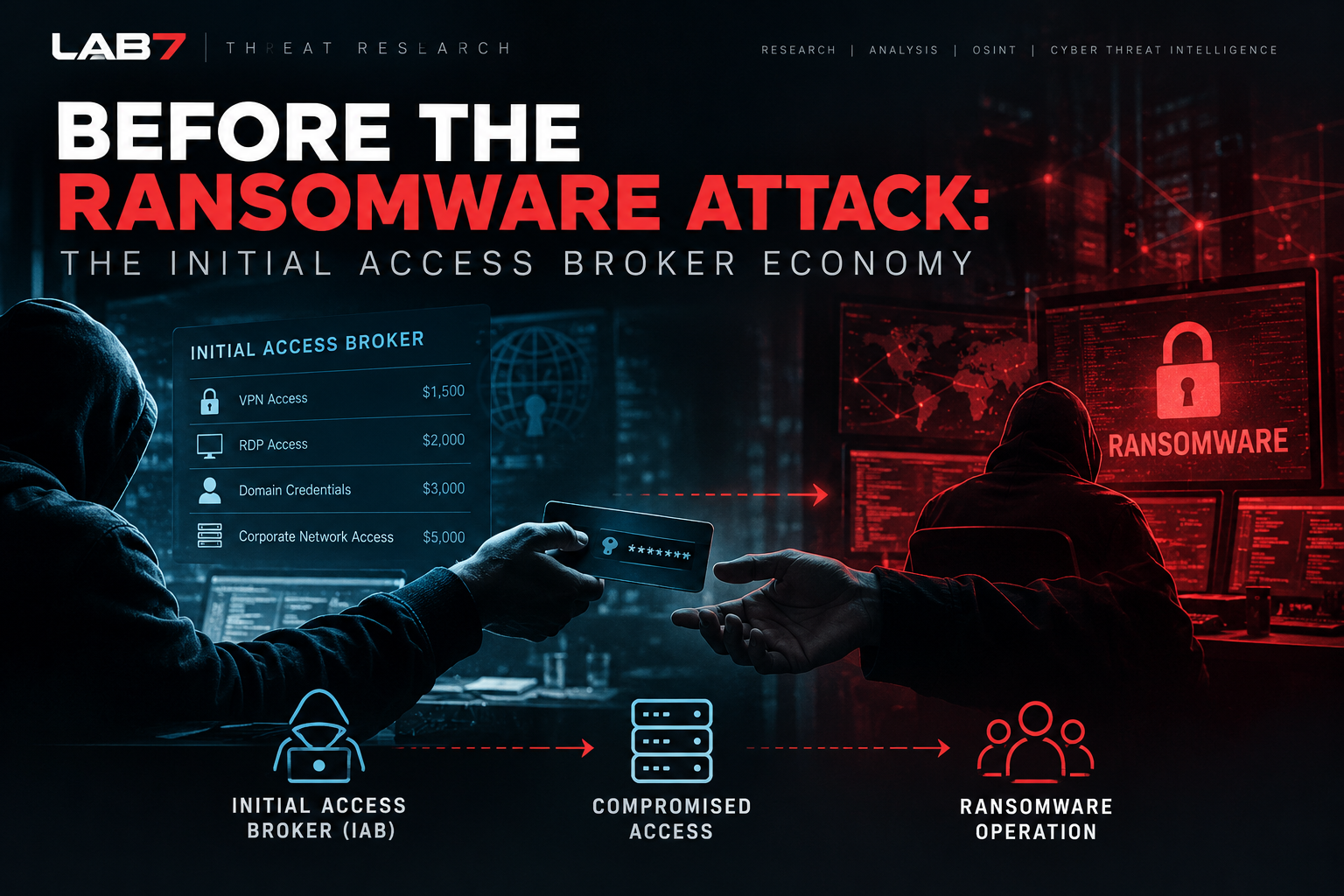
Before the Ransomware Attack: The Initial Access Broker Economy Not every ransomware operation begins with…
Mario M. — Independent Threat Researcher | Ransomware Intelligence & OSINT
Before the Ransomware Attack: The Initial Access Broker Economy
Not every ransomware operation begins with the ransomware group gaining initial access.
In some cases, that access may already be available through an Initial Access Broker (IAB).
Compromised VPN credentials, exposed remote access services, and access to corporate environments can become commodities in underground markets.
For threat researchers, the important question isn't simply who deployed the ransomware.
It's also:
- Who may have obtained the initial access?
- Was that access advertised or transferred before the attack?
- Are there credible links between the access broker and the ransomware operation?
- What evidence supports those connections?
At LAB7 Threat Research, we're exploring these questions through passive OSINT monitoring and analysis of publicly available intelligence.
An advertised access listing is not proof of compromise, and a claimed connection is not confirmed attribution.
Understanding the access economy may help explain what happens before ransomware deployment.
#ThreatIntelligence #InitialAccessBroker #Ransomware #ThreatResearch #OSINT
8 reactions · 5 comments
Topics: #ransomware, #threatresearch, #threatintelligence, #osint, #initialaccessbroker
Comments
Schomer: Brilliant piece. What stands out most from an engineering stance is that IAB commodities rely heavily on boundaries that trust access implicitly once a token or credential passes through. At ETBV, we’ve spent a lot of time engineering deterministic, non-invasive validation mechanics right at Layer Zero to disrupt exactly this phase of the pipeline. If you isolate runtime states at the lowest bound
Mario M.: Schomer Thanks for sharing your perspective. The trust boundary is certainly an important part of the initial access problem. From a threat intelligence perspective, we're particularly interested in understanding how compromised access is acquired, advertised, and potentially transferred between initial access brokers and ransomware operators. Mapping those relationships, while distinguishing obse
Schomer: Validating and mapping those broker-to-operator transfer relationships is exactly where the strategic value lies, Mario. Distinguishing real, observed telemetry from unverified assertions remains the biggest hurdle in the landscape, which is why shifting the focus to reproducible, state-based runtime metrics is critical. From our side, the goal is turning that observed activity into structured, ac
Mario M.: Agreed that structured intelligence and evidence-based relationship mapping are valuable areas to explore. STIX 2.1 can provide a useful framework for representing IAB-to-ransomware relationships, but the key challenge remains establishing reliable evidence for those connections. From our research perspective, maintaining clear distinctions between observed activity, reported claims, and analytica
Schomer: Exactly, Mario. The industry is flooded with analytical assessments and lagging post-incident reports, but lacks raw, indisputable baseline evidence. That is the exact gap this architecture addresses. By executing a deterministic validation loop directly at the Layer Zero asset gateway, we don't rely on reported claims or subjective correlation. If an IAB uses an unpatched edge flaw or stolen VPN