Posted in CVE-2026-109618
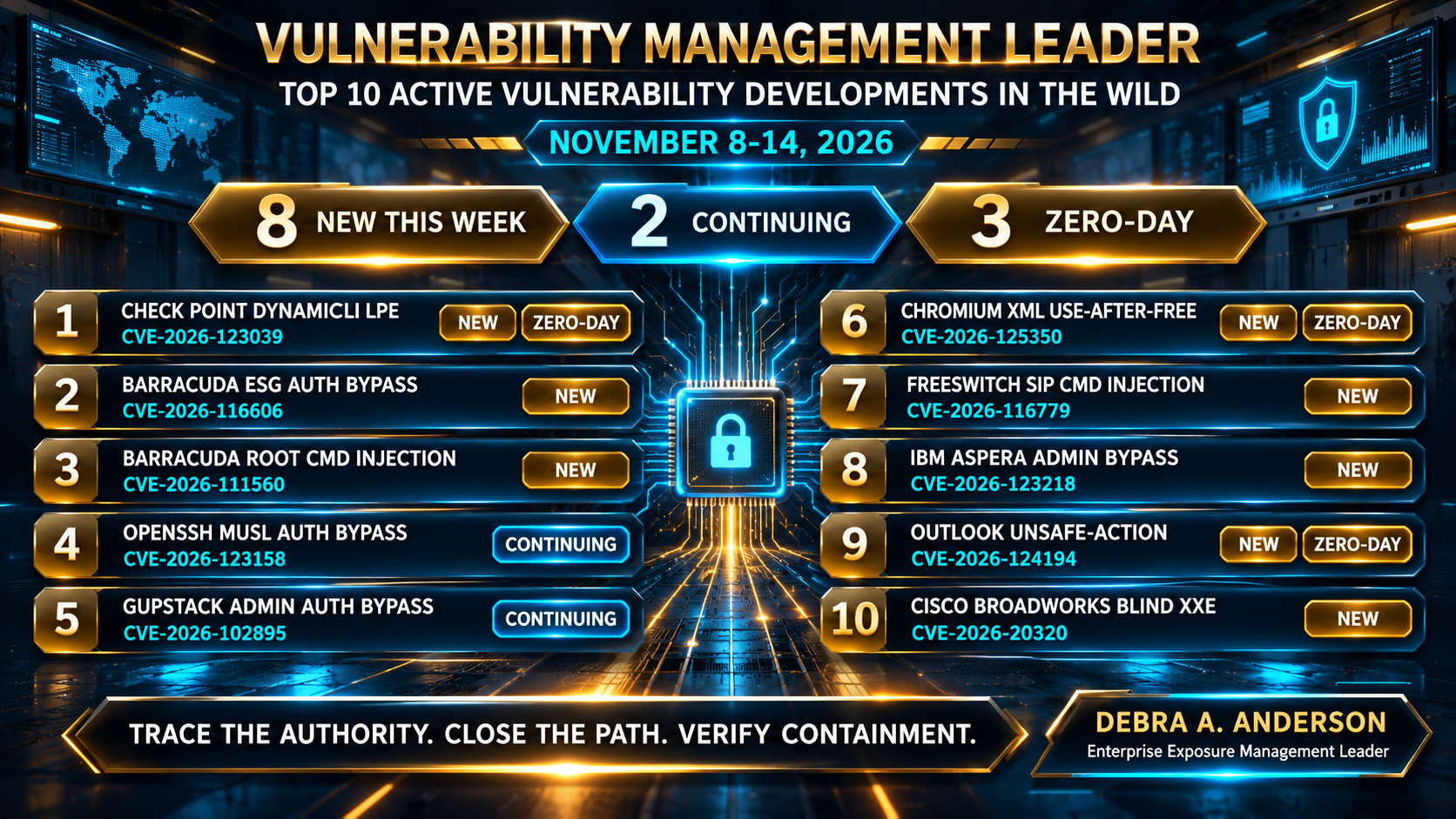
Top 10 Active Vulnerability Developments in the Wild | November 8–14, 2026
Debra A. — Security Leadership | Vulnerability Management | Operational Risk
The Top 10
1. Check Point DynamicCLI Local Privilege Escalation — CVE-2026-123039
Status: NEW THIS WEEK | ZERO-DAY
Check Point Research publicly confirmed on November 12 that attackers chained PHP2Shell initial access with a local privilege-escalation flaw in the DynamicCLI process to obtain root authority and establish persistence on internet-facing Security Gateways. The observed activity ran from October 30 through November 4 and affected a couple of dozen unpatched systems in one region. Check Point reported that some incidents created a foothold in customer networks and a limited number included destructive, ideologically motivated activity.
The initial-access component was not new: PHP2Shell CVE-2026-109618 and CVE-2026-109619 appeared in the prior editions, and Check Point had made PHP2Shell fixes available on October 23. The new development is the first public confirmation of CVE-2026-123039 as the root-privilege stage of an exploited chain. Because that stage was used before public disclosure and the November hotfix, it receives a separate zero-day label.
Why it matters: Root on a security gateway is not a single-host problem. It can expose network trust, credentials, policy, traffic, and downstream systems while weakening the evidence used to investigate the incident. Install the November Jumbo Hotfix on affected gateways and management servers, use Check Point’s indicators and verification guidance, preserve external telemetry, investigate the surrounding network, rotate reachable credentials, and rebuild or replace appliances when clean state cannot be demonstrated.
Sources: Check Point Research | CISA KEV Catalog
2. Barracuda ESG Pre-Authentication Authorization Bypass — CVE-2026-116606
Status: NEW THIS WEEK
Barracuda published the vulnerability on November 2, then updated its advisory on November 9 to confirm exploitation affecting a small number of organizations. The flaw does not require authentication, but the administrative interface must be reachable by the attacker. On Barracuda Email Security Gateway, it can bypass authorization controls and provide the access needed to exploit the companion command-injection flaw.
The original advisory alone did not establish active exploitation. The November 9 vendor confirmation is the new, authoritative in-the-wild development for this reporting window. CISA added the CVE to KEV on November 10.
Why it matters: An email-security appliance sits at a trusted boundary and often has privileged connectivity, message access, credentials, and administrative reach. Restrict the Admin UI immediately, apply Barracuda’s current firmware and security patches, verify that the patched build is actually running, review administrative activity and configuration changes, and assess whether appliance compromise exposed mail, credentials, connectors, or downstream systems.
Sources: Barracuda Security Advisory | Canadian Centre for Cyber Security | CISA KEV Catalog
3. Barracuda Multiple Products OS Command Injection — CVE-2026-111560
Status: NEW THIS WEEK
This companion flaw allows an authenticated administrator to place shell metacharacters in the timezone configuration field. When the value is processed, commands execute as root. It affects multiple Barracuda products, including ESG, ADC, WAF, WSG, Message Archiver, and WAF Control Center. Mandiant’s November 2 disclosure described the prerequisite as administrative access; Barracuda’s November 9 update and CISA’s November 10 KEV addition confirmed active exploitation.
Assessed alone, the authentication requirement appears to reduce urgency. Assessed with CVE-2026-116606 on ESG, it becomes the root-execution stage behind an unauthenticated authorization-bypass path.
Why it matters: Vulnerability ownership breaks down when teams remediate CVEs independently but attackers use them as a chain. Patch every affected Barracuda product, but treat the ESG pair as one incident-assessment workstream. Review timezone and configuration changes, root-level processes, persistence, outbound connections, administrator accounts, and secrets accessible from the appliance. Closure requires proof that both the access path and the post-exploitation state are clean.
Sources: Mandiant MNDT-2026-0041 | Barracuda Security Advisory | CISA KEV Catalog
4. OpenSSH Password Authentication Bypass on musl Linux — CVE-2026-123158
Status: CONTINUING ACTIVE THREAT
The OpenSSH flaw became public on November 5, and exploitation attempts were publicly reported on November 7—before this reporting window began. CISA added it to KEV on November 9. It is therefore continuing, not new, even though it did not appear in the prior Top 10.
The exposure is narrower than “all OpenSSH.” The vulnerable path requires Linux using musl libc without PAM, password authentication enabled, an account whose password field is *, and at least one local account with a $5$ or $6$ password hash. Under those conditions, a long password can be misinterpreted as a successful match and allow remote login. Alpine Linux is the primary affected ecosystem; Red Hat Enterprise Linux uses glibc and PAM and is not affected.
Why it matters: A configuration-specific flaw can still be operationally critical when it turns an internet-facing SSH service into a one-connection authentication bypass. Inventory the running SSH build and authentication configuration—not only the package name. Apply the fixed Alpine/OpenSSH package, restart sshd, verify the running daemon, or disable password authentication as an interim control. Hunt for accepted-password events against key-only accounts, new authorized keys, new users, and doas or root activity.
Sources: Alpine Linux Security Advisory | OpenSSH Release Notes | Red Hat CVE Assessment | CISA KEV Catalog
5. GPUStack Loopback-Trust Authentication Bypass — CVE-2026-102895
Status: CONTINUING ACTIVE THREAT
GPUStack’s July 31 advisory states that the vulnerability was observed in the wild against a version 2.1.1 deployment, where attackers created custom inference backends that launched reverse shells. CISA added it to KEV on November 9, but the active threat was already public before this reporting window.
Before version 2.2.0, GPUStack could treat a request as the built-in administrator when it appeared to originate from loopback. A same-host reverse proxy or a forged X-GPUStack-Real-IP: 127.0.0.1 header could trigger that trust decision. The result is unauthenticated administrative access, persistent admin API-key creation, exposure of worker and cloud-provider secrets, and code execution through backend configuration.
Why it matters: The root cause is a trusted-network assumption converted into identity. In an AI infrastructure platform, that authority reaches models, workers, cloud credentials, inference backends, and code execution. Upgrade to GPUStack 2.2.0 or later, remove implicit loopback administration, strip untrusted forwarding headers, restrict API access, revoke attacker-created or exposed keys, rotate worker and provider secrets, and inspect backend definitions and worker hosts for reverse shells.
Sources: GPUStack Security Advisory | CISA KEV Catalog
6. Google Chromium XML Use-After-Free — CVE-2026-125350
Status: NEW THIS WEEK | ZERO-DAY
Google released Chrome 157.0.8103.50/.51 on November 9 and stated that an exploit for CVE-2026-125350 existed in the wild. The high-severity use-after-free affects XML handling. CISA added the CVE to KEV on November 10. Google withheld detailed bug information while users and downstream projects received the fix.
The exploitation disclosure and patch arrived together during the reporting window. Because exploitation existed before broad public remediation, the vulnerability receives a zero-day label.
Why it matters: Browser vulnerabilities combine enormous endpoint prevalence with untrusted content and rapid downstream propagation requirements. Update Chrome and Chromium-based products to a fixed vendor build, force browser relaunches, verify the running version across managed and unmanaged endpoints, and identify embedded Chromium runtimes that do not follow the normal browser update channel. Patch deployment is not complete until the vulnerable process is no longer running.
Sources: Chrome Stable Channel Update | CISA KEV Catalog
7. SignalWire FreeSWITCH SIP MESSAGE Command Injection — CVE-2026-116779
Status: NEW THIS WEEK
FreeSWITCH’s October 28 advisory described a critical flaw in which an inbound SIP MESSAGE can select the API chat protocol and invoke FreeSWITCH API commands. Depending on exposed functionality, exploitation can disclose configuration and credentials, control calls, and execute commands. FreeSWITCH 1.11.3 fixes the issue.
The vulnerability disclosure predates this week, but the first authoritative public active-exploitation confirmation came when CISA added it to KEV on November 9. That exploitation confirmation—not the advisory date—supports the new classification.
Why it matters: Communications infrastructure carries credentials, call-control authority, availability obligations, and integration paths into billing and operations. Identify direct and embedded FreeSWITCH deployments, update to 1.11.3 or later, restart the service, verify the running version and module configuration, restrict unnecessary SIP exposure, and review commands, call routing, configuration changes, and child processes for evidence of misuse.
Sources: SignalWire FreeSWITCH Advisory | FreeSWITCH 1.11.3 Release | CISA KEV Catalog
8. IBM Aspera Faspex Authorization Bypass to Administrator — CVE-2026-123218
Status: NEW THIS WEEK
IBM published its bulletin on November 7 and fixed the issue in Faspex 5.0.19 PL1. An authenticated user can craft a message that bypasses authorization and gains full administrative privileges. CISA’s November 9 KEV addition provided the first authoritative public confirmation of active exploitation.
IBM lists versions 5.0.0 through 5.0.19 as affected and provides no workaround. Owners must upgrade and validate that the faspex-core container is the corrected 5.0.19 Fix Pack 1 image.
Why it matters: Managed file-transfer platforms concentrate sensitive data, trusted users, external collaboration, and high-volume movement across organizational boundaries. Full administrator access can expand from one account to every transfer and connected trust path. Upgrade, verify the running container image, review administrator and user changes, inspect transfer and message activity, revoke suspicious sessions and tokens, and assess the confidentiality of files and credentials reachable through Faspex.
Sources: IBM Security Bulletin | CISA KEV Catalog
9. Microsoft Outlook Unsafe-Action / Spoofing Vulnerability — CVE-2026-124194
Status: NEW THIS WEEK | ZERO-DAY
Microsoft released the fix on November 10, marked the vulnerability as exploited, and rated it Moderate with a CVSS base score of 6.5. Successful exploitation requires user action. CISA added the CVE to KEV the same day.
The score does not describe the full operational decision. Outlook is broadly deployed, email is an attacker-controlled content path, and the weakness can expose confidential information when the interface fails to provide an appropriate warning before an unsafe action. Because Microsoft confirmed exploitation at the time public remediation became available, it receives a zero-day label.
Why it matters: User interaction is not a reason to defer a widely exploited email-client flaw; it is the attack path. Deploy the current Microsoft 365 Apps or Office security update, verify installation across supported and disconnected endpoints, review endpoint and mail telemetry for suspicious messages and follow-on activity, and reinforce technical controls that reduce unsafe external-content handling. Do not substitute awareness training for remediation.
Sources: Microsoft Security Response Center | CISA KEV Catalog
10. Cisco BroadWorks Blind XXE Information Disclosure — CVE-2026-20320
Status: NEW THIS WEEK
Cisco first published this BroadWorks advisory on August 19 and updated it on November 13. The flaw in the Open Client Interface XML parser allows an unauthenticated remote attacker to perform blind XML external entity injection and read sensitive configuration information. Cisco lists no workaround. CISA added it to KEV on November 10, providing the first authoritative public active-exploitation confirmation.
The CVSS 7.5 score reflects information disclosure, but BroadWorks sits inside telecommunications service delivery. Configuration data can expose credentials, topology, endpoints, and the information needed to build a second-stage attack.
Why it matters: Information disclosure becomes more consequential when it occurs in a communications control plane. Apply Cisco’s fixed release, restrict access to the affected interface, review XML requests and outbound resolution behavior, identify exposed secrets or topology data, rotate credentials that could have been disclosed, and investigate connected systems for follow-on access.
Sources: Cisco Security Advisory | CISA KEV Catalog
What Changed This Week
November 9: CISA added GPUStack, FreeSWITCH, OpenSSH, and IBM Aspera Faspex to KEV. FreeSWITCH and Aspera are NEW because active exploitation first became authoritative and public during this window. OpenSSH and GPUStack remain CONTINUING because their exploitation evidence predates November 8.
November 9: Barracuda updated its November 2 advisory to confirm exploitation affecting a small number of organizations. The two-CVE chain can move from pre-authentication authorization bypass on ESG to root command execution.
November 9: Google released a Chrome fix and confirmed in-the-wild exploitation of CVE-2026-125350.
November 10: CISA added six CVEs spanning Cisco BroadWorks, Barracuda, Openwave, Outlook, and Chromium. The Openwave Webtop media-transcoder flaw was validated but did not displace the Top 10 because the public evidence describes a narrower, lower-impact resource-transfer issue with limited campaign detail.
November 12: Check Point disclosed that attackers used PHP2Shell and CVE-2026-123039 to reach root and persistence on Security Gateways.
November 13: CISA added Check Point CVE-2026-123039 and UnrealIRCd CVE-2026-114713 to KEV. UnrealIRCd was validated but ranked below the ten selected developments because exploitation requires a linked-server topology and the affected technology has a narrower enterprise footprint.
None of the four direct carryovers from last week—Brotli, GitLab, Ivanti, or the two PHP entries—was relabeled new. PHP2Shell remains operationally relevant as the initial-access stage in the Check Point chain, but this edition ranks the newly disclosed privilege-escalation stage rather than repeating both PHP CVEs.
Executive Priorities
Treat appliance chains as incident paths. Coordinate Check Point PHP2Shell plus CVE-2026-123039 and Barracuda CVE-2026-116606 plus CVE-2026-111560 as end-to-end attack paths, not unrelated tickets.
Remove management exposure before the change window. Restrict Barracuda Admin UI, Check Point management surfaces, GPUStack APIs, SSH password authentication, SIP interfaces, and BroadWorks OCI paths while updates are staged.
Validate the running state. Restart sshd and FreeSWITCH, relaunch browsers, verify container digests, confirm firmware and hotfix levels, and test externally reachable behavior. Installed packages are not the same as corrected running processes.
Rotate what the compromised control plane could reach. Evaluate cloud-provider keys, worker secrets, appliance credentials, mail connectors, file-transfer tokens, network secrets, and downstream administrative access according to actual authority.
Preserve independent evidence. Security appliances and control planes can be tampered with. Retain external logs, network telemetry, identity records, endpoint evidence, and immutable backups before relying on the affected system’s own audit trail.
Narrow inventory by real conditions. For OpenSSH, identify musl, PAM state, password-authentication configuration, and account structure. For Chromium, find embedded runtimes. For FreeSWITCH and GPUStack, find bundled or self-hosted instances hidden beneath another product name.
Assign one accountable owner per exposure path. Name who can isolate the service, authorize downtime, prove remediation, lead compromise assessment, rotate credentials, and accept residual risk.
Build prevention into deployment. Default-deny management interfaces, remove network-origin authentication assumptions, constrain service accounts, require external telemetry, maintain supported builds, and keep tested rebuild procedures for high-authority systems.
Leadership POV
This week is a reminder that authority accumulates in places organizations often call “infrastructure.”
A security gateway can become a network foothold. An email appliance can turn an authorization bypass into root. An SSH configuration can convert a long password into access. An AI platform can mistake network location for identity. A file-transfer application can turn one authenticated user into an administrator.
Those are not isolated patching problems. They are ownership and trust-boundary decisions.
The leadership questions are practical:
Which exposed system can exercise the most authority?
Which attack paths require more than one CVE to close?
What secrets, users, data, or downstream systems become part of the blast radius?
What evidence is independent of the potentially compromised control plane?
Who owns the decision when clean state cannot be proved?
Strong security foundations reduce the number of emergency choices: accurate inventory, bounded management access, supported versions, least privilege, external logging, credential discipline, and tested rebuilds.
A patch changes software.
Verified containment changes risk.
Hashtags
Verification and Classification Note
This Top 10 was validated against public information available through Sunday, November 15, 2026, at 12:05 AM CST and compared with the November 1–7 edition.
NEW THIS WEEK means credible active-exploitation evidence or an authoritative exploitation confirmation first became public during November 8–14, 2026. It does not claim that the underlying attack activity began during the week.
CONTINUING ACTIVE THREAT means exploitation was publicly verifiable before November 8, even if CISA added the CVE to KEV during this reporting window or it did not appear in the preceding Top 10.
ZERO-DAY is a separate descriptor used when credible evidence shows exploitation preceded public remediation or disclosure. It applies here to Check Point CVE-2026-123039, Chromium CVE-2026-125350, and Outlook CVE-2026-124194.
Classification decisions and limitations:
OpenSSH CVE-2026-123158 is CONTINUING because public exploitation reporting dates to November 7. Its impact is configuration-specific; this article does not generalize the flaw to all OpenSSH or all Linux deployments.
GPUStack CVE-2026-102895 is CONTINUING because the July 31 advisory states that in-the-wild exploitation was observed against version 2.1.1.
Barracuda’s original November 2 advisory did not establish active exploitation. The vendor’s November 9 update first confirmed exploitation affecting a small number of organizations; both Barracuda entries are therefore NEW THIS WEEK.
FreeSWITCH, IBM Aspera, and Cisco BroadWorks were disclosed or fixed before the reporting window, but their authoritative public exploitation confirmations first arrived through CISA during the week.
Check Point’s observed attacks ran from October 30 through November 4, but CVE-2026-123039 and its role in the chain were not publicly confirmed until November 12. The classification is based on when evidence became public and actionable, not when the private incident began.
Microsoft confirms exploitation of Outlook CVE-2026-124194 but does not publicly describe campaign scale at the cutoff. Google confirms an exploit for Chromium CVE-2026-125350 exists in the wild but withholds bug detail while updates deploy.
CISA added twelve CVEs during the window. Openwave CVE-2026-111793 and UnrealIRCd CVE-2026-114713 were validated but ranked below the ten selected developments based on authority gained, prevalence, attack-path value, public campaign detail, and operational consequence.
Sources & References
Government and National CERT
CISA Known Exploited Vulnerabilities Catalog
CISA — Four KEV additions, November 9
CISA — Six KEV additions, November 10
Canadian Centre for Cyber Security — Barracuda AV26-1112
Canadian Centre for Cyber Security — Check Point AV26-1154
Vendor and Original Research
Check Point Research — Active exploitation of PHP2Shell and local privilege escalation
Barracuda — Pre-authentication authorization bypass and command injection
Mandiant — MNDT-2026-0041
Alpine Linux — OpenSSH password authentication bypass
OpenSSH release notes
Red Hat — CVE-2026-123158
GPUStack — GHSA-gj9m-f8ph-pmhr
Google Chrome Stable Channel Update
SignalWire FreeSWITCH — GHSA-mg63-h38w-8p9p
IBM Aspera Faspex Security Bulletin
Microsoft Security Response Center — CVE-2026-124194
Cisco BroadWorks Advisory
#VulnerabilityManagement #CVE #ThreatIntelligence #ZeroDay #ExposureManagement
0 reactions · 0 comments
Topics: #cve, #threatintelligence, #vulnerabilitymanagement, #zeroday, #exposuremanagement