Posted in Security Operations
Escalating from Technical Filters to Full Incident Response Playbooks Following some excellent feedback from…
Omobamidele F. — Cybersecurity & Computer Science Student
Escalating from Technical Filters to Full Incident Response Playbooks
Following some excellent feedback from Senior peers in the community, I spent my evening expanding my Blue Team repository to focus on the full operational lifecycle of a critical intrusion!
As an Incident Responder, running a command like grep to filter logs is only the first step. True technical maturity means executing a structured, defensible workflow.
For my new lab update, I mapped out a formal Case Disposition Report based on the NIST SP 800-61 incident handling framework:
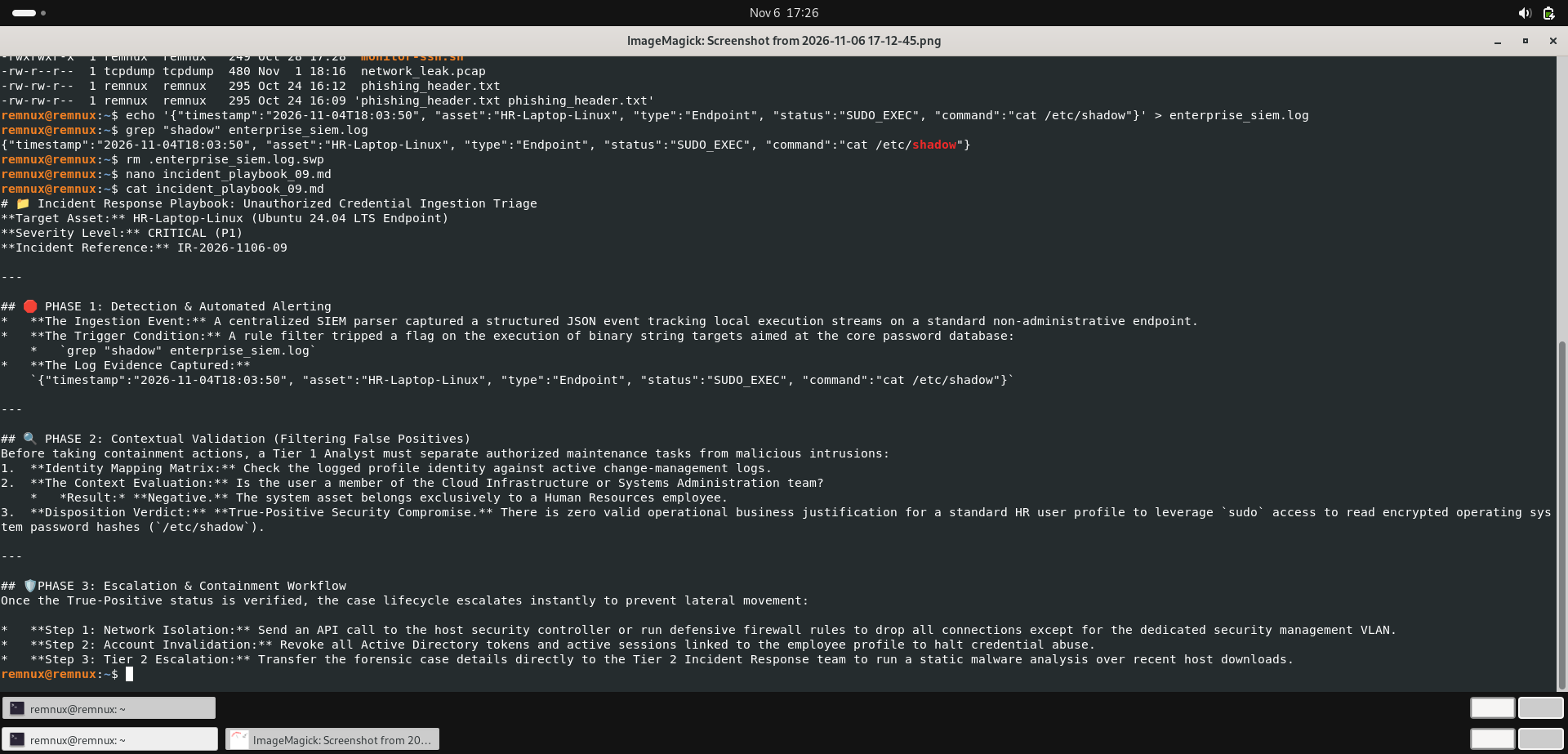
PHASE 1 (Detection): Isolated a critical endpoint alert tracking raw SUDO_EXEC commands targeting the system core password database (cat /etc/shadow).
PHASE 2 (Contextual Validation): Cross-referenced the user profile against active identity registries. Verified that because the host belongs to a non-technical department (Human Resources), the activity is classified as a True-Positive security breach.
PHASE 3 (Containment): Outlined the exact defense playbooks needed to isolate the host network layer and revoke active session tokens to stop lateral movement vectors.
Documenting the complete timeline from alert to containment is how we build modern, resilient security infrastructures. Check out the updated repository details live on my GitHub! 🚀💻
#Cybersecurity #IncidentResponse #BlueTeam #NIST #SIEM #GothenburgTech #ProofOfWork #ComputerScienceStudent
2 reactions · 2 comments
Topics: #blueteam, #gothenburgtech, #siem, #incidentresponse, #computersciencestudent, #nist, #cybersecurity, #proofofwork
Comments
Victor Font: Emmanuel, this is an important progression from identifying suspicious activity to understanding the full incident response lifecycle. One distinction worth emphasizing is that a true-positive detection does not automatically establish a confirmed breach. Access to /etc/shadow on an HR endpoint certainly warrants investigation, but determining whether the activity was authorized, malicious, or evi
Omobamidele F.: Brilliant distinction, Victor! Thank you for pushing my analytical thinking further on this. You are entirely correct isolating a true-positive execution event does not immediately dictate malicious intent or an active threat actor. Determining if the activity was authorized, policy-violating administrative maintenance, or an actual compromised state requires pulling deeper contextual evidence art