Most API security issues don’t come from missing protections. They come from how the system is designed…
Damian K. — Penetration Tester / Offensive Security Engineer
Most API security issues don’t come from missing protections.
They come from how the system is designed.
d:-)-<-<]:
I’ve recently been analyzing multiple applications built on modern stacks:
• API-first architecture
• microservices / serverless components
• third-party integrations
• client-driven data flows
Everything looked “secure” on paper.
And yet — critical issues kept emerging.
d:-)-<-<]:
The problem wasn’t implementation.
It was architecture-level assumptions.
d:-)-<-<]:
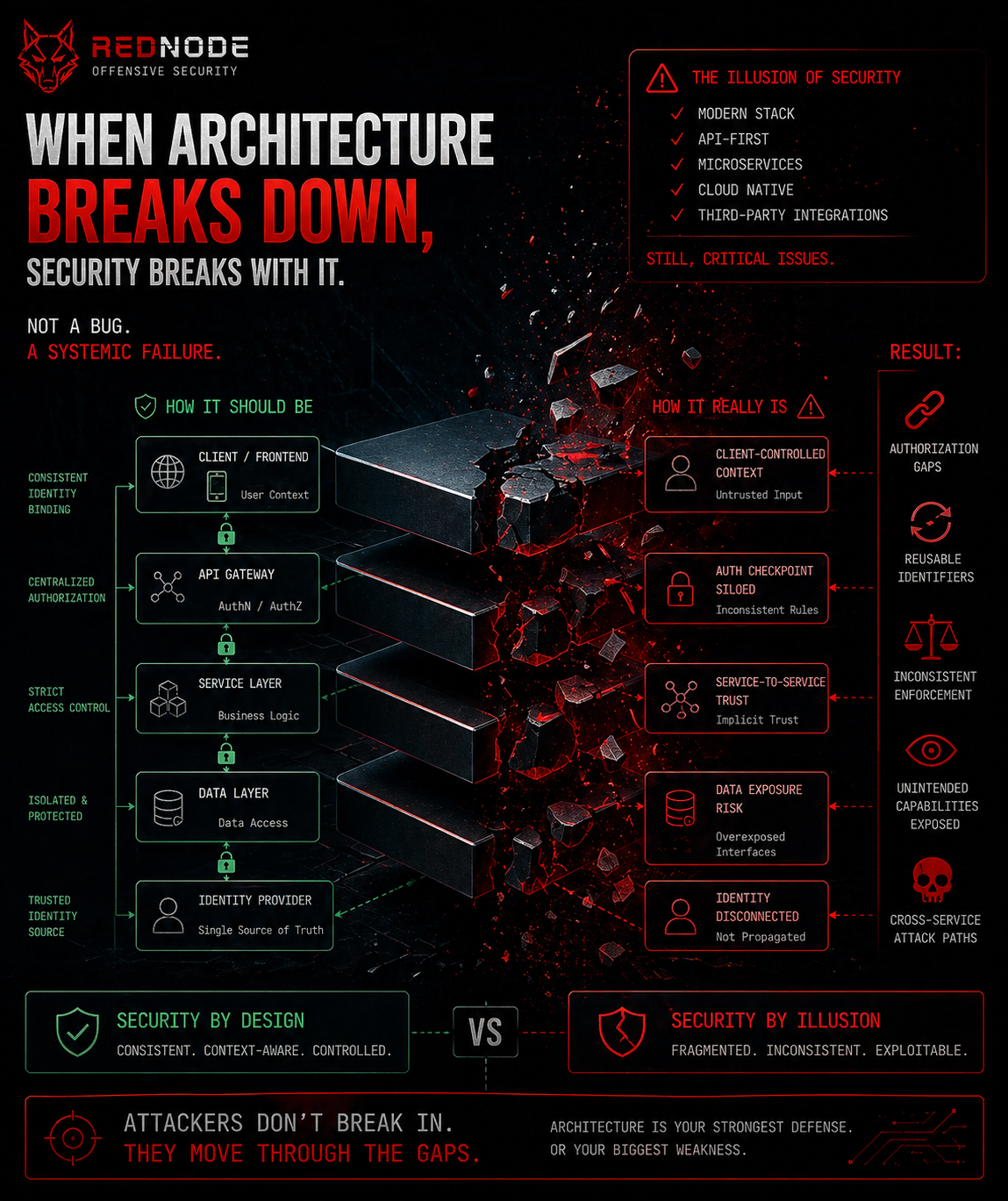
What I keep seeing:
• Authorization treated as a single checkpoint
• Identity not consistently propagated across services
• Trust implicitly extended to client-controlled context
• Sensitive operations exposed outside intended flows
• Security logic fragmented across layers
d:-)-<-<]:
This creates a dangerous illusion:
Each component is “secure” in isolation.
But the system as a whole is not.
d:-)-<-<]:
In real scenarios, this leads to:
• cross-service authorization gaps
• reusable identifiers across contexts
• inconsistent enforcement of access rules
• unintended exposure of internal capabilities
• attack paths that only exist when systems interact
d:-)-<-<]:
Attackers don’t break systems by attacking one layer.
They move across layers.
They exploit the gaps between them.
d:-)-<-<]:
What actually works at scale:
• Treat authorization as a system-wide concern — not a feature
• Enforce consistent identity binding across all services
• Eliminate trust in client-supplied context
• Centralize or strictly standardize access control logic
• Design flows so sensitive operations cannot exist outside intended paths
d:-)-<-<]:
Modern architectures don’t fail because they are complex.
They fail because trust is misplaced inside that complexity.
d:-)-<-<]:
Security is not a layer you add.
It’s a property your architecture either has… or doesn’t.
0 reactions · 0 comments