Posted in Security Operations
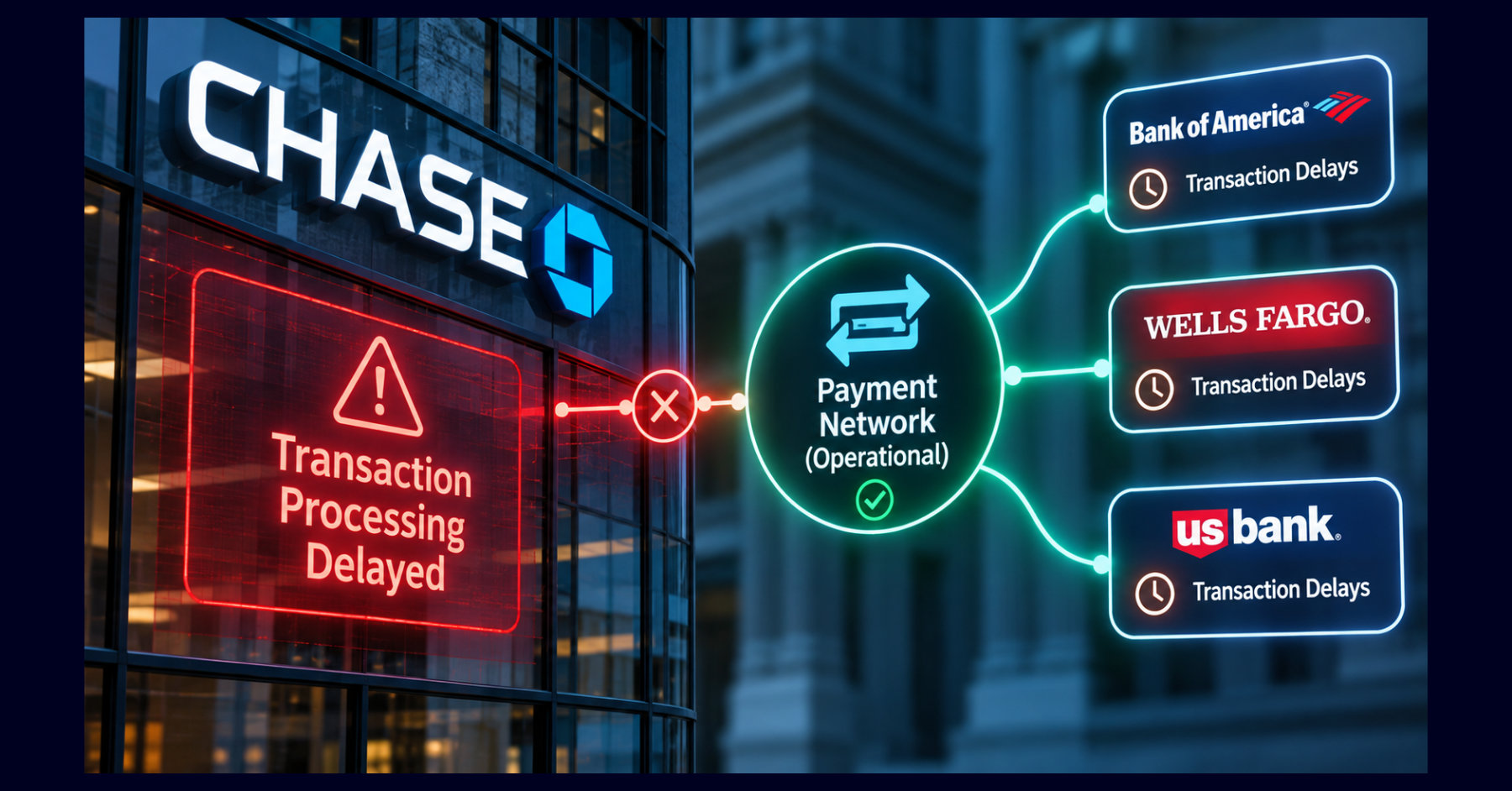
Chase Had a Software Bug. Why Did Other Banks Feel It?
Victor Font — Keynote Speaker | Strategic Technology Leader | Fractional CIO | IT & Cyber Governance Expert | Published Author | FedRAMP Readiness | Board-Level Advisor | Digital Transformation | Enterprise WordPress/Formidable Forms
The Governance Problem Hidden Inside America's Interconnected Payment Infrastructure
On November 16, 2026, JPMorgan Chase experienced a software defect affecting its on-premises systems. Transactions slowed, customers encountered banking service disruptions, and reports of problems appeared across multiple major financial institutions.
By Monday evening, Chase reported that transactions were processing normally again.
The incident was not attributed to a cyberattack. According to Chase, the problem originated with an internal software bug.
But the most important lesson has little to do with whether an attacker was involved.
It concerns what happens when one institution's operational failure affects transactions involving other institutions.
The Network Was Working. The Transactions Were Not.
Consider what happened with Zelle.
Early Warning Services, which operates the Zelle payment network, reported that its network remained fully operational.
U.S. Bank similarly reported that its systems were not directly affected.
Yet customers attempting transactions involving other financial institutions, particularly Chase, could experience delays.
Think about the architectural implications.
The payment network could be available. A customer's bank could be available. The customer's account could be accessible.
And the transaction could still fail to complete on time.
That distinction exposes a fundamental weakness in how organizations sometimes define operational resilience.
Infrastructure availability is not the same as business-service availability.
A system can meet its uptime targets while the business process it supports remains unavailable.
The Governance Boundary Extends Beyond the Institution
Financial institutions operate within interconnected ecosystems of payment processors, settlement mechanisms, technology providers, and other banks.
Each organization governs its own systems.
But customers experience the combined result.
This creates a difficult governance question:
Who is accountable for the resilience of a transaction that crosses multiple independently governed institutions?
The answer is not that one bank automatically becomes responsible for another bank's technical failure.
Rather, each institution must understand its dependencies, establish appropriate controls, and determine how it will respond when an external participant cannot fulfill its obligations.
That responsibility cannot be satisfied simply by demonstrating that internal systems remained operational.
A Successful Recovery Does Not Answer Every Resilience Question
Chase restored normal transaction processing Monday evening.
That is an important operational outcome.
But restoration alone does not establish whether the underlying architecture was sufficiently resilient.
Several questions remain unanswered publicly.
Was the affected software component a critical dependency for multiple transaction-processing services?
Could the failure have been isolated?
Were alternative processing paths available?
What prevented affected transactions from completing normally?
How quickly was the problem detected, escalated, and contained?
Were recovery procedures exercised before the incident?
We should not presume that Chase lacked adequate controls. The detailed technical evidence necessary to reach that conclusion has not been released.
Nevertheless, these are precisely the questions executive leadership and board risk committees should expect management to answer.
The Evidentiary Architecture™ Perspective
This incident illustrates why governance cannot depend exclusively on dashboards, availability metrics, or assurances that recovery plans exist.
A defensible resilience program requires evidence demonstrating that critical business services can withstand foreseeable disruptions.
That evidence should include dependency maps, documented recovery objectives, tested failover procedures, escalation authority, and records showing whether recovery mechanisms performed as designed.
It should also distinguish between restoring a technical component and restoring the business capability that depends upon it.
A green infrastructure dashboard does not necessarily mean the enterprise is fulfilling its obligations.
The Boardroom Question
The Chase incident was reportedly resolved within hours.
But the larger governance question remains:
If every system under your organization's direct control is operational, can you demonstrate that your most critical business services will remain available when an external dependency fails?
That is the difference between measuring system availability and governing enterprise resilience.
And increasingly, boards need evidence of both.
#CybersecurityGovernance #OperationalResilience #BankingTechnology #EnterpriseRiskManagement #FinancialServices #BusinessContinuity #BoardAccountability #EvidentiaryArchitecture
4 reactions · 0 comments
Topics: #boardaccountability, #financialservices, #cybersecuritygovernance, #operationalresilience, #businesscontinuity, #evidentiaryarchitecture, #bankingtechnology, #enterpriseriskmanagement