Posted in Security Awareness
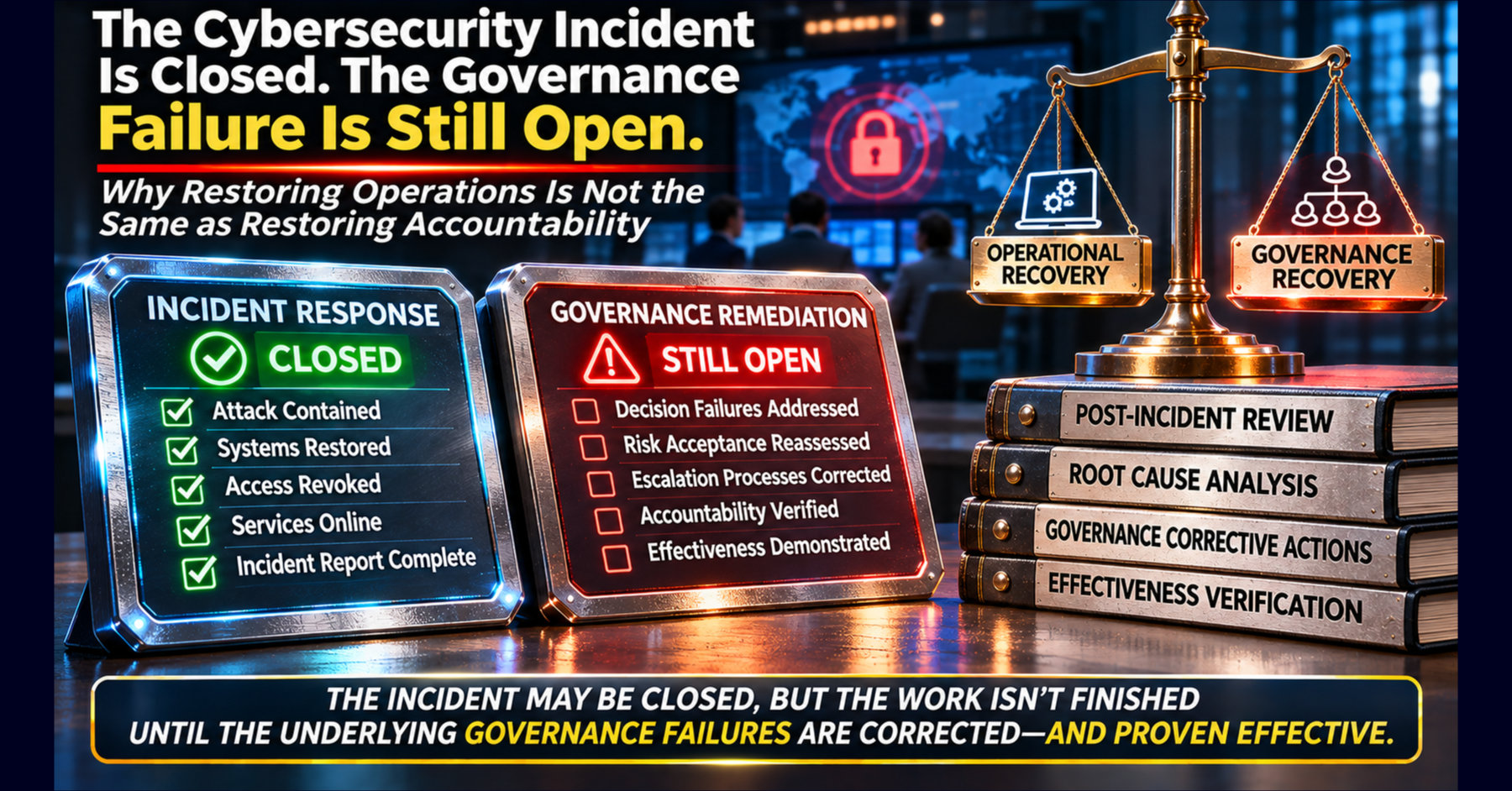
The Cybersecurity Incident Is Closed. The Governance Failure Is Still Open.
Victor Font — Keynote Speaker | Strategic Technology Leader | Fractional CIO | IT & Cyber Governance Expert | Published Author | FedRAMP Readiness | Board-Level Advisor | Digital Transformation | Enterprise WordPress/Formidable Forms
Why Restoring Operations Is Not the Same as Restoring Accountability
The ransomware attack has been contained.
Affected systems have been isolated.
Compromised credentials have been revoked.
Backups have been restored.
Business applications are operational again.
The incident response team completes its final report.
The incident management system changes the status to Closed .
Leadership receives the recovery summary.
The organization returns to normal operations.
Everyone is relieved.
But there is a question that rarely receives the same urgency as restoring the technology.
Has the organization corrected the governance failure that allowed the incident to occur—or has it simply restored the environment in which the next incident will happen?
That distinction matters because technical recovery and governance recovery are not the same thing.
An organization can successfully contain an attack, restore its systems, and satisfy its immediate operational objectives while leaving the underlying decision-making failures untouched.
And when those failures remain, the incident may be closed administratively while the enterprise remains exposed to the same organizational weaknesses.
Two Different Definitions of Recovery
Cybersecurity incident response is understandably focused on immediate consequences.
Stop the attack.
Limit the damage.
Preserve evidence.
Restore critical services.
Validate system integrity.
Resume business operations.
These activities are essential.
But they address only part of the organization's recovery obligation.
Consider a ransomware incident involving a known vulnerability.
The security team had identified the weakness months earlier.
IT developed a remediation plan.
The business unit requested a delay because the affected application supported essential operations.
Management approved an exception.
The exception was subsequently extended.
Eventually, attackers exploited the vulnerability.
Following the incident, the organization patches the system, restores operations, and closes the incident.
From a technical perspective, the immediate exposure may have been eliminated.
But several governance questions remain.
Why was remediation delayed?
Who possessed the authority to accept the risk?
What information supported that decision?
Were compensating controls implemented?
Did anyone reassess the exposure as threat conditions changed?
Was the exception renewed because continued acceptance remained reasonable—or because the organization had become accustomed to the risk?
Restoring the affected system does not answer those questions.
The organization has addressed the technical consequence.
It has not necessarily addressed the governance conditions that contributed to it.
The Incident Report That Stops Too Soon
Most mature incident response programs include some form of post-incident review.
The team reconstructs the attack timeline.
Investigators identify the initial access vector.
Security analysts examine lateral movement.
Technical teams document containment and recovery actions.
Recommendations are developed to prevent recurrence.
The report may be thorough.
But its recommendations often concentrate on technical controls.
Deploy additional endpoint protection.
Improve network segmentation.
Accelerate vulnerability remediation.
Expand logging.
Strengthen privileged access controls.
Conduct additional security awareness training.
These may all be appropriate.
Yet they can overlook an important question.
What organizational decisions, authority structures, or governance processes permitted the technical weakness to persist?
If a vulnerability remained unresolved because business leadership repeatedly deferred remediation, adding another vulnerability scanner does not address the decision failure.
If incident containment was delayed because nobody knew who could authorize operational disruption, purchasing another response platform does not establish decision authority.
If a third-party security weakness persisted because procurement, legal, IT, and security each assumed another department owned the exposure, another vendor questionnaire may not resolve the accountability gap.
The technical corrective actions may be necessary.
They may also be insufficient.
Root Cause Analysis Must Extend Beyond Technology
Organizations frequently distinguish between immediate causes and contributing factors.
A compromised credential may be the immediate mechanism through which an attacker gained access.
But why did the credential remain active?
Perhaps the employee had left the organization.
Perhaps the identity management system did not receive the termination event.
Perhaps the offboarding workflow required manual coordination between HR and IT.
Perhaps the account belonged to a third-party contractor whose access was never assigned a clearly accountable owner.
Each answer moves the investigation further from the initial technical symptom.
Eventually, the inquiry may reach the governance system itself.
Who was responsible for ensuring that termination events resulted in access revocation?
How was that responsibility established?
What verification was required?
What evidence demonstrated that the process operated effectively?
Who reviewed failures or exceptions?
The investigation is no longer simply about an active credential.
It is about the organization's ability to translate an authorized business event into a verified security outcome.
A technical failure may be the visible consequence of a governance failure that occurred much earlier.
That does not mean every cybersecurity incident originates in defective governance.
Some attacks succeed despite reasonable decisions and effective controls.
But when governance contributed to the outcome, the post-incident review should identify it explicitly.
Otherwise, the organization risks correcting the symptom while preserving the underlying weakness.
The Difference Between Lessons Identified and Lessons Implemented
After significant incidents, organizations often produce extensive lessons-learned reports.
Recommendations are categorized.
Action items are assigned.
Deadlines are established.
Management receives updates.
Eventually, the corrective action plan is declared complete.
But what does completion mean?
Was the policy updated?
Was a procedure rewritten?
Did employees attend training?
Was a new approval requirement introduced?
Those activities may be necessary.
Yet they do not automatically establish that the governance weakness has been corrected.
Suppose an incident revealed that critical security exceptions could be renewed indefinitely without meaningful reassessment.
Management responds by revising the exception management policy.
The updated policy requires executive review after two extensions.
The document is approved.
The corrective action is marked complete.
But has the organization demonstrated that the revised process works?
Have existing exceptions been reassessed?
Are decision authorities properly configured?
Does the workflow prevent unauthorized extensions?
Are overdue reviews escalated?
Can management produce evidence that the new requirements are operating?
Until those questions are answered, the organization may have implemented a policy change without verifying the intended governance outcome.
A lesson identified is not a lesson implemented. And a lesson implemented is not necessarily a lesson proven effective.
That distinction should be central to post-incident accountability.
The Governance Corrective Action Plan
Organizations already understand the importance of technical corrective action plans.
Governance failures deserve equivalent discipline.
When an incident exposes a material weakness in decision-making, authority, oversight, or accountability, the corrective action should address the governance mechanism itself.
Consider five elements.
1. Identify the failed governance obligation.
Was the problem unclear decision authority, ineffective escalation, inadequate risk reassessment, insufficient oversight, or failure to verify execution?
The corrective action should address the specific obligation that failed.
2. Establish accountable ownership.
Someone with appropriate authority must be responsible for correcting the weakness.
Assigning the issue to a committee or department without identifying decision ownership may recreate the original problem.
3. Define the required operating change.
What must function differently after remediation?
A new document is not an adequate outcome by itself.
The organization should identify the behavior, decision process, control, or verification mechanism that must change.
4. Establish effectiveness criteria.
How will management determine whether the corrective action works?
The answer may involve workflow testing, decision record sampling, incident exercises, control validation, or independent assurance.
5. Preserve evidence of closure.
The organization should retain evidence that the required changes were implemented and that their effectiveness was evaluated.
These elements distinguish governance remediation from administrative follow-up.
The objective is not simply to document that management responded.
It is to demonstrate that the organization corrected the weakness that required the response.
Who Decides When Governance Remediation Is Complete?
There is another accountability question that deserves attention.
Who has the authority to close a governance corrective action?
The department responsible for implementing it?
The executive who approved the original decision?
The risk management function?
Internal Audit?
The board?
The answer should depend on the significance of the issue and the organization's established governance model.
Operational management may appropriately validate routine corrective actions.
Material governance deficiencies may require independent assurance or review by a higher authority.
But the distinction between implementation and assurance should remain clear.
A manager may legitimately report that a corrective action has been implemented.
That does not necessarily mean the organization has independently established its effectiveness.
For consequential governance failures, closure criteria should be defined in advance.
The person responsible for correcting a governance weakness should not automatically possess unrestricted authority to declare that the weakness no longer exists.
Appropriate separation of responsibilities helps preserve confidence in the result.
Evidentiary Architecture™ and the Post-Incident Record
This is another application of Evidentiary Architecture™.
Traditional incident records are often organized around detection, investigation, containment, eradication, and recovery.
Those records are essential.
But governance accountability requires connecting the incident to the decisions that preceded it and the corrective actions that followed.
A defensible governance evidence chain should establish:
Pre-incident decisions → Incident conditions → Governance failures identified → Corrective actions authorized → Changes implemented → Effectiveness verified → Closure approved → Evidence preserved.
The important feature is continuity.
The incident should not become disconnected from the governance decisions that shaped the organization's exposure.
Nor should corrective actions become disconnected from the findings they were intended to resolve.
When an auditor, regulator, insurer, executive, or board member asks what changed after an incident, the organization should be able to demonstrate more than a collection of completed tasks.
It should be able to trace each material finding to an accountable decision, an implemented corrective action, and evidence supporting the resulting assurance claim.
That is the difference between documenting recovery and demonstrating organizational learning.
The Boardroom Problem
Boards understandably focus on significant cybersecurity incidents.
They want to know what happened.
How the attack occurred.
What information was affected.
Whether operations have been restored.
What the financial consequences may be.
Whether reporting obligations have been satisfied.
And what management is doing to prevent recurrence.
These are appropriate questions.
But boards should also distinguish between operational recovery and governance remediation.
An incident may no longer require emergency response while still revealing a material deficiency in enterprise oversight or decision-making.
The board should therefore seek assurance that governance findings are tracked beyond technical incident closure.
Which material governance weaknesses contributed to the incident?
Who owns their remediation?
What decisions or operating processes must change?
How will management verify effectiveness?
Which findings remain unresolved?
And who has authority to approve closure?
These questions do not require directors to manage incident response.
They require directors to oversee whether management has addressed the organizational conditions that contributed to the event.
The board's interest should not end when the systems come back online.
The Danger of Returning to Normal
There is a phrase that appears frequently after disruptive incidents.
"We're back to normal."
Operationally, that may be welcome news.
But what if normal was part of the problem?
What if normal meant repeatedly extending critical risk exceptions?
What if normal meant security teams lacked authority to resolve conflicts with business operations?
What if normal meant committees discussed material risks without making decisions?
What if normal meant corrective actions were closed when documentation was updated rather than when effectiveness was verified?
Returning to those conditions is not organizational recovery.
It is restoration of the environment that contributed to the failure.
The objective after a significant cybersecurity incident should not always be to return to normal. It should be to establish a more defensible operating condition than the one that existed before the incident.
That requires learning at the governance level, not merely improving the technology.
The Question Every CISO Should Ask
Think about the last significant cybersecurity incident your organization experienced.
The systems were restored.
The investigation concluded.
The corrective actions were assigned.
The incident was closed.
Now examine the governance record.
Were the decisions that preceded the incident evaluated?
Were failures in authority, escalation, risk acceptance, or verification identified?
Were those failures assigned to accountable executives?
Were the corrective actions tested?
Was there evidence that the governance operating model actually improved?
Or did the organization close the incident after completing technical remediation while leaving the underlying management processes largely unchanged?
The answer may reveal whether the organization learned from the incident or simply recovered from it.
A cybersecurity incident is not fully resolved merely because the technology has been restored. The organization must also address the governance failures that contributed to the event—and demonstrate that the corrective actions work.
Otherwise, the incident may be closed.
But the conditions that made it possible remain open.
Discussion
Imagine an organization that suffers a major cybersecurity incident, restores operations successfully, and closes every technical remediation ticket.
The investigation also reveals that management repeatedly deferred a known risk, but no changes were made to the risk acceptance or escalation process.
Should the incident be considered closed?
Who should have the authority to declare governance remediation complete?
And should material governance findings remain open independently of the technical incident record until their effectiveness has been verified?
#CybersecurityGovernance #IncidentResponse #ExecutiveAccountability #CyberResilience #RootCauseAnalysis #SecurityAssurance #GRC #EvidentiaryArchitecture
1 reactions · 0 comments
Topics: #incidentresponse, #cybersecuritygovernance, #executiveaccountability, #evidentiaryarchitecture, #cyberresilience, #rootcauseanalysis, #grc, #securityassurance