Posted in GRC
📢 Shared from Cybersecurity Governance & Executive Accountability NIST CSF 2.0 GOVERN: The Function That…
Victor Font — Keynote Speaker | Strategic Technology Leader | Fractional CIO | IT & Cyber Governance Expert | Published Author | FedRAMP Readiness | Board-Level Advisor | Digital Transformation | Enterprise WordPress/Formidable Forms
📢 Shared from Cybersecurity Governance & Executive Accountability
NIST CSF 2.0 GOVERN: The Function That Changes the Conversation
Cybersecurity Governance & Executive Accountability | Governance in Practice
For years, cybersecurity conversations have concentrated on what organizations must do to protect their systems.
Identify assets. Protect information. Detect threats. Respond to incidents. Recover operations.
These activities remain essential.
But the NIST Cybersecurity Framework 2.0 introduced an important structural change by adding GOVERN as a sixth core function.
That change deserves more attention than it often receives.
GOVERN changes the conversation from what cybersecurity teams do to how organizations establish the authority, accountability, and oversight under which cybersecurity operates.
And that distinction has significant implications for boards, executive leadership, CISOs, CIOs, and enterprise risk management.
Cybersecurity Governance Is Not Another Technical Control
Organizations frequently approach cybersecurity frameworks as collections of activities to implement, assess, and measure.
They establish policies, deploy safeguards, perform assessments, and document compliance.
The result is often a substantial cybersecurity management program.
But an organization can maintain a sophisticated security program while operating under an inadequate governance structure.
Consider a company with mature vulnerability management capabilities.
It continuously scans critical systems, prioritizes exposures, assigns remediation tickets, and reports progress to executive leadership.
Yet when a business unit refuses to remediate a material vulnerability because of operational disruption, nobody can determine who possesses the authority to accept the resulting risk.
The technical processes function.
The governance process does not.
The effectiveness of cybersecurity operations cannot compensate for the absence of legitimate decision authority.
This is why GOVERN matters.
It makes organizational governance an explicit component of cybersecurity risk management rather than an assumption buried within other security activities.
What GOVERN Actually Addresses
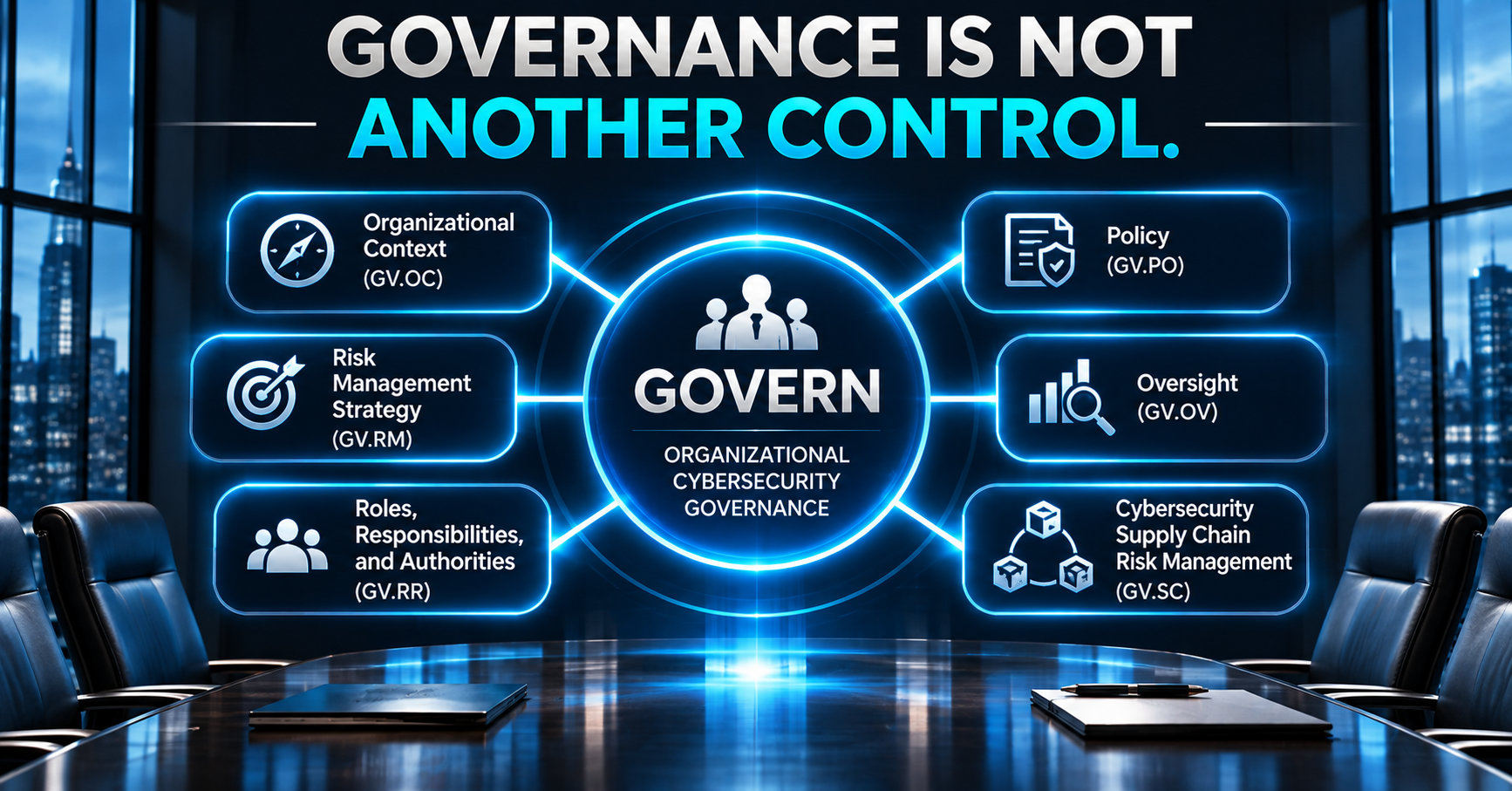
NIST CSF 2.0 organizes GOVERN around six categories:
- Organizational Context (GV.OC): Understanding the organization's mission, stakeholders, dependencies, and relevant requirements.
- Risk Management Strategy (GV.RM): Establishing risk management objectives, risk appetite, tolerance, and strategic direction.
- Roles, Responsibilities, and Authorities (GV.RR): Defining and communicating accountability and decision authority.
- Policy (GV.PO): Establishing, communicating, and maintaining cybersecurity risk management policies.
- Oversight (GV.OV): Reviewing cybersecurity risk management performance and outcomes to inform adjustments.
- Cybersecurity Supply Chain Risk Management (GV.SC): Establishing processes for managing cybersecurity risks arising from suppliers and other third parties.
These categories are interconnected.
Organizational context informs risk management strategy.
Risk strategy establishes boundaries for decisions.
Roles and authorities determine who may act within those boundaries.
Policies communicate expectations.
Oversight evaluates whether the governance system is operating effectively.
Supply chain governance extends these responsibilities across organizational dependencies.
Together, they describe an organizational governance capability—not merely another cybersecurity compliance checklist.
The Critical Difference Between Responsibility and Authority
One of the most consequential elements of GOVERN is its explicit recognition of roles, responsibilities, and authorities.
Organizations often document responsibilities extensively.
The CISO manages cybersecurity risk.
The CIO oversees technology operations.
Business units own their applications.
Risk management maintains the enterprise risk register.
Internal audit evaluates controls.
But these descriptions may not establish who can make consequential decisions.
Who can accept a material cybersecurity risk?
Who can authorize an exception to a security requirement?
Who can require a business unit to suspend an unsafe operation?
Who can approve a risk treatment that exceeds an established budget?
Who resolves disagreements between cybersecurity leadership and business executives?
And what happens when the required decision exceeds an individual's delegated authority?
A governance model that assigns responsibility without defining decision authority is structurally incomplete.
GOVERN provides a framework for examining those relationships.
But the framework cannot establish an organization's authority structure by itself.
Leadership must make those decisions and institutionalize them.
Risk Appetite Must Influence Actual Decisions
Risk appetite statements are common in enterprise governance.
Organizations describe their willingness to accept certain categories of risk, sometimes using qualitative labels such as low, moderate, or high.
But a statement of risk appetite has limited practical value if it does not influence operational and executive decisions.
Consider a company declaring a low appetite for exposure involving sensitive customer information.
A critical application containing that information has an unresolved vulnerability.
The business unit requests a six-month remediation deferral.
Who determines whether that deferral is consistent with the organization's stated risk appetite?
What thresholds apply?
What evidence must support the decision?
Who has authority to approve the exception?
And what conditions require escalation?
If the organization cannot answer these questions, its risk appetite statement may function more as a declaration of intent than an operational governance constraint.
Risk appetite becomes meaningful when it establishes boundaries that decision-makers are required to observe.
That requires defined tolerances, delegated authorities, escalation mechanisms, and monitoring.
Without those elements, governance remains aspirational.
Oversight Is More Than Receiving Reports
GOVERN also emphasizes oversight.
This is particularly important for boards and executive leadership.
Many organizations demonstrate cybersecurity oversight by producing dashboards, presenting periodic reports, and recording cybersecurity discussions in meeting minutes.
These activities may support oversight, but they do not necessarily establish that effective oversight occurred.
A board can receive extensive cybersecurity information without understanding whether management is operating within established risk tolerances.
An executive committee can review unresolved vulnerabilities without determining whether the appropriate authorities have accepted or rejected the resulting exposures.
A governance committee can monitor remediation progress without evaluating whether repeated delays reveal systemic weaknesses in decision-making.
Oversight requires more than visibility. It requires evaluation, accountability, and appropriate action.
The governance operating model must connect reported conditions to decision thresholds, escalation requirements, assigned responsibilities, and follow-through.
Otherwise, reporting becomes a recurring activity disconnected from the decisions it should inform.
Third-Party Risk Is Still an Enterprise Governance Responsibility
The inclusion of cybersecurity supply chain risk management within GOVERN reinforces another important principle.
Organizations can outsource services, infrastructure, and operational functions.
They cannot simply outsource accountability for the risks those dependencies create.
Consider a critical technology provider that fails to meet contractual cybersecurity requirements.
The vendor management team identifies the deficiency.
Security recommends corrective action.
The business unit insists the relationship must continue because the service is essential.
Legal reviews the contract.
Procurement requests updated assurances.
Who decides whether the organization may continue relying on the provider?
What risk tolerance applies?
Who authorizes an exception?
What conditions must the supplier satisfy?
And who monitors whether those conditions remain effective?
These are governance decisions involving multiple organizational functions.
They cannot be resolved through vendor security questionnaires alone.
Third-party cybersecurity risk must be governed through the same principles of authority, accountability, and defensible decision-making that apply to internal operations.
A Framework Is Not an Operating Model
This is where organizations must be particularly careful.
Adopting NIST CSF 2.0 does not automatically establish effective cybersecurity governance.
An organization can map policies to GOVERN categories.
It can complete a maturity assessment.
It can identify gaps and develop improvement plans.
It can produce an impressive framework alignment report.
But none of those activities independently demonstrates that governance operates effectively when difficult decisions arise.
The real test occurs when business priorities conflict with cybersecurity requirements.
When remediation threatens revenue.
When executive leadership rejects a security recommendation.
When a critical supplier cannot meet contractual obligations.
When an AI system requires broader authority to perform a business function.
When an incident requires decisions involving operational continuity, disclosure obligations, and enterprise risk.
At those moments, the organization needs more than a framework.
It needs an operating model that establishes who decides, under what authority, using what information, and subject to which accountability mechanisms.
A framework describes what effective governance should address. An operating model determines how governance actually works.
That distinction should guide every serious implementation of GOVERN.
Governance Must Produce Evidence
Another question deserves attention.
How does an organization demonstrate that its governance operating model is functioning?
Policies establish expectations.
Responsibility matrices describe assigned roles.
Committee charters define authority.
Risk registers document exposures.
Dashboards communicate conditions.
But these artifacts do not necessarily establish that consequential decisions were appropriately authorized, evaluated, and monitored.
This is where Evidentiary Architecture™ becomes relevant.
Governance processes should produce reliable evidence connecting material risks with organizational authority, supporting analysis, decisions, conditions, and subsequent oversight.
When an executive accepts a significant cybersecurity risk, the record should establish the authority under which the decision was made.
When an exception is approved, the organization should preserve the justification, applicable limitations, and review requirements.
When management escalates an exposure, the governance process should establish what decision was required and how it was resolved.
When the board directs corrective action, the organization should be able to demonstrate how that direction was implemented and verified.
These records should be proportionate to the significance of the decisions involved.
The objective is not to increase documentation for its own sake.
It is to make governance decisions traceable, examinable, and defensible.
Evidence alone does not prove that a decision was sound. It enables the organization to evaluate whether the decision was authorized, informed, and consistent with established governance requirements.
AI Makes GOVERN Even More Relevant
The increasing deployment of autonomous AI systems adds urgency to these questions.
An AI agent may possess permission to retrieve sensitive information, initiate transactions, modify business records, or execute workflows.
Technical controls can constrain its behavior.
But who determines which actions the agent should be authorized to perform?
Who approves expansions of its authority?
Who owns the business consequences of its actions?
What conditions require suspension or renewed authorization?
How does executive leadership determine whether autonomous operations remain within acceptable risk boundaries?
These questions belong within the organization's governance structure.
They cannot be delegated entirely to the technology implementing the agent.
As operational systems gain greater autonomy, organizational decision authority must become more explicit—not less.
GOVERN provides a useful foundation for addressing these challenges, even though AI-specific governance requirements may also require additional frameworks, controls, and oversight mechanisms.
The Real GOVERN Maturity Test
Organizations evaluating their implementation of NIST CSF 2.0 should ask more than whether the six GOVERN categories have been addressed.
They should examine whether governance works under real organizational pressure.
Consider five practical questions.
1. Can the organization identify who possesses authority to accept each category of material cybersecurity risk?
2. Are risk appetite and tolerance translated into enforceable decision boundaries and escalation requirements?
3. Can leadership demonstrate that significant cybersecurity decisions were appropriately authorized and supported by relevant information?
4. Does executive and board oversight produce meaningful evaluation, direction, and follow-through rather than merely recurring reports?
5. Can the organization produce reliable evidence showing how its governance mechanisms operated when consequential decisions were required?
If the answers are unclear, the organization may have implemented governance documentation without establishing an effective governance operating model.
That is the distinction leadership must confront.
A Question for the Community
NIST CSF 2.0 GOVERN provides a valuable structure for enterprise cybersecurity governance.
But implementing its categories is only the beginning.
What has been the greatest challenge in translating GOVERN from framework requirements into actual executive decision-making and accountability?
Is it defining decision authority?
Establishing meaningful risk tolerance?
Securing business ownership?
Connecting board oversight to management action?
Or producing reliable evidence that governance decisions were properly made?
I am interested in practical experiences from organizations implementing or evaluating GOVERN.
Because the real value of NIST CSF 2.0 GOVERN is not that it gives organizations another function to assess. It is that it forces a more fundamental question: Who governs cybersecurity risk, and how can the organization demonstrate that governance is working?
#CybersecurityGovernance #ExecutiveAccountability #NISTCSF #NISTCSF2 #GRC #BoardOversight #CyberRisk #EvidentiaryArchitecture
1 reactions · 0 comments
Topics: #cyberrisk, #nistcsf2, #cybersecuritygovernance, #nistcsf, #executiveaccountability, #evidentiaryarchitecture, #boardoversight, #grc