Posted in Incident Response
ITriage: IT triage for Windows and Linux
jp101216 — Security Engineer | Offensive Security Research & Custom C2 Tooling
I know this isn't a security tool. I'm sharing it anyway, because a lot of security starts with a healthy, patched endpoint.
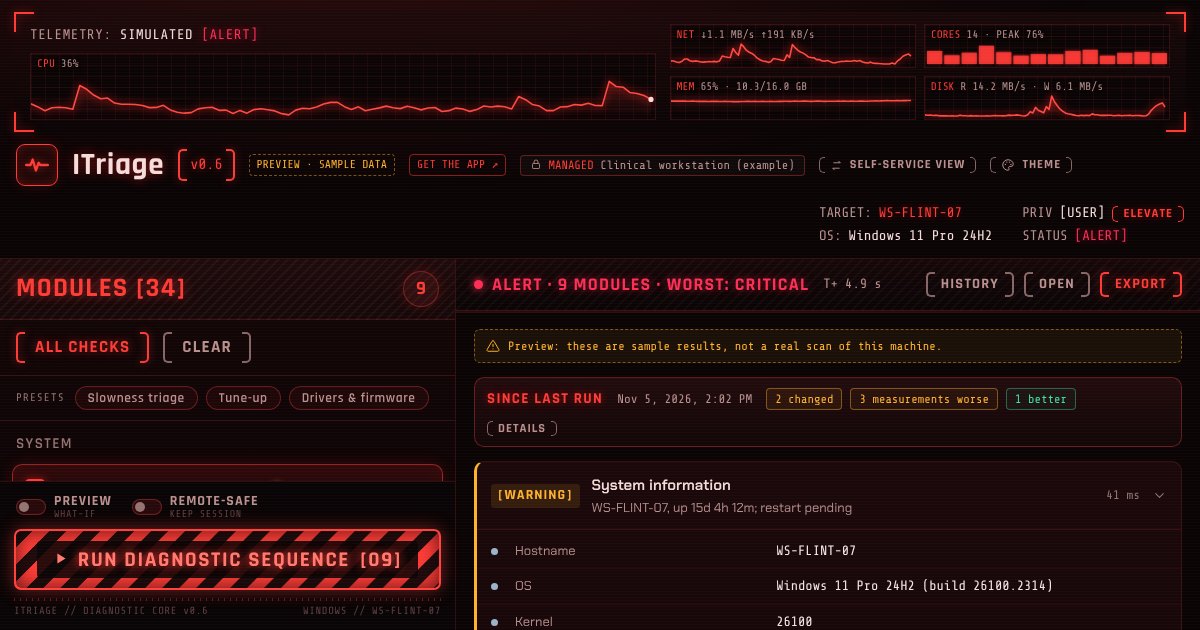
Meet ITriage: a free IT triage, repair and update tool for Windows and Linux, written in Rust.
WHY I BUILT IT
I spent nearly eight years on a healthcare IT service desk, and the same calls came in every day: "my computer is slow," "the VPN won't connect," "it won't print," "it needs updates." I'd built a set of PowerShell scripts to work those tickets faster. ITriage turns that toolkit into one cross-platform desktop app that's also a command line. The incident response side of the toolkit lives in a separate project, LiveResponse-NG.
WHAT IT DOES
• 34 modules: 20 read-only checks, 12 repairs and maintenance tasks, and updates for the OS, apps, drivers and firmware (through the vendor's own tools).
• Presets for the common calls: Slowness triage, Tune-up, and Drivers & firmware.
• Streamed, severity-coded results with one-click fixes and knowledge-base links.
• Every run is saved, and the next run on that machine shows what changed: problems resolved, new or still failing, plus before-and-after numbers for latency, packet loss, DNS time, disk latency and CPU.
• Exports for tickets: plain text, a full transcript, rich text for TeamDynamix, Markdown or JSON.
• A self-service view for the person at the PC: their computer name with a copy button, one "Check my computer" button, results in plain words, and "Copy details for the service desk."
• A command line with exit codes, for RMM tools, remote shells and scheduled tasks.
• Site profiles that set required apps, services and endpoints, which fixes are allowed, alert thresholds and KB links.
WHERE SECURITY SHOWS UP
It's not a security tool, but I built it the way I'd want a tool on hospital machines to behave:
• Least privilege: checks run as a standard user, and anything that needs admin says so before you click.
• Preview mode: every change says exactly what it would do before it does it.
• Remote-safe mode locks anything that could drop your remote session or restart the PC.
• Fixed procedures only: no input is ever put into a shell command, and a profile can turn fixes off but can't add commands.
• Policy is checked again in the engine, not just the UI, and every fix attempt (allowed, refused or failed) is logged to an audit file and the Windows Event Log or syslog.
• A managed profile that doesn't parse fails closed: the app goes read-only and shows the error.
• No remote content in the app window (strict CSP), and the only network traffic comes from checks you run. The public probes can be switched off.
• Windows checks use native APIs instead of spawning PowerShell, so it still works where PowerShell is locked down.
• Supply chain: every release ships with SHA-256 checksums and GitHub build-provenance attestations you can check with gh attestation verify. Windows code signing through Azure Artifact Signing is wired up with short-lived OIDC tokens and no stored secrets; I'm working through Microsoft's identity validation now.
• And the update side matters: keeping the OS, apps, drivers and firmware patched is still one of the best defenses an endpoint has.
THE STACK
A Rust engine, a Tauri desktop app and a plain JavaScript interface. CI runs clippy with warnings as errors and 130 tests on Linux (123 on Windows), then builds an MSI for SCCM or Intune, a setup .exe and a .deb. It also has nine themes, including amber and green-phosphor CRT looks, because why not.
HONEST STATUS
It's tested on Linux and on Windows Server CI runners, but I haven't run the repairs or the OEM update tools on a physical Windows workstation yet. That's next. If you've worked a service desk, I'd love to know which checks you'd add.
Try the interface in your browser (sample data, nothing to install): https://jp101216.github.io/ITriage/
Code and downloads: https://github.com/jp101216/ITriage
3 reactions · 2 comments
Comments
Omobamidele F.: This is exceptional work, JP! I really appreciate the emphasis on secure engineering practices here, specifically designing it to run under the principle of least privilege as a standard user and forcing managed profiles to fail closed. Shipping releases with SHA-256 checksums and leveraging GitHub build-provenance attestations adds immense supply chain security value to a diagnostic tool like thi
Victor Font: This is an impressive example of applying security engineering principles to everyday IT operations. Having worked extensively with enterprise IT service delivery, I particularly appreciate the separation between read-only diagnostics and privileged remediation, the enforcement of policy within the engine rather than merely the interface, and the preservation of audit evidence. Those are architect