Most security issues don’t come from a single vulnerability. They come from how small weaknesses connect…
Damian K. — Penetration Tester / Offensive Security Engineer
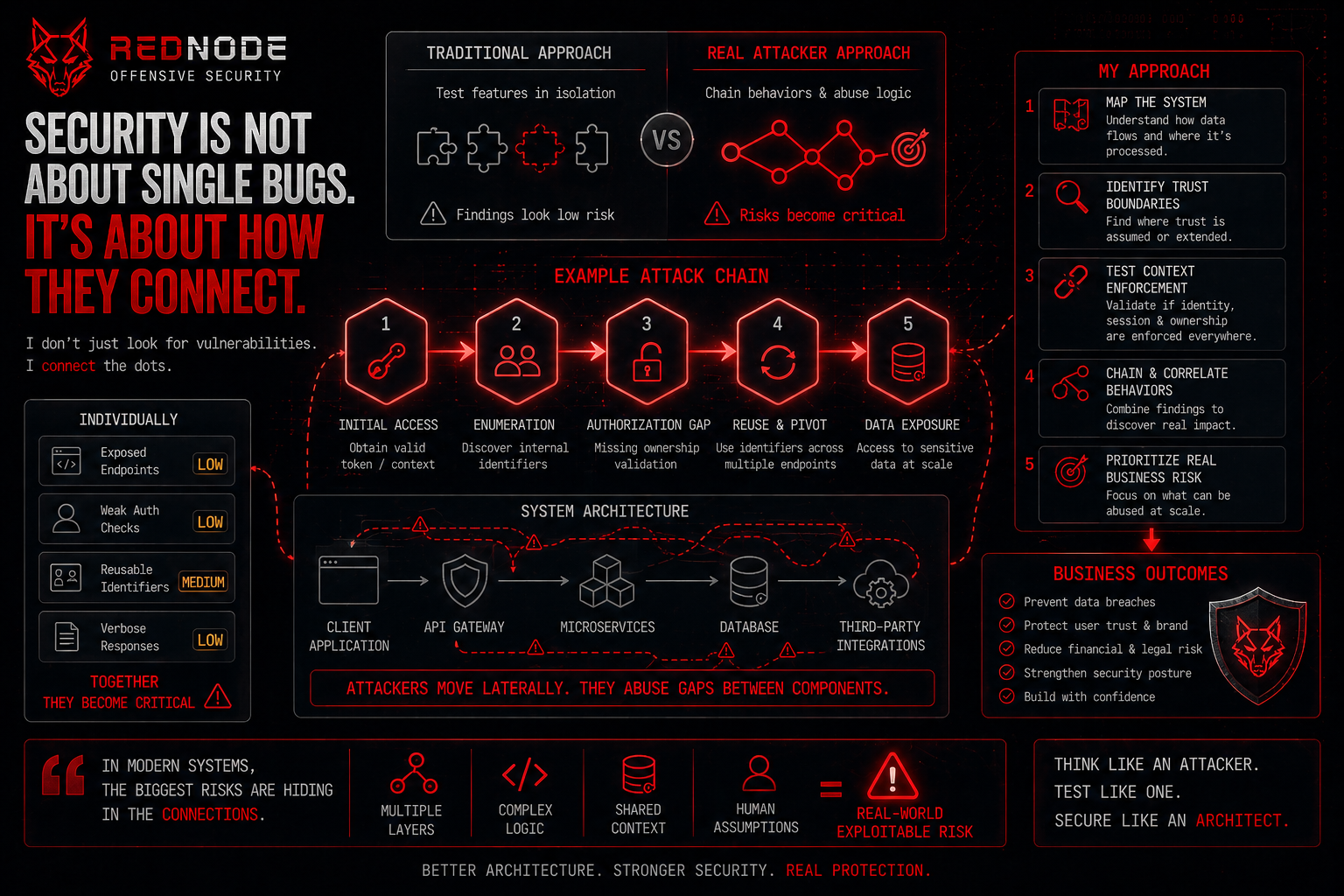
Most security issues don’t come from a single vulnerability.
They come from how small weaknesses connect.
When I look at an application, I’m not asking:
“Is there a bug?”
I’m asking:
What happens if I combine everything that “almost works”?
A typical review doesn’t stop at findings like:
• exposed endpoints
• weak authorization checks
• reusable identifiers
Because in isolation, they often don’t look critical.
The real work starts when you connect them:
→ Can an identifier from one context be reused in another?
→ Does authorization behave consistently across endpoints?
→ What happens when responses are compared, not just read?
→ Can “harmless” features be triggered outside intended flows?
This is where things change:
Low → Medium → Critical
Not because of severity…
…but because of interaction.
A recent assessment followed a pattern like this:
• initial access to a valid context
• ability to enumerate internal identifiers
• missing ownership validation
• reuse of data across multiple endpoints
• gradual expansion of accessible data
Individually — acceptable risk.
Together — full data exposure.
My approach is simple:
• Map how data flows through the system
• Identify where trust boundaries break
• Test how context is enforced (or not)
• Chain behaviors instead of testing features in isolation
Because in modern systems,
security is not about what each part does.
It’s about what happens when everything interacts.
If you're reviewing your API or application security,
this perspective often reveals risks that standard testing misses.
1 reactions · 0 comments