Quick cybersecurity reality check: Buying a SIEM does not mean you are secure. Out of the box, most security…
Ikechukwu O. — Security Operations Center (SOC) Analyst
Quick cybersecurity reality check: Buying a SIEM does not mean you are secure.
Out of the box, most security monitoring tools are completely blind to unique business and application logic. If you aren't actively engineering your detections, you're blind to real threats.
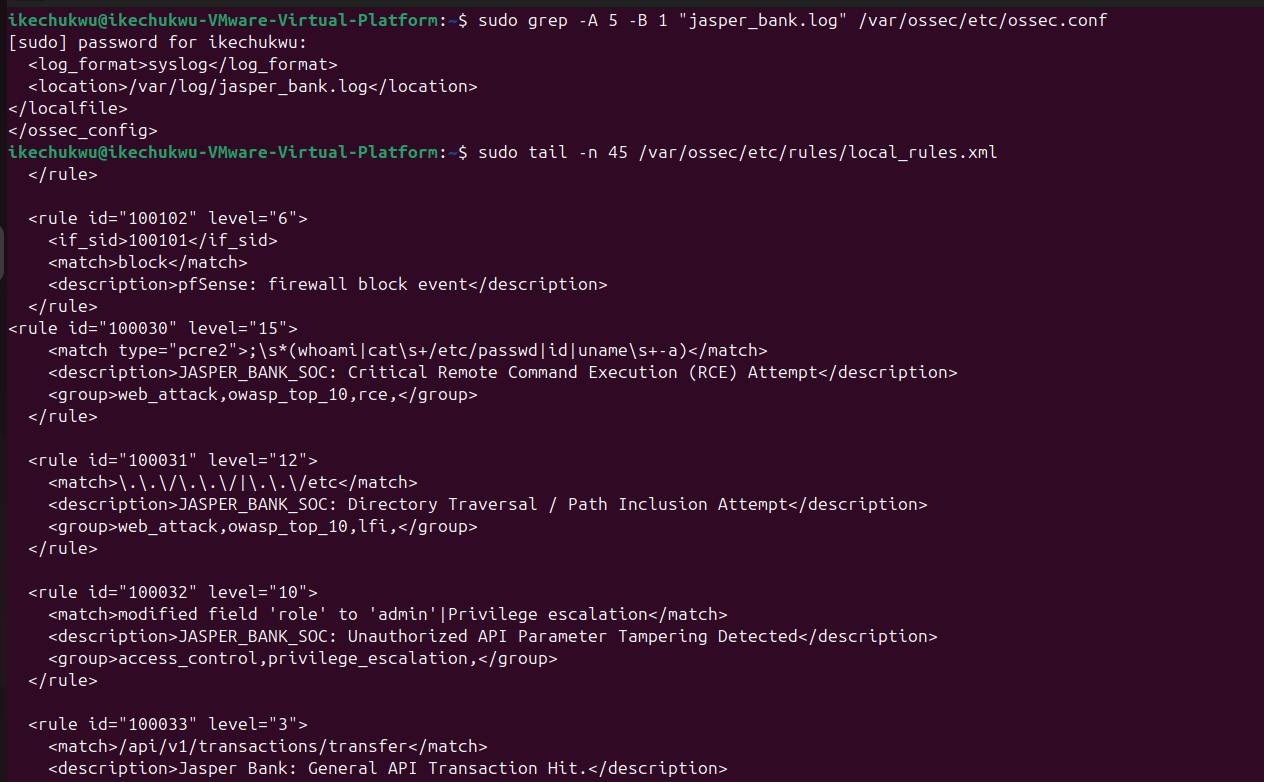
I recently ran a project simulating a fintech ecosystem to put this to the test. By building custom log ingestion pipelines and authoring targeted XML signatures, I configured the environment to catch high-severity exploits like RCE, SQLi, and API parameter tampering that standard signatures missed entirely.
The biggest takeaway? The true value of a modern SOC isn't the platform you deploy; it's the custom engineering and systematic tuning you do under the hood to eliminate false positives and catch true attacks.
the JASPER_BANK is an intentional vulnerable web application I designed with AI for simulation and never a real infrastuture. 😊
Back to building. 💻🔥
#DetectionEngineering #Cybersecurity #SIEM #Wazuh #BlueTeam #SOC #Fintech
3 reactions · 2 comments
Topics: #fintech, #wazuh, #blueteam, #siem, #cybersecurity, #soc, #detectionengineering
Comments
Damian K.: Exactly. And this is also one of the biggest reasons why modern attack chains increasingly bypass traditional SOC visibility. Most SIEM/SOC pipelines still think in: → signatures → isolated alerts → known IOC patterns Meanwhile attackers think in: → behavior → workflow abuse → authorization drift → trust propagation → attack-chain correlation A single RCE signature is easy. What is difficult is de
Ikechukwu O.: Damian Kuś you nailed it. That gap between event detection and attack‑path understanding is where most SOCs struggle. The lab exercise was to prove that without custom engineering, you miss the subtle behaviors that build into real breaches. I like how you framed it as ‘operational danger’ rather than just ‘malicious event’. That’s the mindset shift SOC teams need. Thanks for adding depth to the d