Posted in GRC
📢 Shared from Cybersecurity Governance & Executive Accountability Today's article for Cybersecurity…
Victor Font — Keynote Speaker | Strategic Technology Leader | Fractional CIO | IT & Cyber Governance Expert | Published Author | FedRAMP Readiness | Board-Level Advisor | Digital Transformation | Enterprise WordPress/Formidable Forms
📢 Shared from Cybersecurity Governance & Executive Accountability
Today's article for Cybersecurity Governance & Executive Accountability, November 8, continues our examination of NIST CSF 2.0 GOVERN.
Yesterday, we established why GOVERN is more than another cybersecurity control. Today, we'll examine a practical consequence: organizations that assign cybersecurity responsibilities without granting the authority necessary to fulfill them.
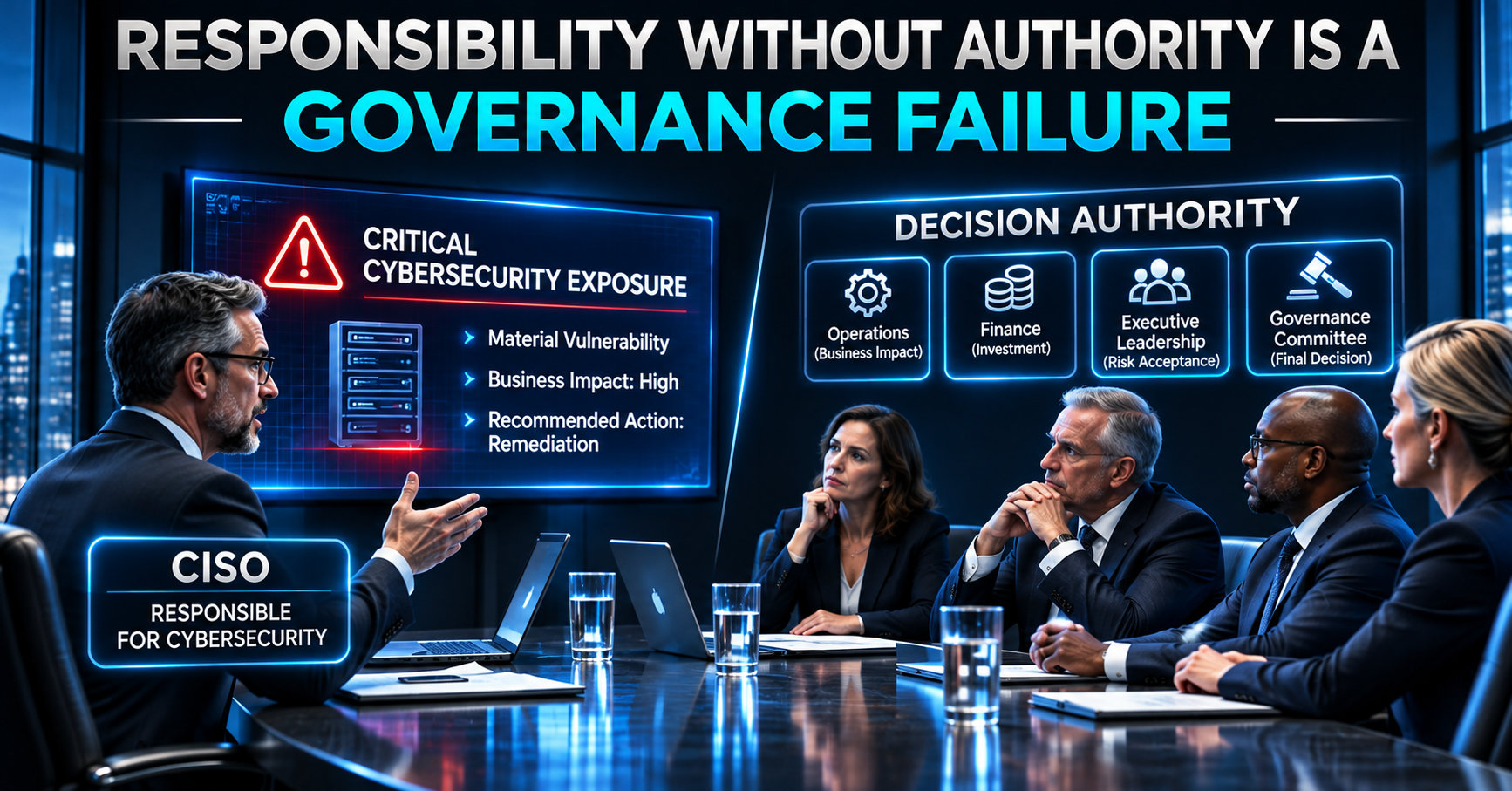
Cybersecurity Responsibility Without Authority Is a Governance Failure
Cybersecurity Governance & Executive Accountability | Governance in Practice
The CISO is responsible for cybersecurity.
That statement appears in countless organizational charts, job descriptions, governance policies, and board presentations.
But what happens when the CISO identifies a material cybersecurity risk and lacks the authority to require corrective action?
What happens when a business executive refuses remediation because it threatens revenue?
What happens when Finance declines funding, Operations rejects disruption, and executive leadership postpones the decision?
The CISO remains responsible for cybersecurity.
The exposure remains unresolved.
And the organization continues operating.
Responsibility has been assigned, but the authority necessary to fulfill it has not.
This is not simply an organizational inconvenience.
It is a structural governance failure.
The Accountability Paradox
Many organizations expect cybersecurity leaders to be accountable for outcomes they cannot independently control.
The CISO is expected to reduce enterprise cyber risk, protect critical information, maintain regulatory readiness, and provide assurance to executive leadership.
Yet the decisions that determine whether those objectives can be achieved often belong to other executives.
Business leaders control operational priorities.
Finance controls investment decisions.
Technology leadership controls infrastructure and application roadmaps.
Procurement manages supplier relationships.
Executive management resolves competing organizational objectives.
These arrangements are not inherently defective. Cybersecurity is an enterprise responsibility, and no single executive should possess unlimited authority over every business decision involving technology.
The governance failure emerges when the organization assigns accountability for outcomes without establishing the decision rights, escalation mechanisms, and executive obligations necessary to achieve them.
An executive cannot reasonably be held accountable for decisions that another executive possesses the exclusive authority to make.
The distinction is especially important when cybersecurity recommendations conflict with business priorities.
A Scenario Every CISO Recognizes
Consider a financial services organization operating a legacy application that processes sensitive customer information.
The security team identifies a critical vulnerability.
The CISO recommends replacing the application because the underlying technology cannot be adequately secured through conventional patching.
The CIO supports the recommendation.
The business unit refuses because replacement would interrupt a critical revenue-generating process.
Finance rejects the investment because the expenditure was not included in the annual budget.
The CISO escalates the issue to executive leadership.
Management acknowledges the concern but decides to revisit the matter during the next planning cycle.
Six months pass.
The application remains operational.
The vulnerability remains unresolved.
The CISO continues reporting the exposure.
Now consider the governance implications.
Who made the decision to continue operating?
Was that decision an authorized acceptance of residual cybersecurity risk?
Did the decision-maker possess authority to accept the potential business consequences?
Was the exposure evaluated against established risk tolerance?
What conditions were imposed?
Who is accountable for monitoring the risk?
And what would trigger reconsideration?
If the organization cannot answer these questions, it has not merely encountered a disagreement over cybersecurity funding.
It has exposed a disconnect between organizational responsibility and decision authority.
Responsibility, Accountability, and Authority Are Not Interchangeable
Effective governance requires distinguishing among three concepts that are frequently treated as though they mean the same thing.
Responsibility concerns the duties an individual or function is expected to perform.
The cybersecurity team may be responsible for assessing vulnerabilities, recommending controls, and monitoring threats.
Accountability concerns answerability for assigned decisions, obligations, and outcomes.
A business executive may be accountable for ensuring that risks affecting a critical business process are appropriately managed.
Authority concerns the legitimate power to make decisions, approve actions, allocate resources, accept risk, or require escalation.
An executive may possess authority to accept certain exposures within established limits.
These concepts must be connected.
A CISO can be responsible for identifying and communicating a material exposure without possessing authority to accept the resulting business risk.
A business executive can be accountable for managing that exposure without possessing unlimited authority to accept risks exceeding enterprise tolerance.
A risk committee can possess authority to approve exceptions without assuming responsibility for operating the underlying technical controls.
The organization must define these relationships deliberately.
Governance becomes ineffective when responsibility is assigned through job descriptions while authority is left to informal organizational negotiations.
The CISO Should Not Become the Enterprise's Default Risk Acceptor
One of the most problematic consequences of unclear authority is the tendency to treat the CISO as the default owner of every unresolved cybersecurity risk.
A business unit rejects remediation.
The exposure remains on the cybersecurity dashboard.
The CISO continues reporting it.
Eventually, organizational attention shifts elsewhere.
If an incident occurs, the first question may be why the CISO allowed the vulnerability to remain.
But that question may overlook the actual decision structure.
Did the CISO possess authority to require remediation?
Could the CISO allocate the necessary funding?
Could the CISO suspend the affected business operation?
Did another executive formally accept the exposure?
Was the disagreement escalated to an appropriate decision-making authority?
The answers determine where accountability properly resides.
This does not absolve the CISO of professional responsibilities.
Security leadership must provide competent assessments, communicate material risks, recommend appropriate treatments, and escalate unresolved exposures through established channels.
But accountability for business risk acceptance should follow legitimate decision authority—not simply the organizational title most closely associated with cybersecurity.
That principle protects the integrity of enterprise governance.
Escalation Must Lead Somewhere
Organizations frequently describe escalation as the solution when cybersecurity leaders lack decision authority.
But escalation is only effective when it connects unresolved matters to an authorized decision-maker.
Consider a governance process requiring the CISO to escalate material risks to an executive risk committee.
That sounds appropriate.
But what happens if the committee repeatedly postpones decisions?
What happens if committee members disagree about funding?
What happens if no individual possesses authority to resolve the conflict?
What happens when the exposure exceeds established risk tolerance?
An escalation process that merely moves unresolved issues between meetings does not establish effective governance.
It institutionalizes delay.
Escalation must be designed to produce an authorized decision, a defined next action, or a further escalation—not indefinite acknowledgment.
A functioning escalation mechanism should establish decision thresholds, responsible authorities, required information, response expectations, and procedures for unresolved matters.
It should also distinguish between decisions management may legitimately make and matters requiring higher-level oversight.
Not every cybersecurity disagreement belongs before the board.
But management should not be able to avoid consequential decisions indefinitely because no governance mechanism requires resolution.
What NIST CSF 2.0 GOVERN Requires Us to Examine
The NIST Cybersecurity Framework 2.0 addresses this problem through its GOVERN function.
In particular, the Roles, Responsibilities, and Authorities category, GV.RR, emphasizes establishing and communicating organizational cybersecurity responsibilities and authorities.
This is an important distinction.
The framework does not merely encourage organizations to identify who performs cybersecurity activities.
It recognizes the need for defined authority within the cybersecurity risk management structure.
The Risk Management Strategy category, GV.RM, provides the strategic context for risk appetite, tolerance, and risk management expectations.
The Oversight category, GV.OV, addresses the review of cybersecurity risk management outcomes and the adjustment of governance practices.
Together, these categories reinforce a practical principle.
An organization cannot demonstrate effective cybersecurity governance merely by showing that responsibilities have been assigned. It must also establish that the authority structure enables those responsibilities to be fulfilled.
A responsibility matrix is useful.
A governance policy is necessary.
A committee charter may establish formal decision rights.
But the actual test occurs when an authorized executive must make an uncomfortable decision.
The Evidence of Authority Matters
How does an organization demonstrate that cybersecurity authority operates as intended?
This question is central to Evidentiary Architecture™.
A policy may state that business executives own cybersecurity risks associated with their operations.
A committee charter may describe delegated risk acceptance authority.
A risk register may identify accountable individuals.
But these documents do not necessarily demonstrate that authority was properly exercised in a specific decision.
For consequential cybersecurity matters, governance evidence should establish:
- The exposure: What risk required a decision, and what organizational objectives were affected?
- The accountable owner: Who was answerable for ensuring that the exposure received appropriate treatment?
- The authorized decision-maker: Who possessed authority to approve treatment, accept residual risk, or grant an exception?
- The decision basis: What assessments, alternatives, business consequences, and risk limits informed the decision?
- The authorization: What decision was made, by whom, and under what delegated authority?
- The conditions: What compensating controls, deadlines, monitoring obligations, or escalation triggers applied?
- The follow-through: What evidence demonstrates that required actions occurred and the decision remained appropriate?
These records should be proportionate to the significance of the risk.
The objective is not to create a bureaucratic approval process for every operational security decision.
It is to ensure that consequential decisions remain traceable to legitimate authority.
A governance decision is not defensible merely because someone approved it. The organization must be able to establish that the person had authority to make that decision and that the decision was appropriately informed.
AI Makes the Authority Problem More Complicated
Autonomous AI systems introduce another dimension to this challenge.
An AI agent may possess technical permission to retrieve sensitive data, modify business records, initiate transactions, or execute operational workflows.
The engineering team may be responsible for deploying and maintaining the system.
The security team may be responsible for enforcing technical restrictions.
The business unit may define the agent's objectives.
But who possesses authority to approve the actions the agent may perform?
Who determines acceptable exposure when the agent operates autonomously?
Who can suspend its authority when conditions change?
And who is accountable when the agent performs an authorized action that produces an unacceptable business consequence?
Technical permissions are not equivalent to organizational decision authority.
An AI system may be capable of executing an action without that action being appropriate under enterprise governance requirements.
The more authority organizations delegate to autonomous systems, the more precisely they must define the human authority governing those delegations.
This is not simply an AI security issue.
It is an extension of the same executive accountability problem that has existed in enterprise cybersecurity for decades.
The Executive Authority Test
Organizations can evaluate this weakness without launching a major governance transformation.
Start with the five most consequential unresolved cybersecurity risks.
For each exposure, identify the executive accountable for managing its business consequences.
Then determine whether that executive possesses the authority necessary to approve treatment, secure resources, accept residual exposure within established limits, or escalate the matter.
Next, examine what happens when another executive refuses cooperation.
Is there a defined mechanism for resolving the conflict?
Does the organization establish who has final decision authority?
Are there deadlines or escalation triggers?
Can management demonstrate how previous disagreements were resolved?
Finally, review the evidence.
Can the organization produce records establishing that consequential decisions were made by appropriately authorized individuals?
If not, the problem may not be inadequate cybersecurity expertise, insufficient technology investment, or poor operational performance.
It may be a governance structure that assigns responsibility without providing a functioning mechanism for exercising authority.
A Question for the Community
Many CISOs are held accountable for enterprise cybersecurity outcomes while lacking direct control over business priorities, budgets, and operational decisions.
When a CISO recommends remediation of a material cybersecurity risk and a business executive refuses, who should possess the final decision authority?
Should the decision rest with the business executive, an enterprise risk committee, the CEO, or another designated authority?
And how should the organization demonstrate that the decision was legitimate?
I am particularly interested in how organizations have structured escalation and risk acceptance authority to resolve these conflicts without making the CISO the default owner of every unresolved exposure.
Because cybersecurity accountability cannot be credible when responsibility is assigned without the authority necessary to act—or a defined governance mechanism for obtaining an authorized decision.
\#CybersecurityGovernance #ExecutiveAccountability #CISO #CyberRisk #GRC #NISTCSF #BoardOversight #EvidentiaryArchitecture
Hero image direction for today's article
Use our established 1.91:1 executive visual style, with deep navy, electric blue, and silver. Depict a CISO presenting a critical cybersecurity exposure to executive leadership, with a visual separation between the person assigned responsibility and the executives holding decision authority.
The image headline should read:
RESPONSIBILITY WITHOUT AUTHORITY IS A GOVERNANCE FAILURE
This continues our hero-image experiment. The image should be generated and attached before publishing, since Cyberr does not permit adding an image to an existing post.
2 reactions · 0 comments
Topics: #cyberrisk, #ciso, #cybersecuritygovernance, #nistcsf, #executiveaccountability, #evidentiaryarchitecture, #boardoversight, #grc