Posted in Security Awareness
Your Security Controls Passed Every Test. So Why Did They Fail?
Victor Font — Keynote Speaker | Strategic Technology Leader | Fractional CIO | IT & Cyber Governance Expert | Published Author | FedRAMP Readiness | Board-Level Advisor | Digital Transformation | Enterprise WordPress/Formidable Forms
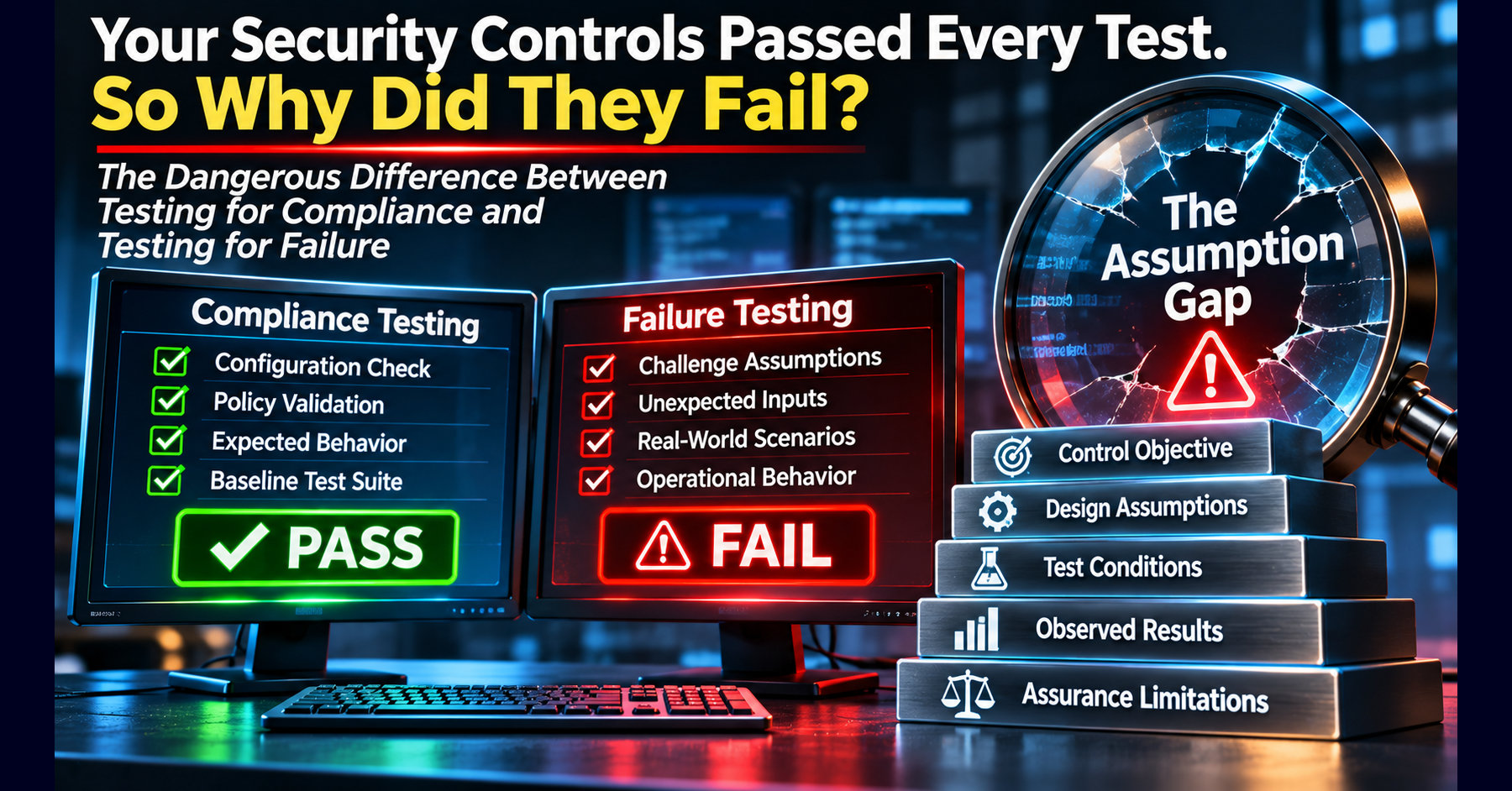
The Dangerous Difference Between Testing for Compliance and Testing for Failure
A security engineer designs a control to prevent unauthorized activity.
The control is implemented.
A test suite is developed.
Every test passes.
The results are documented.
The control is declared effective.
Then someone tries something the test suite never considered.
And the control fails.
No sophisticated exploit was necessary.
No advanced persistent threat was involved.
The control simply encountered a condition that its designers had not adequately tested.
The organization proved that the control worked under the conditions it expected. It never established whether the control would survive the conditions it failed to anticipate.
That distinction is becoming one of the most important questions in cybersecurity assurance.
And it deserves considerably more attention from executives, security architects, auditors, and boards.
The Green Dashboard Problem
Cybersecurity programs produce enormous quantities of evidence.
Vulnerability scans.
Configuration assessments.
Penetration tests.
Control evaluations.
Compliance certifications.
Automated test results.
Security dashboards consolidate these activities into indicators intended to communicate organizational readiness.
Green means the requirement was satisfied.
Red means something needs attention.
But what does green actually prove?
Suppose an organization reports that 100% of its required security controls passed testing.
That sounds reassuring.
Yet the result tells us remarkably little without understanding how those controls were tested.
Were the tests designed to confirm expected behavior?
Were they designed to challenge the control's assumptions?
Did they include malformed inputs, unexpected sequences, conflicting conditions, and realistic operational behavior?
Did they examine what happens when employees, systems, or adversaries behave differently from the scenarios envisioned by the control designers?
Or did they simply verify that the control performed the function described in its implementation requirements?
A passing test establishes that a control passed that test. It does not establish that the control cannot fail.
This should be obvious.
Yet cybersecurity reporting frequently treats successful testing as though it establishes a much broader level of assurance.
A Real Example From the Cyberr Community
Yesterday, following my article about a remote employee using a $20 mouse mover to circumvent workstation inactivity locking, a Cyberr member shared an interesting example from his own security testing.
He had developed a Modbus security gate.
The gate passed its test suite.
But the tests evaluated single-value write operations.
When a two-value write was attempted, the validation logic examined only the first value.
The second value escaped the intended validation.
Once he modified the logic to evaluate every value, the bypass was closed.
The important lesson was not that the original implementation contained a defect.
Software defects are inevitable.
The important lesson was that the test suite had validated an incomplete assumption about how the control would encounter input.
The control passed because the test never challenged the condition that exposed its weakness.
That is a fundamentally different problem from a control that fails a known test.
In the first case, the organization knows something is wrong.
In the second, the organization may believe everything is working precisely because its tests are passing.
The latter can create a dangerous form of false assurance.
We Test What We Expect
There is a natural tendency in engineering to design tests around known requirements.
A control must reject unauthorized access.
We test an unauthorized access attempt.
A system must lock after a period of inactivity.
We stop interacting with it and verify that it locks.
A validation mechanism must reject prohibited values.
We submit a prohibited value and confirm rejection.
These tests are necessary.
But they may not be sufficient.
The deeper question is whether the test design adequately challenges the assumptions embedded in the requirement.
What happens when an unauthorized access attempt follows an unexpected sequence?
What happens when input appears valid in one field but malicious in another?
What happens when a workstation receives artificial activity that does not represent human presence?
What happens when two individually valid operations produce an unsafe result when combined?
What happens when a security control behaves correctly in isolation but fails within a larger business workflow?
These are not merely additional test cases.
They represent a different approach to assurance.
Instead of asking whether the control performs as expected, we must also ask what assumptions would have to be wrong for the control to fail.
That question changes how security testing is designed.
Compliance Testing and Adversarial Testing Are Different Disciplines
Compliance testing generally evaluates whether an organization satisfies defined requirements.
Adversarial testing examines whether protections remain effective when challenged by behavior intended to expose weaknesses.
Both are valuable.
Neither should be mistaken for the other.
A compliance assessment may establish that a workstation inactivity policy is configured and enforced under specified conditions.
An adversarial assessment may examine whether artificial input can prevent the intended protection from activating.
A configuration review may confirm that a firewall rule blocks prohibited traffic.
An adversarial test may examine whether alternate paths, protocol behaviors, or application dependencies permit the same prohibited activity.
A control assessment may establish that privileged access requires approval.
A workflow test may discover that emergency procedures, inherited permissions, or poorly governed service accounts bypass the intended authorization boundary.
The distinction is not that compliance testing is inherently weak.
It is that different testing methods support different assurance claims.
The problem begins when organizations use evidence from one type of testing to make claims that only another type of testing could reasonably support.
A control can satisfy a documented requirement while remaining vulnerable to conditions outside the scope of the assessment.
That limitation should be understood and communicated.
The Assumptions Nobody Documented
Every security control depends on assumptions.
Some are technical.
Some are operational.
Some involve human behavior.
A workstation inactivity control may assume that mouse movement indicates user presence.
An access control may assume that authentication establishes the identity of the person operating the session.
A network segmentation policy may assume that all relevant communication paths have been identified.
A vulnerability management process may assume that its asset inventory is sufficiently complete.
A backup assurance program may assume that successful backup jobs imply recoverability.
A security awareness program may assume that employees will follow prescribed procedures even when those procedures interfere with legitimate work.
None of these assumptions should be accepted without qualification.
Some may be reasonable within defined conditions.
Others may be incomplete.
Still others may become invalid as technology, threats, or business operations change.
The challenge is that assumptions frequently remain implicit.
They are embedded in system designs, policies, test cases, and operating procedures without being clearly identified as conditions on which effectiveness depends.
That makes them difficult to challenge.
An undocumented assumption can become an invisible dependency in the organization's security architecture.
And invisible dependencies are particularly dangerous because they may remain undiscovered until something fails.
Why Independent Testing Matters
When the same team designs a control, implements it, and develops the tests used to validate it, there is a risk that the tests will reflect the team's original assumptions.
That does not imply incompetence.
It reflects a common engineering limitation.
People naturally test the behaviors they believe matter.
Independent reviewers may approach the problem differently.
They may question the requirements.
They may challenge the input boundaries.
They may examine operational scenarios the original designers did not consider.
They may ask whether the test suite establishes the security objective or merely verifies the implementation.
This is one reason independent security assurance can provide value beyond routine operational testing.
But independence alone is not enough.
An external assessment that follows the same narrow assumptions can reproduce the same blind spots.
The value comes from the quality of the challenge.
Independent assurance should introduce independent thinking—not merely another signature on the same evidence.
The Governance Failure Behind Incomplete Testing
At first glance, incomplete security testing appears to be a technical problem.
A test case was missing.
A boundary condition was overlooked.
A validation routine failed to examine every input.
Engineers correct the defect and expand the test suite.
Problem solved.
But from a governance perspective, another question remains.
What did management believe the original passing test results established?
Were executives told that a control had been tested?
Or were they told that the control was effective?
Those statements are not equivalent.
The first describes an activity.
The second makes an assurance claim.
If management relies on the second claim to make risk decisions, the quality and scope of the underlying evidence become governance concerns.
Consider an organization that accepts a significant residual risk because compensating controls have reportedly passed validation.
If the tests never challenged the conditions most likely to undermine those controls, the risk acceptance decision may rest on incomplete assurance.
The problem is no longer confined to test engineering.
It has entered the enterprise decision-making process.
When incomplete testing produces overstated assurance, a technical limitation becomes a governance failure.
Evidentiary Architecture™ and the Assurance Chain
This is where Evidentiary Architecture™ provides a useful framework for examining the problem.
Effective cybersecurity governance requires traceability between the security objective, the control intended to achieve it, the assumptions on which the control depends, and the evidence supporting claims about its effectiveness.
A defensible assurance chain should connect:
Security objective → Control requirements → Design assumptions → Test conditions → Observed results → Assurance limitations → Governance decision.
Notice the inclusion of assurance limitations.
That element is frequently missing from executive reporting.
A test report should not simply state that a control passed.
It should establish what was tested, which conditions were evaluated, what evidence was observed, and which material conditions remain untested or uncertain.
This does not require proving that a control will never fail.
Such a claim would be unrealistic.
It requires ensuring that the organization does not claim more assurance than the evidence supports.
That distinction is essential to defensible governance.
Executives should be able to determine not only whether a control passed testing but also what confidence they can reasonably place in the result.
Five Questions That Change Security Assurance
Security leaders can begin challenging their existing assurance practices with five questions.
1. What assumptions does this control depend on?
Identify the technical, operational, and behavioral conditions necessary for the control to achieve its intended objective.
2. Which assumptions have actually been tested?
Distinguish between requirements that were verified and assumptions that remain unchallenged.
3. What conditions could invalidate the result?
Consider unexpected inputs, unusual workflows, environmental changes, conflicting controls, and deliberate circumvention.
4. What does the evidence legitimately prove?
Avoid translating a narrow passing result into a broad claim of effectiveness.
5. Who is accountable for accepting the remaining uncertainty?
Testing cannot eliminate every unknown.
But residual uncertainty should be understood by the individuals authorized to make consequential risk decisions.
These questions move the organization beyond counting completed tests.
They examine whether testing provides meaningful assurance.
The Board Does Not Need a Perfect Test Suite
Boards should not expect management to guarantee that every security control will withstand every possible attack.
That is neither technically realistic nor economically practical.
But directors should expect management to understand the limitations of its security assurance program.
When a significant control is reported as effective, management should be able to explain the basis for that conclusion.
What was tested?
How was effectiveness evaluated?
Were realistic failure conditions considered?
What limitations remain?
How are those limitations reflected in enterprise risk decisions?
These are not questions about individual test scripts.
They are questions about the reliability of the evidence used to support oversight.
A board that receives a green cybersecurity dashboard should understand what the green indicators mean—and what they do not mean.
Otherwise, reporting may create confidence without corresponding assurance.
The Most Dangerous Test Is the One That Never Fails
There is a temptation to view a security test suite with a 100% pass rate as evidence of engineering excellence.
Sometimes it is.
But a consistently passing test suite can also indicate that the tests are no longer challenging the system in meaningful ways.
The purpose of security testing is not to produce green indicators.
It is to discover conditions under which the system fails to meet its security objectives.
A failed test can be valuable.
It identifies a weakness before that weakness becomes an incident.
A test that never challenges the assumptions underlying a control may provide much less value, even when every result is green.
This is the paradox of cybersecurity assurance.
The testing program that discovers more weaknesses may be providing better protection than the program reporting fewer failures.
The difference lies in whether the organization values learning or merely successful reporting.
The Question That Should Make Every CISO Uncomfortable
Think about the security control in your organization that management trusts most.
Perhaps it is identity and access management.
Perhaps it is endpoint protection.
Perhaps it is network segmentation, privileged access management, or backup recovery.
Now ask a different question.
What would someone have to do to make that control fail while every existing compliance indicator continued reporting success?
If nobody can answer, that does not necessarily mean the control is exceptionally strong.
It may mean the organization has never seriously challenged the assumptions on which its confidence depends.
The goal of cybersecurity assurance is not to prove that our expectations are correct.
It is to discover where those expectations may be wrong.
Because a passing test is useful evidence.
But it is not a substitute for understanding what the test never attempted to prove.
The most dangerous cybersecurity failure may not be the control that fails testing. It may be the control that passes every test because nobody asked the question that would make it fail.
Discussion
Imagine two security teams.
Team A reports that 100% of its security controls passed their required tests.
Team B reports an 85% pass rate because its engineers deliberately introduced unexpected conditions, challenged design assumptions, and discovered previously unknown weaknesses.
Which team would give you greater confidence in the organization's cybersecurity posture?
And if you were the CISO, would you reward the team reporting fewer failures—or the team discovering more of them before an attacker does?
#CybersecurityGovernance #SecurityAssurance #ControlEffectiveness #SecurityTesting #CyberRisk #AdversarialTesting #GRC #EvidentiaryArchitecture
4 reactions · 0 comments
Topics: #cyberrisk, #controleffectiveness, #cybersecuritygovernance, #adversarialtesting, #evidentiaryarchitecture, #securitytesting, #grc, #securityassurance