I recently analyzed an application where multiple “low-risk” issues combined into a critical attack chain…
Damian K. — Penetration Tester / Offensive Security Engineer
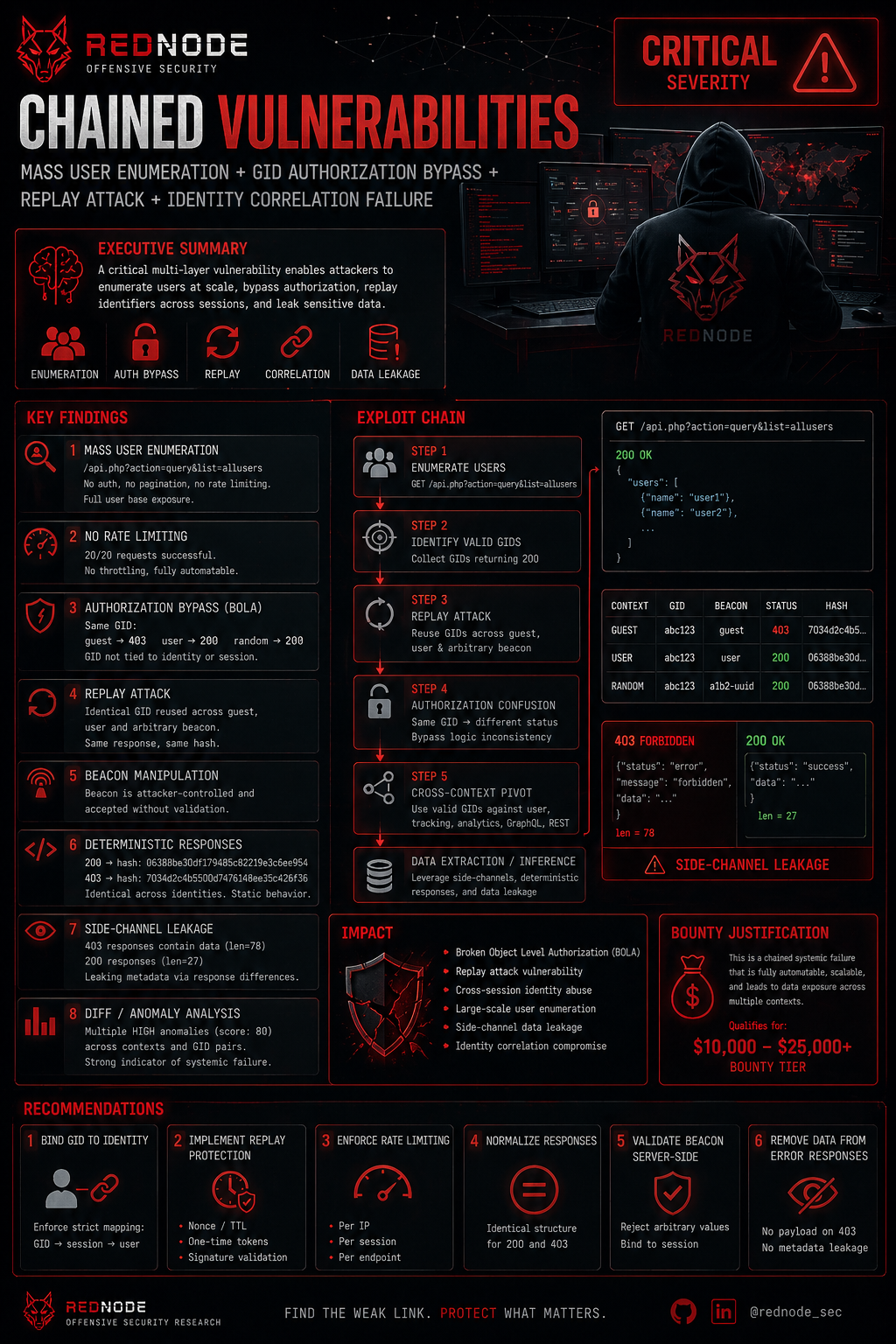
I recently analyzed an application where multiple “low-risk” issues combined into a critical attack chain.
No zero-days.
No complex exploitation.
Just broken assumptions.
d:-)-<-<]:
What started as simple user enumeration…
…quickly escalated into something much more serious:
• Identifiers reusable across sessions
• Authorization behaving inconsistently
• Backend trusting attacker-controlled input
• Responses leaking structured data
d:-)-<-<]:
This enabled a full chain:
→ Enumerate users at scale
→ Reuse identifiers across contexts
→ Trigger authorization inconsistencies
→ Pivot across multiple endpoints
→ Extract and correlate sensitive data
d:-)-<-<]:
Real impact:
* Cross-session identity abuse
* Large-scale data harvesting
* Authorization bypass (BOLA)
* Side-channel data leakage
* Loss of data integrity & trust
d:-)-<-<]:
The issue wasn’t a single bug.
It was a systemic failure across:
* API design
* authorization logic
* identity handling
* response validation
d:-)-<-<]:
Most teams look for vulnerabilities in isolation.
Attackers don’t.
They chain them.
d:-)-<-<]:
What actually matters:
* Binding identifiers to user/session context
* Eliminating trust in client-controlled inputs
* Enforcing consistent authorization logic
* Removing data from error paths
* Detecting abnormal access patterns early
d:-)-<-<]:
This kind of issue is often invisible during standard testing —
but becomes critical under real attack conditions.
d:-)-<-<]:
If you're working with APIs handling user identity or telemetry,
it's worth validating how these layers interact — not just individually, but as a system.
I can help map that out.
1 reactions · 2 comments
Comments
Debra A.: Damian Kuś This is exactly the problem I’ve argued for years with vulnerability management and application security programs. Organizations still tend to measure risk by counting individual findings instead of understanding how flaws interact operationally. A “low” issue by itself rarely tells the full story. Enumeration seems harmless until identity logic is weak. Metadata leakage seems minor unt
Damian K.: Debra Westfall Anderson Exactly. This is also one of the main reasons why I started building RedNode as a runtime attack-chain intelligence system instead of another vulnerability scanner. Most teams can eventually identify a vulnerability. The real problem starts later: understanding how multiple “low-risk” issues interact, reconstructing the operational attack path, determining real exploitabili