Beyond the Incident: What Else Does a Cyberattack Damage? When a company suffers a cyberattack, besides the…
Luis P. — Strategic Advisor | Resilience, Risk & Cybersecurity
Beyond the Incident: What Else Does a Cyberattack Damage?
When a company suffers a cyberattack, besides the obvious damage, what else may be affected?
When a cyberattack occurs, attention naturally turns to containing the incident, restoring systems, and resuming operations. At the same time, another conversation begins. Customers, suppliers, employees, investors, and the market start asking questions. Some have answers. Others quickly become rumors, assumptions, and speculation.
Uncertainty always looks for an explanation. When an organization fails to communicate with transparency and in a timely manner, people create their own. As hours pass, the attack itself gradually becomes less important. What people begin to evaluate is the organization's response. Did it acknowledge the incident? Was it honest? Did it explain what was happening? Did it take responsibility? Did it deliver on the commitments made during recovery?
At that point, something happens that goes far beyond technology.
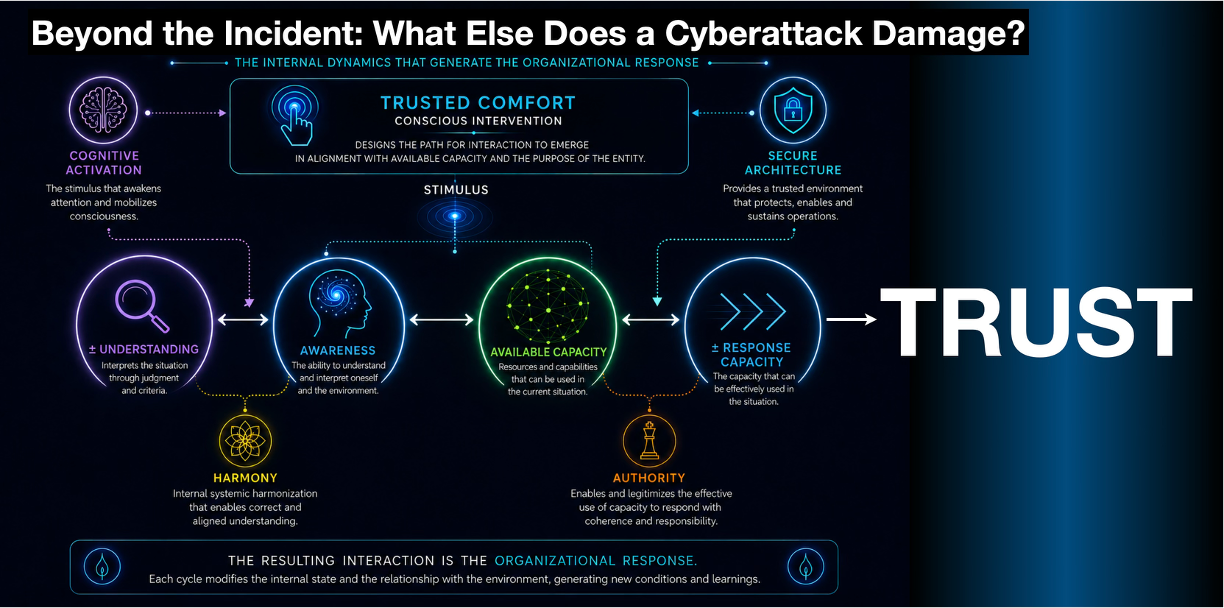
Trust depends on the organizational response, not on the incident itself.
But what do we really mean by organizational response?
It is often associated only with incident containment and system recovery. In reality, those are only part of the response.
Organizational response is the way an organization manages its interaction with its immediate environment. That interaction never stops. A crisis simply changes the conditions under which it must continue.
When available capacity is reduced, the organization must adapt the way it interacts with customers, employees, suppliers, investors, regulators, and the broader market. Recovering systems is essential, but so is preserving trust, honoring the commitments that can still be fulfilled, communicating transparently, and maintaining the legitimacy of its decisions.
In other words, organizational response is not only about restoring operations. It is about preserving a coherent relationship with the environment while circumstances change.
No organization is immune to crisis. What remains under its control is how it chooses to respond. Every message, every silence, every commitment made—and every commitment fulfilled—either strengthens or weakens a trust that may have taken years to build.
Ultimately, organizations are remembered not only for the crises they faced, but for the way they responded to them.
1 reactions · 0 comments