Posted in GRC
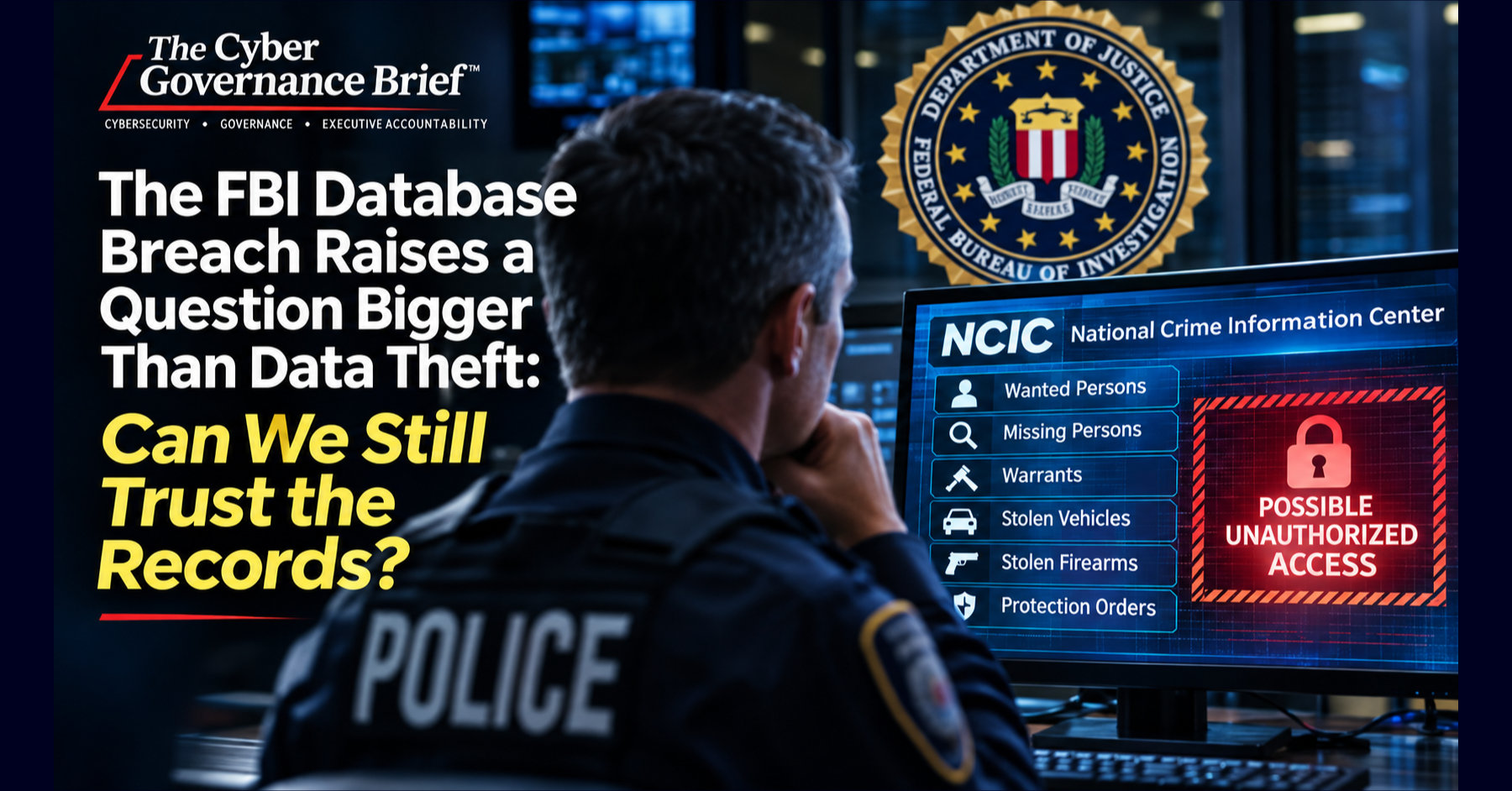
The FBI Database Breach Raises a Question Bigger Than Data Theft: Can We Still Trust the Records?
Victor Font — Keynote Speaker | Strategic Technology Leader | Fractional CIO | IT & Cyber Governance Expert | Published Author | FedRAMP Readiness | Board-Level Advisor | Digital Transformation | Enterprise WordPress/Formidable Forms
A police officer runs a routine database check during a traffic stop. The system responds with information about an outstanding warrant. The officer acts on that information.
But what happens if the database itself has been compromised?
That question has become particularly relevant following reports that the FBI is investigating an apparent intrusion involving the National Crime Information Center (NCIC), one of the most consequential information-sharing systems in American law enforcement.
According to reporting from CNN, BleepingComputer, and the Associated Press, the FBI is investigating an apparent compromise of the system. ABC News subsequently reported that a law enforcement source confirmed the hack.
The scope remains unknown. There has been no public determination of how the attackers gained access, what information they may have obtained, or whether any records were altered.
Those distinctions matter.
The National Crime Information Center Is Not an Ordinary Database
NCIC supports federal, state, and local law enforcement agencies across the United States.
It contains information involving wanted persons, missing individuals, outstanding warrants, stolen vehicles, stolen firearms, protection orders, and other criminal justice matters.
Officers and investigators depend on this information to make operational decisions, sometimes under circumstances where seconds matter.
A database like NCIC is more than an information repository. It is part of the nation's operational decision-making infrastructure.
Its value depends on three essential security properties:
Confidentiality: Sensitive information must remain protected from unauthorized disclosure.
Integrity: Records must remain accurate, complete, and protected against unauthorized modification.
Availability: Authorized personnel must be able to retrieve information when operationally necessary.
Most public discussions of cybersecurity breaches focus on confidentiality.
What information was stolen? How many records were exposed? Who might receive the stolen data?
Those are legitimate questions.
But for systems that influence consequential decisions, integrity may represent an equally serious concern.
A Database Can Be Available and Still Be Dangerous
Consider a hypothetical scenario.
An attacker gains unauthorized access to a criminal justice information system and modifies an existing warrant record.
The database remains online. Authentication works. Queries return results. Monitoring dashboards report normal system availability.
Nothing appears broken.
Yet an officer relying on the altered information could make a decision based on a record that is no longer authoritative.
The consequences could extend well beyond an inaccurate database entry.
A legitimate warrant could disappear from view. An innocent individual could appear to be wanted. A stolen firearm record could be altered. Investigators could receive information that misdirects an active investigation.
There is currently no public evidence establishing that any of these scenarios occurred in the reported NCIC incident.
They illustrate why data integrity must be treated as a separate assurance requirement rather than an assumed consequence of system availability.
Restoring Access Is Not the Same as Restoring Trust
Traditional incident response concentrates on containment, eradication, and recovery.
Identify the intrusion. Remove unauthorized access. Close the vulnerability. Restore affected services.
That sequence is necessary, but it may be insufficient when the integrity of authoritative information is uncertain.
Once an attacker potentially gains the ability to modify records, restoring the application does not automatically establish that its information can be trusted.
The organization must answer additional questions.
Which records were accessible during the suspected intrusion?
Could unauthorized changes have occurred?
Are transaction histories sufficiently complete and protected to establish what changed?
Can current records be independently reconciled against authoritative source systems?
Can investigators distinguish legitimate updates from malicious modifications?
And perhaps most importantly, who has the authority to determine that the information is sufficiently trustworthy for operational use?
These are governance questions supported by technical evidence.
They cannot be resolved simply by declaring the infrastructure operational.
The Evidence Problem Behind the Security Problem
This is where cybersecurity governance must move beyond control implementation.
A security policy may require access controls, audit logging, privileged account monitoring, and incident response procedures.
Those controls establish expectations.
They do not, by themselves, prove that information remained trustworthy throughout a security incident.
An organization needs evidence capable of supporting that conclusion.
That includes protected transaction histories, independent integrity checks, authoritative record reconciliation, documented incident decisions, and verifiable recovery procedures.
It also requires preserving the evidence necessary to reconstruct what happened without depending entirely on systems that may themselves have been compromised.
This is the distinction between maintaining security documentation and establishing defensible assurance.
A system may have passed its most recent security assessment and still experience an intrusion.
The governance question is whether the organization can demonstrate what remained protected, what became uncertain, and what evidence supports its recovery decisions.
The Accountability Problem Extends Beyond the FBI
NCIC illustrates a challenge common to interconnected enterprise systems.
One organization operates a critical information service. Numerous other organizations depend on its outputs.
Those downstream organizations may have little visibility into the security conditions under which the information was produced, maintained, or recovered.
Yet they remain responsible for decisions made using that information.
The same dependency exists in financial services, healthcare, transportation, utilities, and enterprise AI systems.
A hospital relies on externally supplied clinical information.
A financial institution relies on third-party identity verification.
An airline relies on shared operational data.
An AI agent retrieves information from an enterprise knowledge repository and uses it to recommend or execute actions.
In each case, the receiving organization may inherit the consequences of information it did not independently verify.
The resulting governance challenge is not simply whether the external provider has adequate security controls.
It is whether the consuming organization understands the assurance supporting the information it trusts.
Five Questions Every Critical-System Owner Should Be Able to Answer
The reported NCIC incident provides an opportunity for boards, executives, and security leaders to examine their own information dependencies.
1. Which systems contain information that directly influences consequential decisions?
Not all databases carry equal operational risk. Systems supporting safety, legal authority, financial transactions, or critical infrastructure require particular attention.
2. How would we detect unauthorized changes to authoritative records?
Access monitoring is not the same as integrity verification. Organizations need mechanisms capable of detecting unexpected modifications and supporting independent reconciliation.
3. Can we establish the integrity of information after an intrusion?
Recovery planning should address not only restoring applications and infrastructure but also validating the information those systems contain.
4. Who decides when compromised information can be trusted again?
That decision should involve explicitly assigned authority, documented acceptance criteria, and evidence supporting the determination.
5. What happens when an external information provider cannot establish integrity?
Organizations need contingency procedures for operating when a trusted information source becomes unavailable or its accuracy cannot be established.
These questions should be answered before an incident, not improvised during one.
The Governance Standard Must Change
Cybersecurity programs have spent decades improving their ability to prevent unauthorized access, detect suspicious activity, and restore disrupted services.
Those capabilities remain essential.
But organizations increasingly depend on interconnected information systems whose outputs influence decisions across institutional boundaries.
That dependency creates an additional obligation: establishing whether the information itself remains trustworthy.
The reported FBI investigation is still developing. We do not yet know the extent of the intrusion or whether NCIC records were accessed, stolen, or modified.
It would be irresponsible to claim otherwise.
Nevertheless, the incident raises a question that every organization operating a consequential information system should already be prepared to answer.
When a trusted database is compromised, who has the authority—and the evidence—to declare its information trustworthy again?
Because restoring a system is a technical achievement.
Restoring justified trust in its information is a governance responsibility.
Sources: BleepingComputer, November 21, 2026; Associated Press, November 21, 2026; ABC News, November 21, 2026.
#CybersecurityGovernance #DataIntegrity #IncidentResponse #CyberResilience #RiskManagement #DigitalTrust #ExecutiveAccountability #Cybersecurity
2 reactions · 0 comments
Topics: #digitaltrust, #incidentresponse, #cybersecuritygovernance, #executiveaccountability, #dataintegrity, #cybersecurity, #cyberresilience, #riskmanagement