Posted in GRC
Cybersecurity Needs Standing Orders: Lessons From the Early Days of Paramedicine
Victor Font — Keynote Speaker | Strategic Technology Leader | Fractional CIO | IT & Cyber Governance Expert | Published Author | FedRAMP Readiness | Board-Level Advisor | Digital Transformation | Enterprise WordPress/Formidable Forms
Nearly fifty years ago, I was among New Jersey's early paramedics.
We were trained to perform lifesaving interventions, but knowing what needed to be done didn't necessarily mean we had the authority to act. We often needed authorization from an emergency department physician before proceeding.
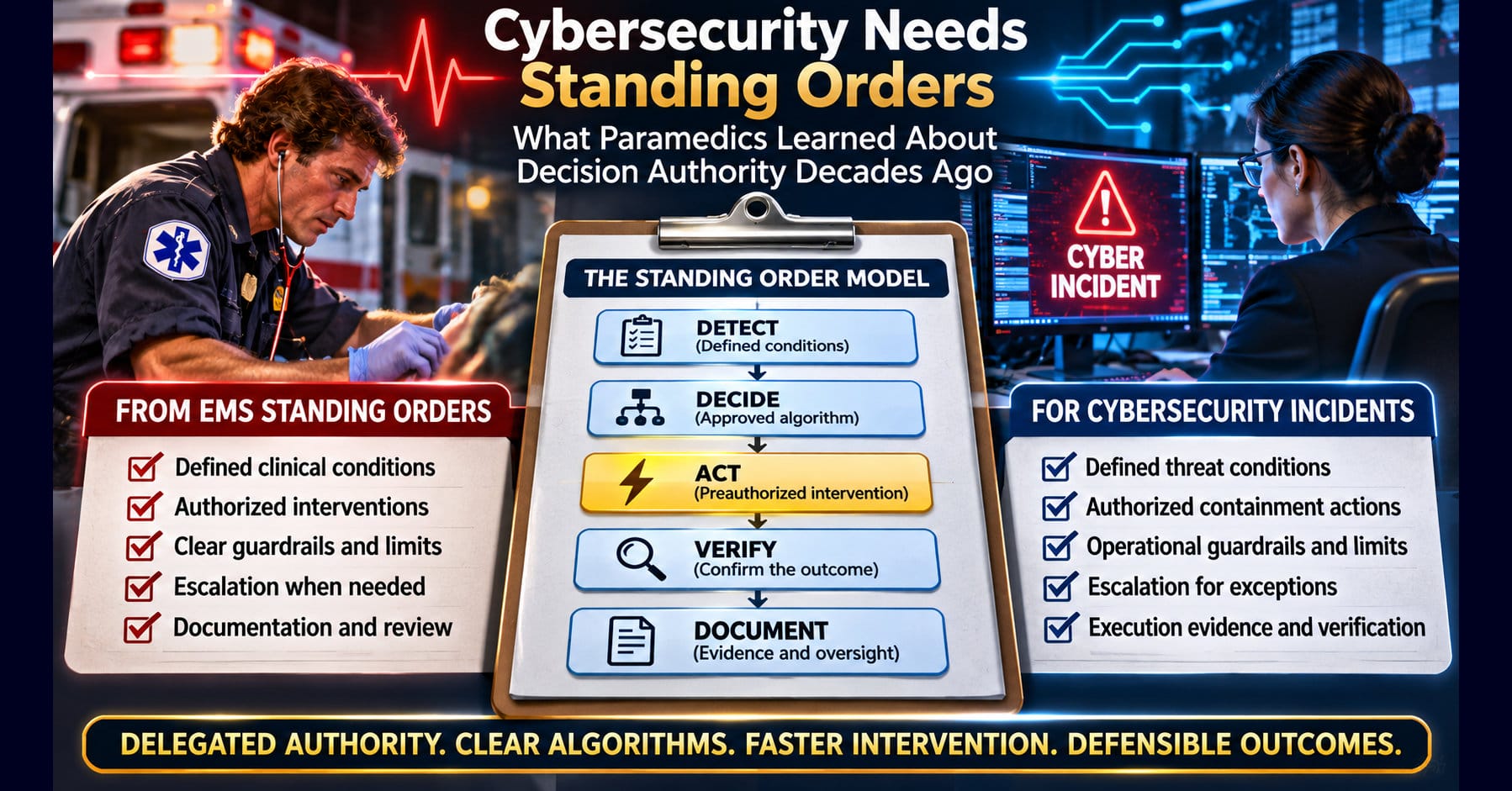
As emergency medical services matured, standing orders changed that.
Medical directors established protocols that allowed qualified paramedics to intervene under predefined conditions, with explicit guardrails and continued medical oversight.
The authority wasn't eliminated. It was delegated in advance.
Cybersecurity faces a remarkably similar problem today.
Security teams can detect an attack and know how to stop it, yet lose critical time obtaining authorization.
In this Cyber Brief, I explore how standing orders can become a governance model for cybersecurity incident response and autonomous AI agents.
The time to authorize a foreseeable emergency intervention is before the emergency makes authorization the obstacle.
https://cybergovernancecenter.com/cybersecurity-standing-orders-incident-response/
2 reactions · 1 comments
Comments
Victor Font: Here's the distinction I want boards to consider: Preauthorized intervention is not the absence of governance. It is governance designed to operate at the speed of an emergency. When paramedics began working under standing orders, medical oversight didn't disappear. It became embedded in protocols defining when to act, what interventions were permitted, and when additional authorization was requir