Most API security issues don’t take weeks to find. They show up much earlier. In many assessments I’ve…
Damian K. — Penetration Tester / Offensive Security Engineer
Most API security issues don’t take weeks to find.
They show up much earlier.
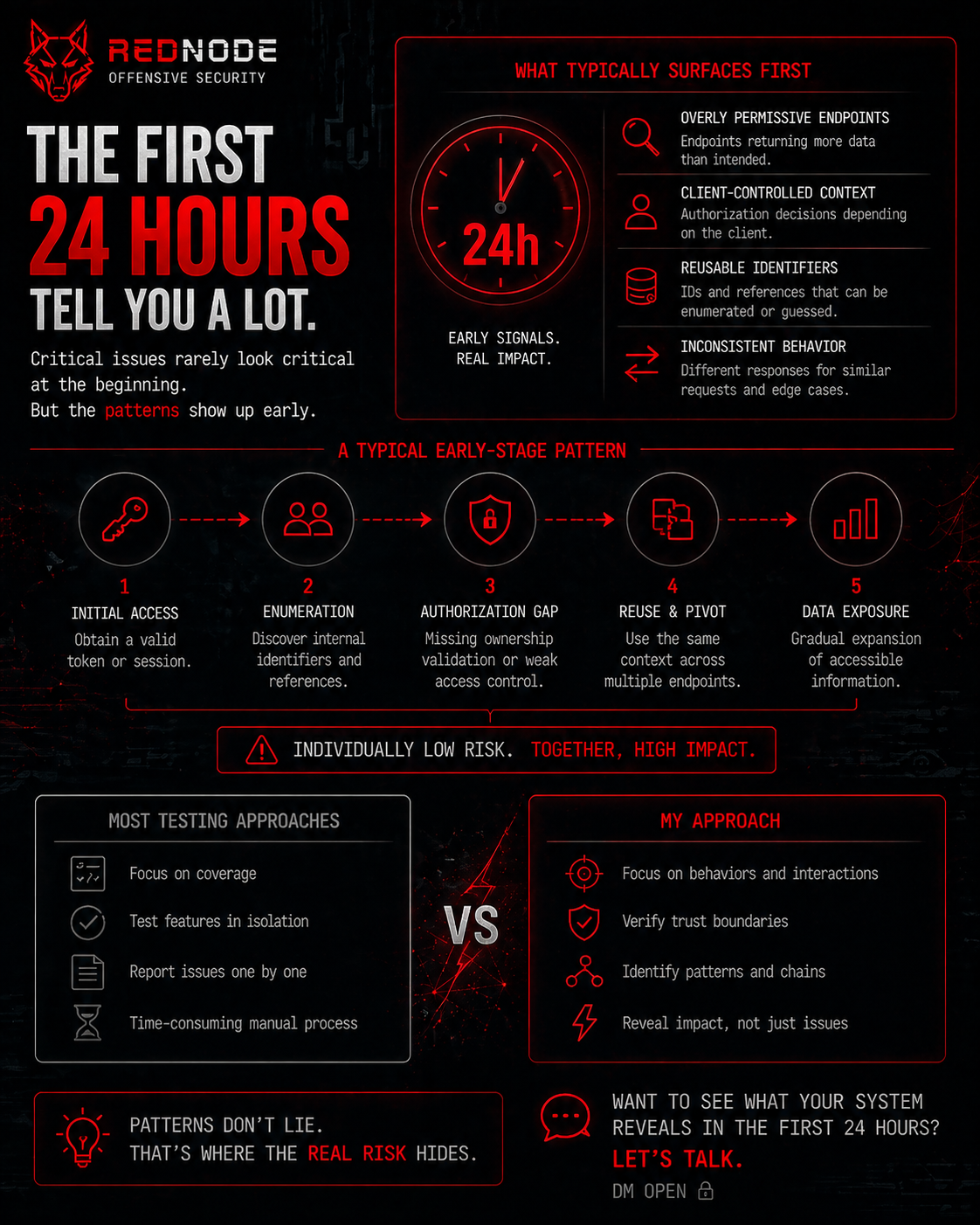
In many assessments I’ve worked on, the first 24 hours already reveal patterns like:
• identifiers that shouldn’t be reusable… but are
• endpoints returning more data than intended
• authorization checks that depend on the client
• inconsistent behavior across similar requests
Nothing “critical” at first glance.
But enough to ask one important question:
What happens if these pieces connect?
A typical early-stage pattern:
→ initial valid access
→ ability to enumerate internal references
→ missing ownership validation
→ reuse across multiple endpoints
From there, it’s usually not about finding new issues…
…it’s about following the path.
That’s why early signals matter:
They don’t tell you what is broken.
They tell you where to look deeper.
Most testing focuses on coverage.
I focus on:
• interaction between components
• trust boundaries
• context consistency
• how systems behave under slight deviation
Because in modern architectures,
critical issues rarely appear as a single obvious flaw.
They emerge from patterns.
If you’ve never looked at your API from this angle,
there’s a good chance the first 24 hours would already uncover something interesting.
2 reactions · 0 comments