Posted in Application Security
Five bugs in ITriage 0.10.1, and the pattern behind them ITriage is my open-source IT triage and repair tool…
jp101216 — Security Engineer | Offensive Security Research & Custom C2 Tooling
Five bugs in ITriage 0.10.1, and the pattern behind them
ITriage is my open-source IT triage and repair tool (Rust, Windows and Linux). A review of 0.10.1 found five bugs, fixed in v0.10.2. None were security bugs. Four of them had the same cause: code that was right for the input its author pictured, then used for another.
1. A version parser built for Windows, used on Linux packages
Versions were split into runs of digits, which works for 24.2.0.187. Debian and Arch put an epoch first: 2:3.8.2. The 2 was read as the major version, so a site profile's min_version = "3.8" failed an up-to-date package. An epoch now counts only when both versions have one. Checked against a real Ubuntu 24.04 package database: bison 2:3.8.2 failed before and passes now.
2. A character allowed for IPv6, accepted everywhere
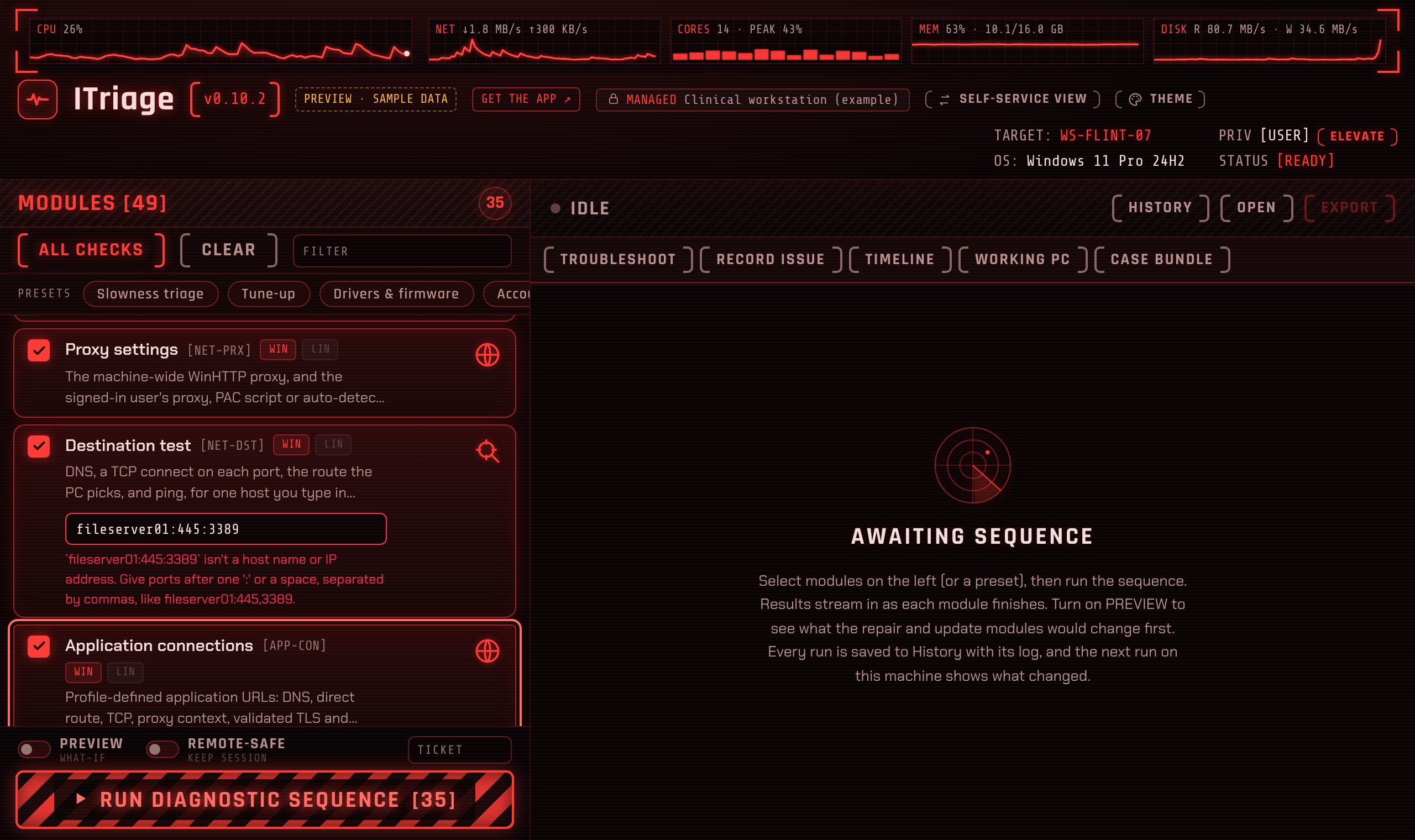
The destination field allowed ':' so IPv6 addresses would pass. So did fileserver01:445:3389, ports joined with colons, which became a host name tried on the default ports. A character allowed for one case now has to make sense in that case: anything with ':' or '%' must parse as IPv6. It wasn't exploitable, since a typed host only reaches name resolution, a socket and ping as a plain argument, never a shell. But an allowlist of characters isn't a grammar.
3. An uptime formatter used for time limits
"Nd Nh Nm" suits uptime. Reused for a 30-second limit on klist or netsh, it said "stopped after 0m".
4. A headline built from the first item, severity from the worst
The likely-cause line took its severity from the worst drive and its name from the first. One message, two rules. Both now come from the same drive.
The fifth was a parser that expected one row per line. dnf check-update wraps a row onto a second, indented line when a package name is too long for its column, and those updates weren't counted.
Each fix has a regression test: 352 core tests on Linux, 345 on Windows and 20 in a browser.
Still true: no run on a real clinical workstation or a domain yet, and the Windows installers are unsigned. Signing is built into the release pipeline but not switched on.
Release notes: https://github.com/jp101216/ITriage/releases/tag/v0.10.2
(Screenshot is the app's sample data.)
3 reactions · 0 comments