Posted in Security Operations
Your Cybersecurity Remediation Is Complete. But Is the Risk Gone?
Victor Font — Keynote Speaker | Strategic Technology Leader | Fractional CIO | IT & Cyber Governance Expert | Published Author | FedRAMP Readiness | Board-Level Advisor | Digital Transformation | Enterprise WordPress/Formidable Forms
Why Closing a Ticket Is Not the Same as Verifying an Outcome
A critical vulnerability is discovered in a business-essential application.
The security team opens a remediation ticket.
IT assigns an engineer.
A patch is applied.
The engineer updates the ticket.
The vulnerability management system records the issue as resolved.
The dashboard turns green.
Management receives a report showing another successful remediation.
Everyone moves on.
But there is a question nobody has answered.
Did the corrective action actually eliminate the exposure the organization intended to address?
Perhaps the patch was installed on the wrong server.
Perhaps the vulnerable component remains active in another environment.
Perhaps a configuration dependency prevented the remediation from taking effect.
Perhaps the vulnerability scanner no longer detects the issue, but the underlying attack path remains available through a different mechanism.
The organization has evidence that work was performed.
It may not have evidence that the intended security outcome was achieved.
This distinction reveals a fundamental weakness in cybersecurity governance.
Activity completion is not outcome verification.
The Administrative Definition of Success
Enterprise cybersecurity programs depend on workflow systems.
Vulnerability management platforms track remediation assignments.
IT service management systems document changes.
Security operations platforms record investigations.
Governance, risk, and compliance applications maintain control assessments and exception registers.
These systems are essential to coordinating work across complex organizations.
But they also encourage a particular definition of success.
A task is assigned.
Someone completes it.
The status changes.
The workflow closes.
The organization records progress.
That process may establish that a required activity occurred.
It does not necessarily establish that the activity produced the intended result.
Consider a security control requiring multifactor authentication for privileged accounts.
IT implements the configuration.
The project is marked complete.
Compliance records the control as implemented.
Six months later, an assessment discovers that several privileged service accounts remain outside the enforcement boundary.
Was the implementation completed?
According to the project record, yes.
Was the security objective fully achieved?
No.
The difference is not trivial.
It is the difference between demonstrating that an organization performed an activity and demonstrating that the activity achieved its intended purpose.
The Three Layers of Cybersecurity Evidence
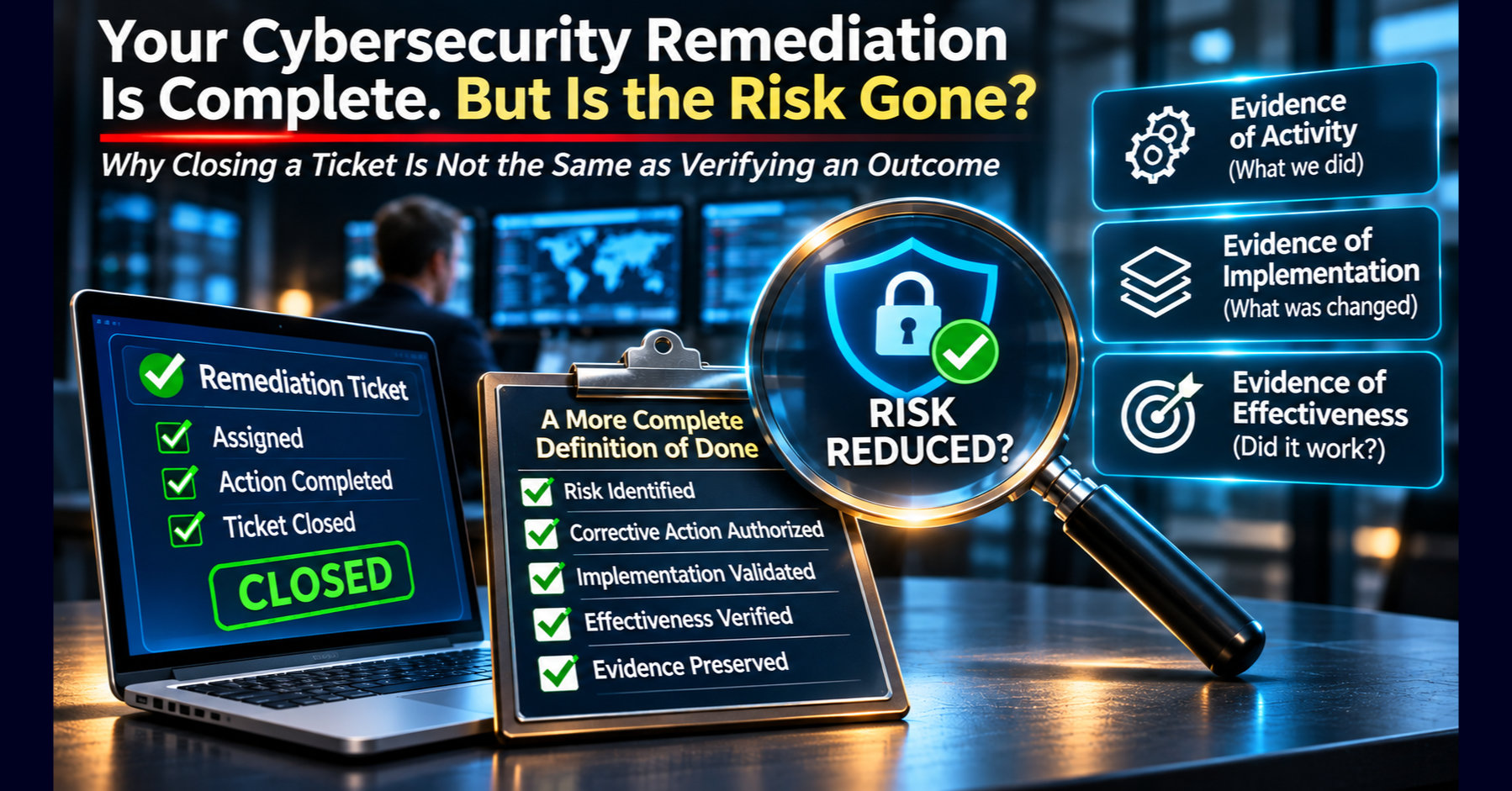
A more defensible approach distinguishes among three categories of evidence.
1. Evidence of activity
This establishes that an action was performed.
Examples include change records, configuration updates, remediation tickets, deployment logs, and completed project tasks.
Activity evidence answers:
What did we do?
2. Evidence of implementation
This establishes that the required control, configuration, or corrective measure exists in the intended environment.
Examples include configuration inspections, deployment validation, asset coverage assessments, and technical control testing.
Implementation evidence answers:
Was the required change actually put in place?
3. Evidence of effectiveness
This establishes whether the implemented measure achieved its intended security objective under the conditions being evaluated.
Examples include vulnerability rescanning, penetration testing, control effectiveness assessments, attack-path validation, and independently verified remediation outcomes.
Effectiveness evidence answers:
Did the change produce the result we needed?
These categories are related, but they are not interchangeable.
A completed change ticket is not proof of effective remediation.
An installed security product is not proof of adequate protection.
A documented policy is not proof that the required behavior occurs.
And a green dashboard indicator is not proof that the underlying risk has been reduced to an acceptable level.
The evidence must match the claim the organization is making.
When Remediation Metrics Become Misleading
Suppose an executive dashboard reports that 98% of critical vulnerabilities were remediated within the established service-level agreement.
That appears to be excellent performance.
But what does the metric actually measure?
Does it count tickets closed?
Does it count patches deployed?
Does it count vulnerabilities that disappeared from subsequent scans?
Does it verify that the affected assets were included in the validation process?
Does it account for systems excluded from scanning?
Does it distinguish between vulnerabilities that were eliminated and vulnerabilities that were merely reclassified or accepted?
Without understanding the underlying measurement criteria, leadership may interpret an administrative completion rate as evidence of reduced cybersecurity exposure.
That creates a dangerous form of governance assurance.
The organization believes it has measured risk reduction when it has actually measured workflow throughput.
A remediation percentage is only as meaningful as the verification criteria behind it.
This is not an argument against performance metrics.
It is an argument for measuring what matters.
The Problem of Unverified Assumptions
Many cybersecurity failures involve controls that were believed to exist or operate effectively.
A backup system was configured but restoration had not been tested.
An endpoint protection platform was deployed but significant portions of the environment were not reporting.
A network segmentation project was completed but undocumented connections remained.
An access review was certified but excessive permissions were never removed.
A third-party remediation plan was accepted but the supplier's corrective actions were not independently verified.
In each case, the organization may possess documentation demonstrating that someone performed an assigned task.
What it lacks is sufficient evidence that the expected control outcome was achieved.
This is where operational weaknesses become governance weaknesses.
Executives make decisions based on reported control status.
Risk committees rely on those reports.
Boards receive summaries derived from the same information.
If the underlying evidence establishes activity rather than effectiveness, the entire reporting chain may inherit an unsupported assumption.
The problem grows more consequential as that information moves upward through the organization.
An unverified operational claim does not become reliable simply because it appears in an executive presentation.
Verification Must Be Designed Into the Workflow
Organizations frequently treat verification as a separate activity performed after remediation.
Sometimes it happens.
Sometimes it is deferred.
Sometimes the original ticket is closed before verification occurs.
And sometimes the organization assumes that implementation itself constitutes sufficient evidence.
A more mature approach makes verification an explicit part of the remediation lifecycle.
The process should establish:
The intended outcome. What specific risk condition must change?
The required corrective action. What work must be performed to produce that change?
The verification method. How will the organization determine whether the intended result occurred?
The verification authority. Who is responsible for evaluating and accepting the evidence?
The exception pathway. What happens if the corrective action is incomplete or ineffective?
The retained evidence. What records demonstrate the result and support subsequent review?
These elements should be established when remediation is assigned—not improvised when someone questions whether the work was successful.
The objective is to prevent administrative closure from becoming a substitute for demonstrated risk reduction.
Evidentiary Architecture™ Closes the Verification Gap
This distinction between activity and outcome is central to Evidentiary Architecture™.
Traditional workflow systems are often optimized to track assignments, approvals, and completion.
Evidentiary Architecture™ connects those records to the governance decisions and verified outcomes they are intended to support.
The resulting evidence chain follows a more complete sequence:
Risk identified → Corrective action authorized → Responsibility assigned → Action executed → Implementation validated → Effectiveness verified → Evidence preserved.
Each stage establishes a different fact.
Authorization demonstrates that an appropriate decision was made.
Assignment establishes responsibility.
Execution demonstrates that work occurred.
Implementation validation establishes that the required change was made.
Effectiveness verification provides evidence that the intended security objective was achieved.
Evidence preservation makes the result available for oversight, reassessment, and future investigation.
The distinction matters because cybersecurity governance should not depend on unsupported assertions that controls are working.
It should rely on evidence appropriate to the assurance being claimed.
Who Should Verify the Result?
An important question arises when the same team that performs remediation also declares it successful.
There is nothing inherently improper about operational teams validating their own work.
In many circumstances, automated testing and routine technical verification are both appropriate and efficient.
But the level of assurance should reflect the significance of the risk.
A routine workstation configuration change may require automated validation.
A critical vulnerability affecting a revenue-generating platform may justify additional technical review.
A material control deficiency involving regulated information may warrant independent assurance.
The objective is not to require external auditors for every corrective action.
It is to establish verification requirements proportionate to the consequences of failure.
The greater the potential business impact, the stronger the evidence required to support the claim that the risk has been addressed.
That principle should inform the organization's control assurance model.
The Boardroom Implication
Boards do not need to examine individual remediation tickets.
They do need to understand whether management distinguishes between corrective actions completed and corrective outcomes verified.
Consider two executive reports.
The first states:
"All critical remediation actions scheduled for this quarter have been completed."
The second states:
"All scheduled critical remediation actions have been completed. Independent validation confirmed effectiveness for 92%, while the remaining 8% require additional corrective work or verification."
The first report presents administrative completion.
The second provides a more meaningful picture of actual assurance.
Neither report should be interpreted without understanding scope, testing methods, and residual risk.
But the second acknowledges that completing work and establishing effectiveness are different management responsibilities.
That distinction can materially improve executive decision-making.
Boards should seek assurance that management has established verification criteria, appropriate independence, exception handling, and reliable reporting.
These are governance requirements, not merely technical testing preferences.
A Better Definition of Done
Software development teams have long used the concept of a "definition of done" to establish when work can legitimately be considered complete.
Cybersecurity governance needs a similarly disciplined approach.
For material corrective actions, completion should not mean that someone checked a box.
It should mean that the organization can demonstrate the required work occurred, the intended control was implemented, the result was appropriately verified, and any remaining exposure was identified and governed.
That does not mean every risk can be eliminated.
Some risks must be reduced, transferred, avoided, or formally accepted.
But the organization should be precise about which outcome it achieved.
A vulnerability that has been accepted is not a vulnerability that has been remediated.
A control that has been deployed is not necessarily a control that has been proven effective.
A completed action is not automatically a resolved risk.
These distinctions should be visible in governance reporting.
The Question That Changes the Conversation
At your next cybersecurity leadership meeting, select one recently closed critical remediation item.
Ask the team to show the original risk condition.
Then examine the corrective action, implementation evidence, verification method, and final outcome.
Can the organization demonstrate that the intended risk reduction occurred?
Or can it demonstrate only that someone completed the assigned work?
That single exercise may reveal more about the maturity of the cybersecurity governance program than another dashboard review.
Because the purpose of remediation is not to close tickets.
It is to change the organization's exposure to risk.
Cybersecurity governance becomes defensible when the organization can prove not only that it acted, but that its actions achieved the outcomes leadership was told to expect.
Discussion
How does your organization determine when a cybersecurity remediation is genuinely complete?
Is closure based on the completion of assigned work, or does it require evidence that the intended security outcome was achieved?
#CybersecurityGovernance #CyberRisk #ControlEffectiveness #RiskManagement #ExecutiveAccountability #SecurityAssurance #GRC #EvidentiaryArchitecture
1 reactions · 0 comments
Topics: #cyberrisk, #controleffectiveness, #cybersecuritygovernance, #executiveaccountability, #evidentiaryarchitecture, #riskmanagement, #grc, #securityassurance