Posted in Threat Intelligence
📢 Shared from Cybersecurity Governance & Executive Accountability Your CISO Says the Risk Is Critical. Your…
Victor Font — Keynote Speaker | Strategic Technology Leader | Fractional CIO | IT & Cyber Governance Expert | Published Author | FedRAMP Readiness | Board-Level Advisor | Digital Transformation | Enterprise WordPress/Formidable Forms
📢 Shared from Cybersecurity Governance & Executive Accountability
Your CISO Says the Risk Is Critical. Your CFO Asks, "How Much Will It Cost Us?"
Cybersecurity Governance & Executive Accountability | Governance in Practice
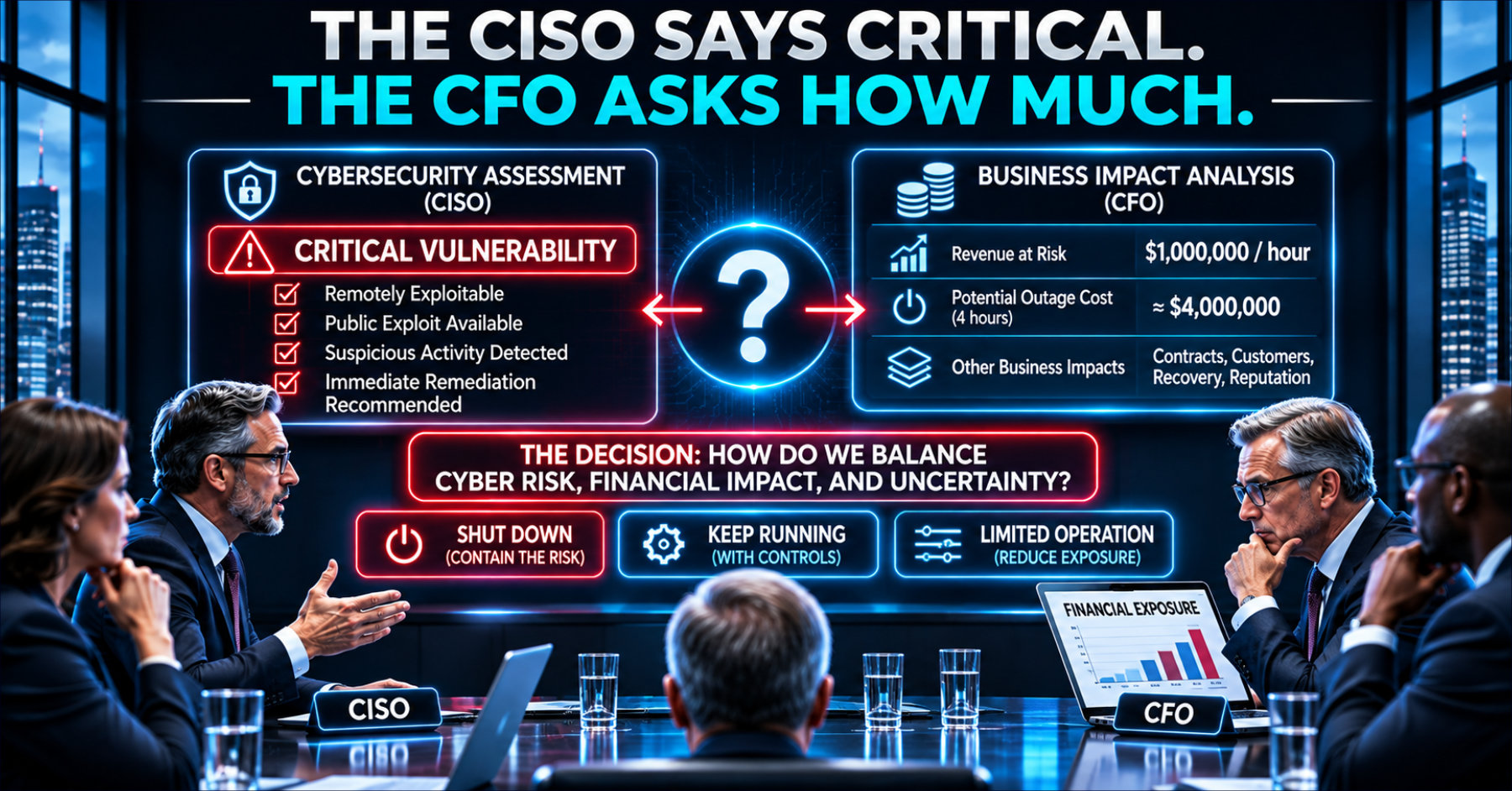
The CISO enters an executive meeting with an urgent warning.
A critical vulnerability has been discovered in an application supporting a major business operation.
The security team recommends immediate remediation, potentially requiring a temporary shutdown.
The CFO asks a reasonable question.
"What is the financial exposure if we keep operating?"
The CISO responds that the vulnerability has a critical severity rating.
The CFO asks again.
"I understand that. But how much could this cost us?"
The CISO explains the potential for unauthorized access, data theft, operational disruption, and regulatory consequences.
The CFO wants numbers.
The business executive wants to know how much revenue will be lost if the application goes offline.
The CIO wants to know whether compensating controls could reduce the exposure.
Everyone is asking legitimate questions.
But the organization has a problem.
It has classified the technical severity of the vulnerability without adequately quantifying the business risk associated with the decision.
And those are not the same thing.
A Critical Vulnerability Is Not Automatically a Critical Business Risk
Security teams routinely use vulnerability severity ratings to prioritize remediation.
These ratings are useful.
They describe technical characteristics such as exploitability and potential impacts on confidentiality, integrity, and availability.
But a vulnerability's technical severity does not independently establish its financial consequences for a particular organization.
A critical vulnerability affecting an isolated test environment may create limited business exposure.
The same vulnerability affecting an internet-facing payment platform may create substantial exposure.
A vulnerability affecting a safety-critical industrial system may introduce consequences that cannot be adequately represented by financial loss alone.
The business context matters.
So do existing controls, attacker capabilities, exposure pathways, and the organization's ability to detect and contain exploitation.
Technical severity helps explain what could happen. Business risk analysis helps determine what those consequences mean to the enterprise.
The distinction becomes essential when executives must choose among competing responses.
The CFO Is Asking the Right Question—but May Be Expecting the Wrong Kind of Answer
Suppose the application generates $1 million in revenue every hour.
Taking it offline for four hours could interrupt $4 million in transactions.
But that does not necessarily mean the organization would lose $4 million.
Some transactions may be delayed rather than permanently lost.
Some revenue may be recovered.
Other consequences may include contractual penalties, customer dissatisfaction, operational recovery costs, or downstream disruptions.
The organization must distinguish between revenue interrupted, revenue permanently lost, and total business impact.
Now consider the cybersecurity exposure.
What is the probability of successful exploitation during the period of continued operation?
What losses could result?
How effective are the existing controls?
What would an attacker be able to access?
How long might compromise remain undetected?
What are the plausible consequences for customers, operations, regulatory obligations, and reputation?
These questions rarely produce a single indisputable number.
But they can produce a structured assessment of uncertainty and potential loss.
The objective of risk quantification is not to manufacture precision. It is to improve the quality of decisions made under uncertainty.
A $1,000 Risk Estimate Can Be More Dangerous Than No Estimate
Imagine that management receives the following analysis.
The application generates $1 million per hour.
A four-hour shutdown could interrupt $4 million in transactions.
The estimated cybersecurity exposure from continuing operations is $1,000.
The financial comparison appears straightforward.
Keep the application running.
But what does the $1,000 represent?
Is it the expected loss over the next four hours?
Is it an annualized estimate?
Does it include only direct remediation expenses?
Does it account for potential data compromise?
Does it consider the probability of exploitation?
Does it incorporate the possibility of a severe but less likely event?
And what assumptions support the estimate?
Without answers, the number may create false confidence.
A low expected loss does not necessarily mean the potential consequences are insignificant.
For example, an event with a low probability but catastrophic consequences may have a modest expected value while still exceeding the organization's tolerance for severe outcomes.
Risk quantification must communicate both estimated exposure and the uncertainty surrounding that estimate.
Otherwise, executives may mistake a calculated number for a reliable boundary on potential loss.
The Decision Requires Comparable Alternatives
The organization should not evaluate only the cost of shutting down the application against the cost of a possible cyberattack.
It should evaluate feasible treatment alternatives.
Consider three options.
Option A — Immediate shutdown
Suspend the application, contain the exposure, remediate the vulnerability, and restore service after appropriate verification.
Potential consequences include interrupted operations, recovery costs, contractual impacts, and customer disruption.
Option B — Continued operation with compensating controls
Maintain service while restricting network access, reducing privileges, increasing monitoring, or implementing other verified safeguards.
Potential consequences include implementation costs, residual cybersecurity exposure, and the possibility that the controls prove insufficient.
Option C — Limited or degraded operation
Restrict high-risk functionality while preserving essential business services.
Potential consequences include reduced revenue, operational complexity, and a different residual exposure profile.
Each option carries costs and risks.
The decision should compare them over a consistent time horizon, using reasonable assumptions and an understanding of uncertainty.
Some consequences may also impose hard constraints.
A legally prohibited activity cannot simply be justified by showing that it is profitable.
Likewise, a safety-critical exposure may require protective action even when the expected financial loss appears relatively small.
A mature governance process evaluates available choices within established risk tolerance and applicable obligations—not merely the cheapest apparent option.
Why Risk Quantification Cannot Begin During the Incident
Here is the deeper governance problem.
Organizations often wait until a critical vulnerability or active incident forces an executive decision before attempting to quantify the business consequences.
That is too late to begin building the necessary foundation.
Meaningful cyber risk quantification depends on information that should already exist.
The organization needs to understand its critical business services, revenue dependencies, operational recovery requirements, data exposure, technology dependencies, and potential loss scenarios.
It also needs a consistent method for evaluating cybersecurity events.
That might include scenario-based analysis, financial impact ranges, probability distributions, or structured methods such as Factor Analysis of Information Risk (FAIR).
No methodology eliminates uncertainty.
But an established approach gives executives a common basis for comparing alternatives.
The purpose of cyber risk quantification is not to predict the next incident perfectly. It is to ensure that the organization can make informed decisions before uncertainty becomes an emergency.
Risk Appetite Must Mean Something Operationally
Many organizations have formally approved risk appetite statements.
They declare that the enterprise has a low appetite for cybersecurity risk.
Or that critical systems must operate within defined tolerances.
Or that management must escalate material exposures.
These statements can be valuable.
But what happens when executives must make a real decision?
How much operational disruption is acceptable to avoid a particular cybersecurity exposure?
What level of potential financial loss requires escalation?
Which consequences cannot be accepted under delegated authority?
What conditions justify emergency containment?
When must an executive reconsider an earlier decision?
If risk appetite cannot inform these questions, it may have limited operational value.
A risk appetite statement that cannot influence a consequential decision is not functioning as an effective governance boundary.
The organization needs to translate broad expectations into decision criteria, delegated authorities, escalation thresholds, and response conditions.
Not every decision can be reduced to a formula.
But executives should not have to invent the organization's risk tolerance during a crisis.
NIST CSF 2.0 and the Business Context of Cybersecurity Risk
The NIST Cybersecurity Framework 2.0 reinforces the importance of connecting cybersecurity risk management to organizational objectives.
Within the GOVERN function, Organizational Context addresses the organization's mission, stakeholders, dependencies, and requirements.
Risk Management Strategy addresses the establishment and use of risk management objectives, appetite, tolerance, and related approaches.
Roles, Responsibilities, and Authorities establish who is accountable for risk management activities and decisions.
These elements are interdependent.
Executives cannot meaningfully evaluate cybersecurity risk without understanding business consequences.
They cannot apply risk tolerance without knowing the organization's expectations.
And they cannot make authorized decisions without defined decision rights.
The framework does not require every cybersecurity exposure to be expressed as a precise dollar amount.
It does, however, support a governance approach in which cybersecurity risk is understood and managed in the context of enterprise objectives.
Cybersecurity risk becomes an executive governance concern when technical exposure must be evaluated against business consequences and organizational obligations.
Evidentiary Architecture™: Can You Defend the Numbers?
There is another dimension to this problem.
Suppose the organization decides to keep the application operational.
Six weeks later, attackers exploit the vulnerability.
A significant incident follows.
The board asks why management accepted the exposure.
Management responds that the estimated cybersecurity loss was substantially lower than the expected cost of interruption.
That explanation raises additional questions.
Where did the estimate originate?
What data supported it?
Which assumptions were used?
What alternatives were evaluated?
Who reviewed the analysis?
What uncertainty was communicated?
Who possessed authority to accept the residual exposure?
And what changed between the original decision and the incident?
This is where Evidentiary Architecture™ becomes particularly relevant.
A defensible governance decision should preserve the relationship between the information considered, the analysis performed, the authority exercised, and the resulting action.
For material cyber risk decisions, that means maintaining traceability across:
- Business context: The critical services, assets, processes, and dependencies involved.
- Risk scenario: The threat event, exposure pathway, and plausible consequences.
- Quantification: The methodology, inputs, assumptions, estimates, and uncertainty.
- Alternatives: The available treatments and their expected operational and financial implications.
- Authority: The individual or body empowered to make the decision.
- Decision record: The selected course of action, rationale, conditions, and required follow-up.
- Verification: Evidence that the selected treatment was implemented and reassessed when necessary.
This does not guarantee that the organization will make the correct decision every time.
It does provide a basis for examining whether the decision was appropriately informed, authorized, and executed.
Defensible risk governance requires more than documenting the final number. It requires preserving the evidence that explains how the number influenced the decision.
The Boardroom Problem With Red, Yellow, and Green
Consider the cybersecurity dashboard presented to the board.
Critical vulnerabilities: Red.
Patch compliance: Yellow.
Security awareness training: Green.
Incident response readiness: Yellow.
These indicators may communicate useful operational information.
But they do not necessarily answer the board's most important risk questions.
What are the plausible business consequences of the organization's most significant cybersecurity exposures?
Which scenarios could exceed enterprise risk tolerance?
How do proposed investments change the exposure?
What operational disruptions might result from different treatment decisions?
And where does management face uncertainty that could materially affect its judgment?
A dashboard can report that an application has a critical vulnerability without explaining whether continued operation creates a $50,000 exposure, a multimillion-dollar exposure, or a plausible catastrophic outcome.
A severity rating is not a substitute for understanding business consequences.
Boards need information that supports oversight of enterprise risk, not simply summaries of technical conditions.
A Practical Test for Your Organization
Select one of your organization's most significant cybersecurity risks.
Ask the CISO to explain the technical exposure.
Ask the CIO to identify the affected systems and feasible treatment options.
Ask the business owner to explain the operational and financial dependencies.
Ask Finance and enterprise risk management to evaluate plausible loss scenarios and uncertainty.
Then ask the authorized decision-maker to explain how the alternatives compare with established risk tolerance.
Finally, ask whether the organization can reconstruct the analysis and decision from preserved evidence.
If the answers are inconsistent, incomplete, or dependent on undocumented assumptions, the problem is larger than risk quantification.
It is a weakness in the governance process connecting technical knowledge to enterprise decisions.
A Question for the Community
Let's return to yesterday's executive dilemma.
A critical application generates $1 million per hour.
The CISO recommends shutting it down because of a remotely exploitable vulnerability.
The business executive opposes interruption.
The CFO asks for a financial comparison.
What minimum information would you require before authorizing continued operation?
Would you insist on a quantified loss estimate?
Would a qualitative assessment supported by credible threat intelligence be sufficient?
Would the presence of active exploitation override the financial comparison?
And who should be accountable for determining whether the analysis is sufficient to support the decision?
I'm especially interested in how CISOs, risk professionals, finance executives, and incident responders approach this problem in practice.
Because the real governance failure is not that cybersecurity risk cannot always be quantified precisely. It is expecting executives to make consequential decisions without an established method for understanding the exposure, uncertainty, and authority involved.
#CybersecurityGovernance #ExecutiveAccountability #CyberRiskQuantification #CISO #GRC #EnterpriseRiskManagement #NISTCSF #EvidentiaryArchitecture
1 reactions · 0 comments
Topics: #ciso, #cybersecuritygovernance, #nistcsf, #executiveaccountability, #cyberriskquantification, #evidentiaryarchitecture, #grc, #enterpriseriskmanagement