Posted in Security Awareness
JPMorgan’s Small Data Leak Exposes a Much Larger Governance Problem
Victor Font — Keynote Speaker | Strategic Technology Leader | Fractional CIO | IT & Cyber Governance Expert | Published Author | FedRAMP Readiness | Board-Level Advisor | Digital Transformation | Enterprise WordPress/Formidable Forms
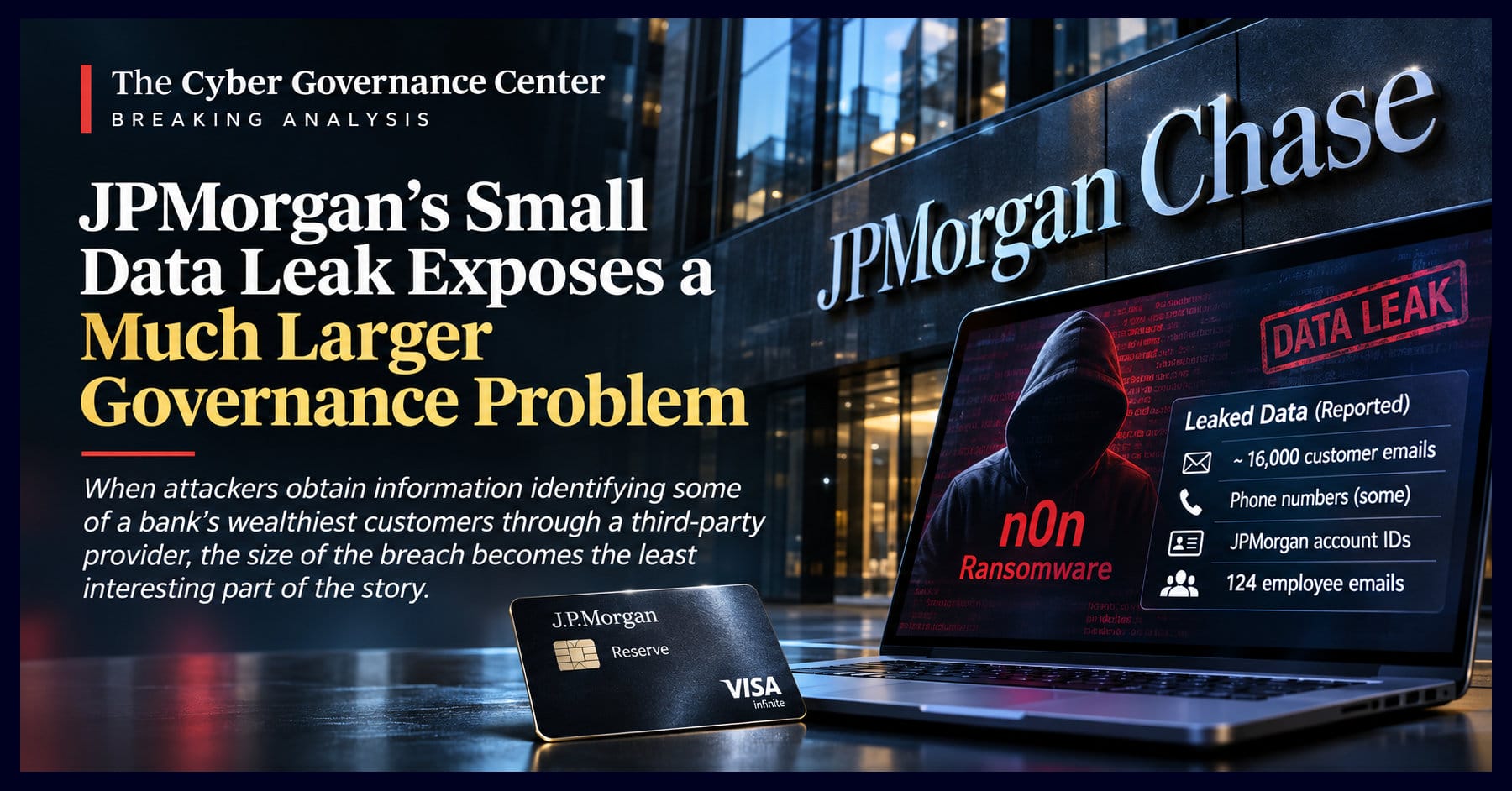
The reported JPMorgan Chase data leak illustrates why cybersecurity incidents cannot be evaluated solely by the number of records exposed. Although the dataset reportedly contains approximately 16,000 customer email addresses, its potential association with high-net-worth banking clients creates a concentrated risk of targeted fraud, impersonation, and social engineering.
The larger governance concern involves third-party accountability. When organizations share sensitive customer information with external providers, they remain responsible for understanding how that information is protected, retained, and handled during a security incident.
This analysis examines why boards must look beyond vendor risk ratings and compliance documentation to demand verifiable evidence of data protection, incident response, and remediation effectiveness.
https://cybergovernancecenter.com/jpmorgan-data-leak-third-party-governance-risks/
4 reactions · 4 comments
Comments
Victor Font: Here's the governance question that concerns me most: If a third-party provider exposed information identifying your organization's most valuable customers, how quickly could management establish exactly what was compromised? Not what the vendor believes was exposed. Not what the contract says should have been protected. What the evidence actually demonstrates. A small dataset can create enormous
Craig M.: Victor Font unfortunately, breaches aren’t the only way personal information becomes exposed. Major social platforms monetise data collected through online tracking, while data brokers sell profiles that can include estimated income and net worth. That commercial data ecosystem creates privacy risks even without a breach. One particularly sad aspect is that people who suddenly acquire wealth, for
Victor Font: Craig Maxwell Craig, that's an important distinction. We've spent years teaching people to protect their information from unauthorized access, while an entire commercial ecosystem profits from collecting, aggregating, and distributing much of that same information through authorized business processes. The resulting exposure can be just as consequential as a breach, particularly when seemingly unr
Craig M.: Victor Font perhaps it's about time organisations offering powerful data collection and targeting tools start to apply the same KYC/KYB and AML checks as financial institutions. This may cut out a lot of the nefarious actors in this domain. . . it almost feels like too much of obvious answer to the problem? At present, personal ID and business verifications do not run deep enough. Clearly.