Posted in Security Operations
Completed 6 Wireshark SOC labs today: identifying an attacker’s IP through traffic analysis Scenario: a…
HOROIHEOMA C. — Cybersecurity Analyst
Completed 6 Wireshark SOC labs today: identifying an attacker’s IP through traffic analysis
Scenario: a staff member reported unusual traffic to the company web server. I captured the packets and investigated.
What I found:
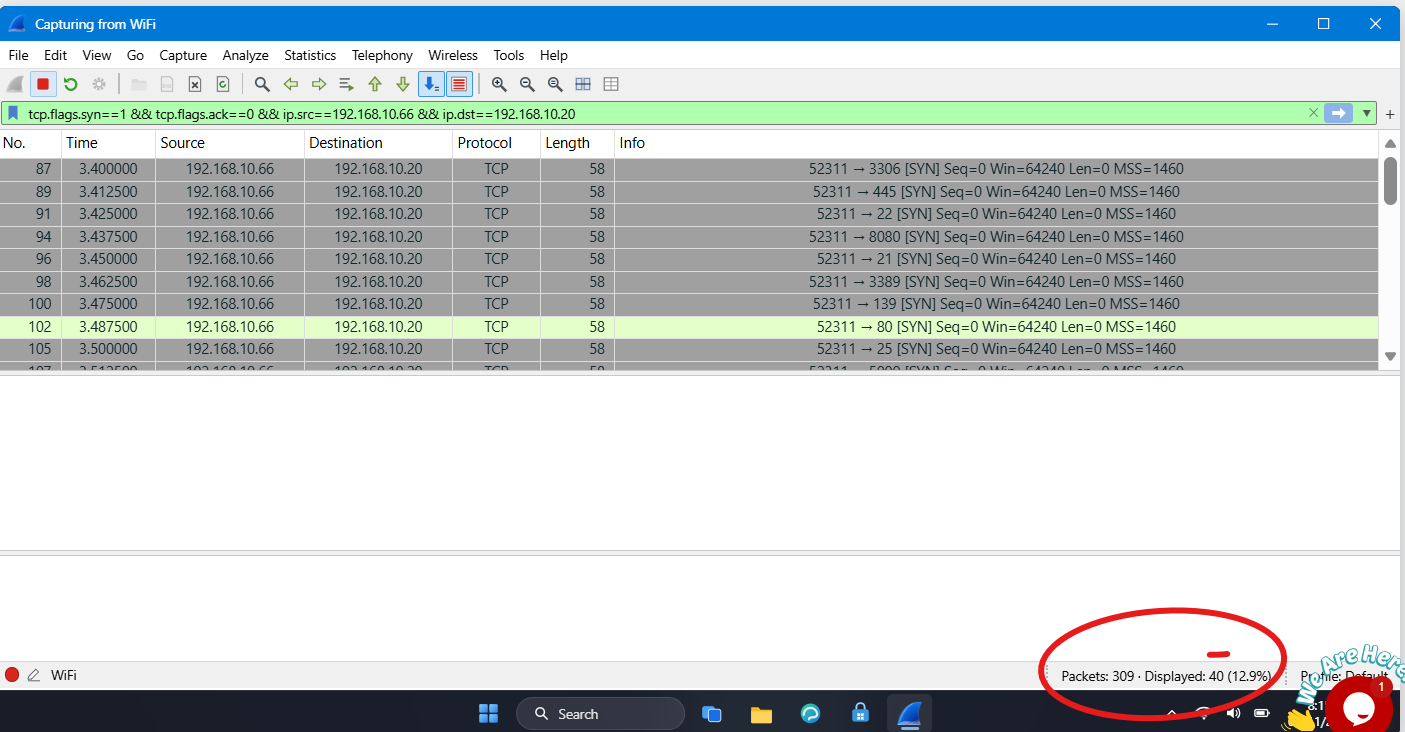
• Total number of Captured packets ;
Show only the packets that start a TCP connection :filtering for SYN packets (tcp.flags.syn == 1)
• Isolated the attacker by sorting SYN packets by source in Statistics → Conversations: one IP, 192.168.--.--, sent far more SYNs than any other host, all from a fixed source port (52*)
• Target was 192.168.--.--, probed across 40 different ports
• Checked the replies: 3 ports answered SYN/ACK (open: , , *), answered RST/ACK (closed)
• The attacker never completed the three-way handshake — classic half-open behavior
Conclusion: a TCP SYN scan (half-open scan), consistent with a tool like Nmap’s -sS — stealthier and less likely to be logged by the target application than a full connect scan.
Also Completed all 6 labs in this series (TCP stream reconstruction, HTTP plaintext credentials, brute-force detection, call-scam traffic analysis) — packet-level investigation is becoming a solid part of my SOC toolkit.
A special thank you to Waqas Karim (CCIE) and the NETWORKWALKS Team for providing these hands on labs
#CyberSecurity #SOC #Wireshark #NetworkForensics #BlueTeam #PacketAnalysis
https://github.com/HoroChime/Wireshark-SOC-Labs-Horoiheoma/tree/main
5 reactions · 6 comments
Topics: #blueteam, #wireshark, #networkforensics, #packetanalysis, #cybersecurity, #soc
Comments
Fredrik L.: going to run this by my mini SOC project to see what happens! thanks for sharing.
HOROIHEOMA C.: Fredrik Lindstrom i'd be glad to note your findings
HOROIHEOMA C.: https://drive.google.com/file/d/1H-c9OUkjqud3hPj6JWMBfc70uY0k0mW1/view?usp=sharing
Fredrik L.: Good post. I fed your findings to my home SOC as a test. On its live feed it would have seen nothing, because a gateway doesn’t see traffic between two hosts on one subnet. Given your packet counts as an alert, its local model called it a likely port scan, high confidence. Given your conclusion as well, it said “textbook Nmap SYN scan (half-open)” on the same packets and cited the target’s RSTs as
HOROIHEOMA C.: Fredrik Lindstrom Checked both. The attacker reset all three open ports (packets 93, 104, 113 — RST right after the target’s SYN-ACK) instead of completing the handshake, which is the real half-open evidence, not the closed-port RSTs. The two extra packets were an ICMP echo request/reply (83–84) — a host-discovery ping before the scan, not part of the TCP exchange at all. Conclusion holds, but for