☁️ AI DevOps Copilot — Building an AI-Powered, Cloud-Native DevOps Platform What if a DevOps platform could…
Naman Mahna — Software Engineer
☁️ AI DevOps Copilot — Building an AI-Powered, Cloud-Native DevOps Platform
What if a DevOps platform could do more than display dashboards—what if it could help engineers investigate failures, understand operational dependencies, and make troubleshooting more intelligent?
That question has been driving the development of my AI DevOps Copilot, a full-stack platform that brings together AI-assisted troubleshooting, CI/CD observability, Kubernetes infrastructure insights, and event-driven incident analysis.
🤖 1. AI-Powered DevOps Assistant
The AI layer uses multiple execution paths rather than relying on a single RAG workflow. Based on user intent, it can:
▪️ Handle conversational queries
▪️ Execute live tools against DevOps and GitHub data
▪️ Retrieve and analyse historical CI/CD failure context through RAG
GitHub Actions logs are processed to extract meaningful failure information, which is transformed into searchable knowledge using Sentence Transformers, embeddings, and Qdrant.
The architecture combines intent classification, live tool execution, historical context retrieval, guardrails, and LLM-generated responses to support more context-aware troubleshooting.
⚙️ 2. Event Engine & Pipeline Intelligence
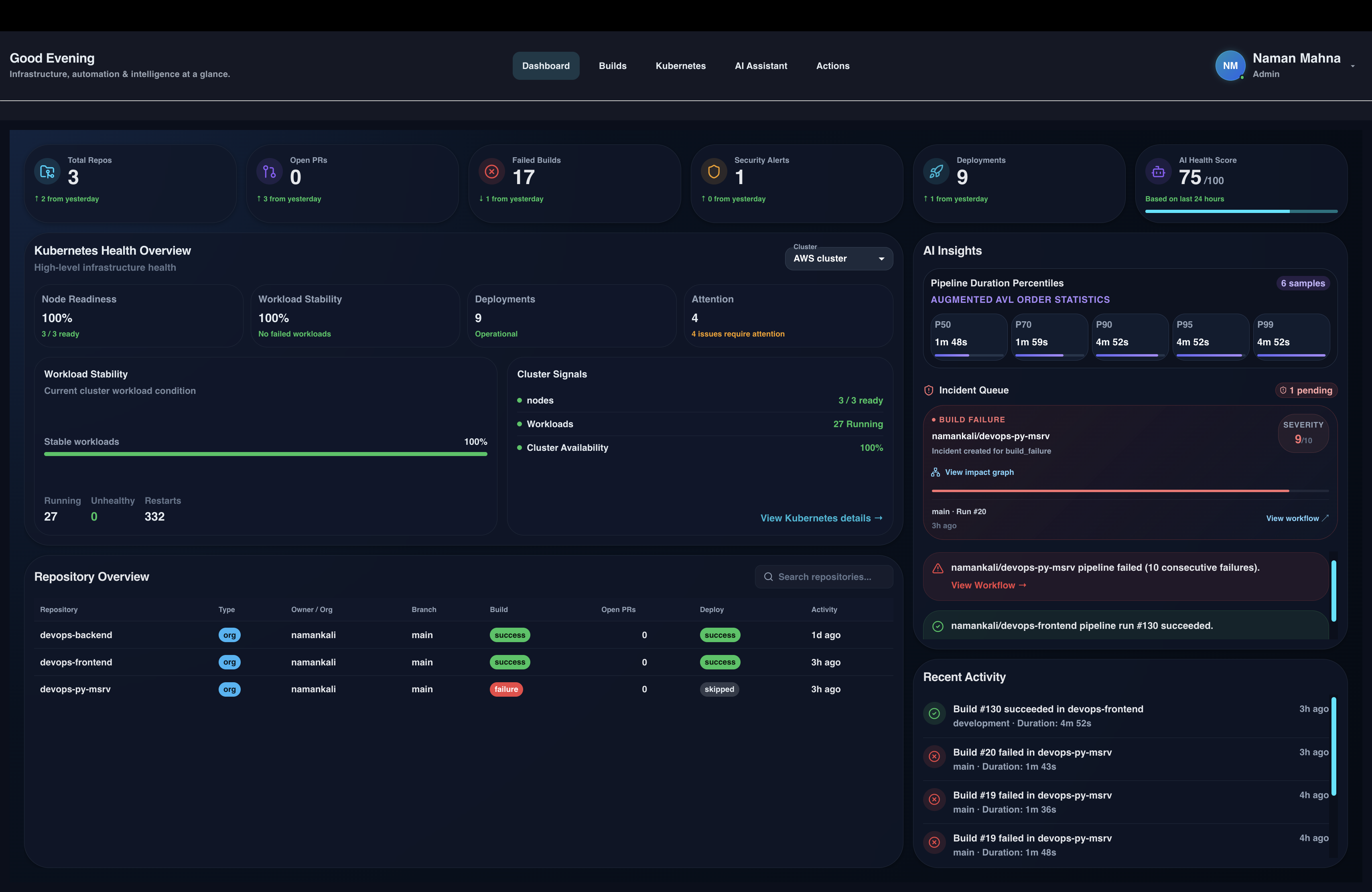
I’ve also been developing an Event Engine that transforms CI/CD workflow events into pipeline state, performance metrics, and dependency-aware incident insights.
Key engineering implementations include:
▪️ Pipeline State Management — Tracks CI/CD activity using repository and workflow identifiers.
▪️ Sliding Window Event Processing — Uses Python’s collections.deque with a two-hour development window to manage recent events and expire stale data efficiently.
▪️ Percentile Metrics with an Augmented AVL Tree — Uses order-statistic operations to calculate P50, P70, P90, P95, and P99 execution-duration percentiles, providing a more detailed view of pipeline performance than averages alone.
▪️ Severity-Based Incident Processing — Classifies operational events and prioritises failures based on severity.
▪️ Runtime State Recovery — Restores recent pipeline state and dependency topology during startup.
▪️ Deployment Target Mapping — Connects repositories, workflows, and branches to their configured Kubernetes clusters and services.
▪️ Dependency-Aware Impact Analysis — Uses Kubernetes service dependency graphs, adjacency structures, and reverse-adjacency traversal to identify potentially affected downstream services.
The objective is to connect CI/CD events with infrastructure relationships and provide more useful context when investigating operational failures.
📊 3. Full-Stack DevOps Platform
The platform brings together several operational views:
▪️ Dashboard: Repository, build, deployment, and AI health insights.
▪️ CI/CD: Workflow runs, jobs, branches, failures, success rates, and execution durations.
▪️ Kubernetes: Visibility into workloads, services, networking resources, configuration, storage, events, and resource usage.
▪️ AI Assistant: An interactive interface combining live operational data with historical failure context.
▪️ AI Health: Monitoring dimensions including provider and model availability, inference success, latency, and tool reliability over a 24-hour window.
🛠️ Technology Stack
Frontend: React, Vite, TypeScript
Backend: Node.js, TypeScript
Database: PostgreSQL
Asynchronous Processing: Redis, Bull
AI Services: Python, FastAPI
LLMs: Ollama (local), OpenAI API
Vector Database: Qdrant
Infrastructure: Docker, Kubernetes, K3s, AWS EC2
The platform currently runs across my local Kubernetes environment and AWS EC2-based K3s infrastructure.
🔐 4. Reliability, Security & What’s Next
The next phase focuses on strengthening the platform through:
▪️ Concurrency validation and load testing
▪️ Improving event-processing reliability and recovery behaviour
▪️ Continuous security testing and penetration testing across APIs, infrastructure, containers, and exposed interfaces
▪️ Further development of AI-assisted troubleshooting and operational reasoning
▪️ Progress towards an AWS EKS deployment
The broader engineering challenge is to make these components work together reliably—not simply to add AI to an existing dashboard.
For me, this project is about combining data structures, backend engineering, AI, infrastructure observability, and security into a platform that can help engineers move from detecting an operational problem towards understanding its context and potential impact.
More to come. 🚀
#AIDevOps #DevOps #AI #PlatformEngineering #SoftwareEngineering #Kubernetes #AWS #Python #FastAPI #DistributedSystems #Observability #CyberSecurity #DevSecOps
7 reactions · 2 comments
Topics: #platformengineering, #softwareengineering, #devsecops, #python, #distributedsystems, #kubernetes, #ai, #aidevops, #devops, #fastapi
Comments
George B.: Not bad! How are you handling the trust boundary between CI logs and live tool execution? I’d be interested in how you keep retrieved content from influencing which tools the assistant calls.
Naman Mahna: George Botnaru Good question! I separate the two paths through intent-based routing: CI failure logs are retrieved from Qdrant for analysis while live queries use configured tools through authenticated Nodejs APIs. The tool handler also restricts execution to an allowlist. I am now tightening the boundary further by enforcing tool permissions at execution time so retrieved log content cannot steer