Posted in GRC
📢 Shared from Cybersecurity Governance & Executive Accountability The CISO Says Shut It Down. The Business…
Victor Font — Keynote Speaker | Strategic Technology Leader | Fractional CIO | IT & Cyber Governance Expert | Published Author | FedRAMP Readiness | Board-Level Advisor | Digital Transformation | Enterprise WordPress/Formidable Forms
📢 Shared from Cybersecurity Governance & Executive Accountability
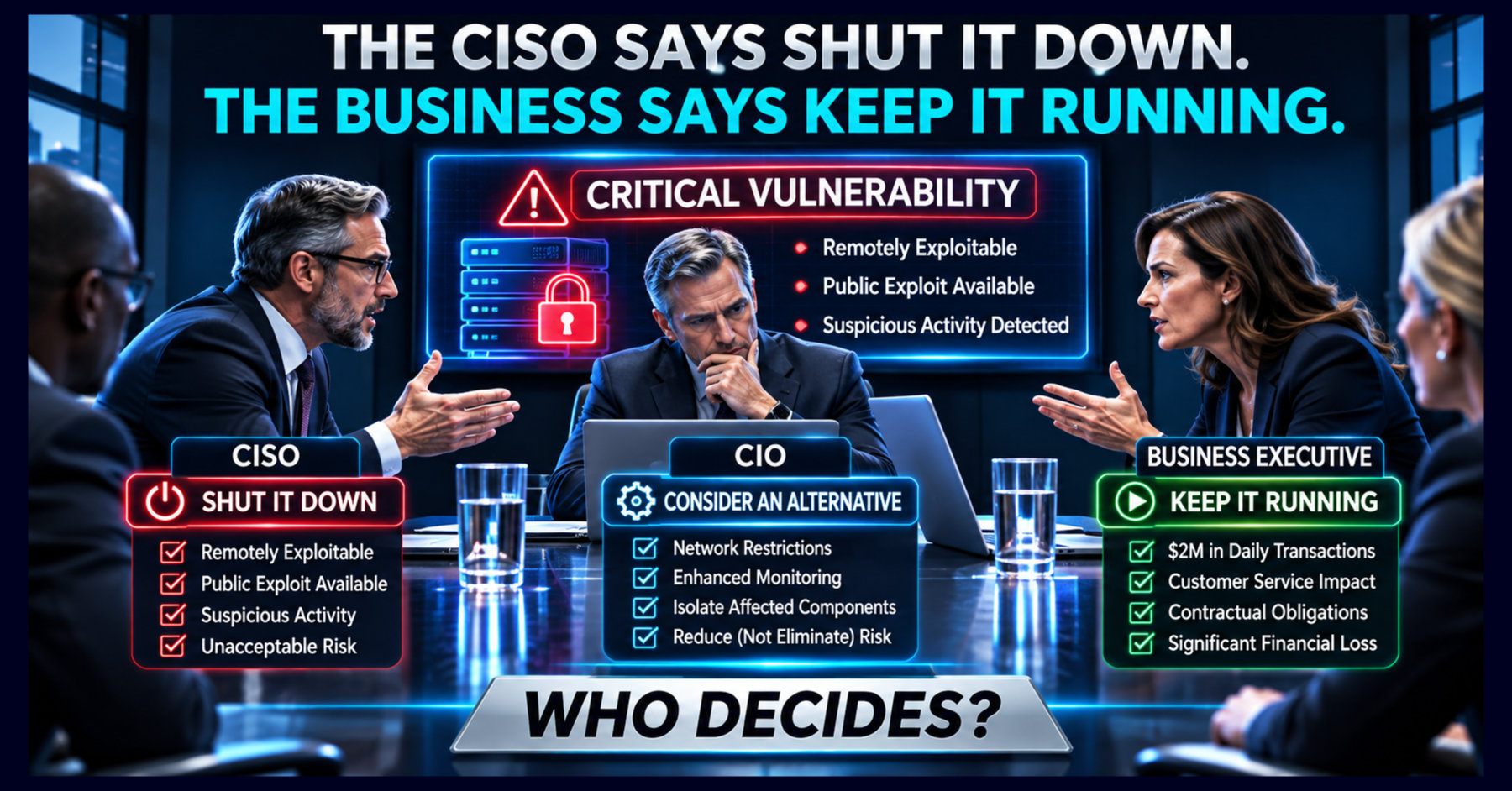
The CISO Says Shut It Down. The Business Says Keep It Running. Who Decides?
Cybersecurity Governance & Executive Accountability | Governance in Practice
Imagine you're sitting in an emergency executive meeting.
The CISO has just informed leadership that a critical business application contains a remotely exploitable vulnerability.
The application processes sensitive customer information and supports approximately $2 million in daily transactions.
The vulnerability has a publicly available exploit. Security monitoring has identified suspicious activity, although investigators have not confirmed that the application has been compromised.
The CISO recommends immediately disconnecting the application until the exposure can be contained.
The CIO agrees that the vulnerability is serious but believes additional network restrictions and enhanced monitoring could reduce the immediate exposure without shutting down the system.
The business executive objects to suspension.
Taking the application offline could interrupt customer transactions, create contractual problems, and produce substantial financial losses.
The CEO asks a straightforward question:
"Do we actually need to shut it down?"
The CISO says yes.
The CIO says there may be another option.
The business executive says no.
All three have legitimate concerns.
All three are operating within their professional responsibilities.
But they cannot all make the final decision.
Who has the authority to decide?
The Problem Is Bigger Than a Technical Disagreement
At first glance, this appears to be a cybersecurity incident management problem.
Security wants to contain the threat.
IT wants to maintain system availability.
The business wants to preserve operations.
But the underlying issue is governance.
The organization must determine whether the potential consequences of continued operation outweigh the consequences of suspending the application.
That decision involves cybersecurity exposure, operational continuity, financial impact, contractual obligations, and potentially legal and regulatory requirements.
No single technical assessment can resolve all those considerations.
The CISO can assess the cybersecurity threat and recommend appropriate protective measures.
The CIO can evaluate technical alternatives and the operational consequences of implementing them.
The business executive can explain the financial and customer impact of interruption.
Legal and risk management may provide additional analysis.
But someone must possess legitimate authority to resolve the competing considerations.
Expertise informs the decision. Authority determines who may make it.
Those are different responsibilities.
The CISO's Position
The CISO has a strong argument.
A remotely exploitable vulnerability with a publicly available exploit creates a credible threat.
Suspicious activity increases concern, even if compromise has not been confirmed.
Continued operation may expose sensitive customer information, disrupt critical services, or allow attackers to establish a foothold within the enterprise.
The CISO's responsibility is to assess the threat, communicate its significance, recommend appropriate safeguards, and escalate material exposure.
But does that responsibility automatically authorize the CISO to suspend a revenue-generating business application?
Not necessarily.
Some organizations explicitly delegate emergency containment authority to cybersecurity leadership.
Others require approval from an incident commander, designated executive, or crisis management structure.
The distinction matters.
A CISO's professional responsibility to recommend containment does not automatically establish unrestricted authority to interrupt business operations.
However, the opposite is equally important.
A CISO should not be prevented from exercising emergency authority that the organization has already established simply because another executive objects to the operational consequences.
That authority must be defined before the crisis.
The CIO's Position
The CIO proposes an alternative.
Rather than disconnecting the application entirely, IT could implement additional network restrictions, limit access, increase monitoring, and isolate affected components.
This may be a reasonable approach.
But it requires evidence.
Can the proposed controls meaningfully restrict the exploit path?
Can they be implemented quickly enough?
Are the monitoring capabilities sufficient to detect exploitation?
Can the organization verify that the controls are functioning?
What residual exposure remains?
The CIO's proposal should be evaluated against the same risk criteria as the CISO's recommendation.
It should not be accepted merely because it preserves availability.
An operationally convenient alternative is not necessarily an effective cybersecurity treatment.
Nor should shutdown be treated as the only defensible response without evaluating feasible containment options.
The decision requires an informed assessment of the alternatives.
The Business Executive's Position
The business executive also has legitimate concerns.
Suspending the application may interrupt customer services, create financial losses, and trigger contractual obligations.
Those consequences matter.
Cybersecurity governance is not intended to eliminate business risk by ignoring business objectives.
Its purpose is to ensure that risks are evaluated and managed through legitimate organizational authority.
But the business executive's argument has a critical limitation.
The financial consequences of shutting down a system do not automatically justify accepting the cybersecurity consequences of keeping it operational.
The business executive must understand the exposure being retained.
That includes the possibility of compromise, data loss, regulatory consequences, operational disruption, and reputational damage.
If continued operation exceeds established risk tolerance, the executive may not possess authority to accept that exposure independently.
Business ownership is not unlimited risk acceptance authority.
Now the CEO Must Decide—or Must Someone Else?
The CEO is the most senior executive in the meeting.
Does that automatically make the CEO the appropriate decision-maker?
Not necessarily.
The organization may already have an established incident response structure that delegates emergency containment authority.
A designated incident commander may be authorized to isolate affected systems under defined conditions.
The CISO may possess authority to implement emergency protective measures.
Certain decisions may require escalation to executive management because they exceed delegated limits.
The CEO may need to resolve a business conflict, authorize extraordinary resources, or direct a broader crisis response.
But the CEO should not have to invent the organization's cybersecurity decision structure during an emergency.
A mature governance operating model establishes decision authority before competing executive priorities collide.
The relevant question is not simply which executive outranks the others.
It is which individual or body possesses authority under the organization's established governance and incident response arrangements.
What If There Is No Time for a Committee Meeting?
This is where the scenario becomes more consequential.
The vulnerability is potentially exploitable now.
Attackers do not wait for the next governance committee meeting.
If every material containment decision requires assembling executives, reviewing presentations, and negotiating consensus, the organization may lose critical response time.
That is why emergency authority matters.
Organizations should establish predefined conditions under which authorized personnel may take immediate protective action.
These arrangements are sometimes described as standing orders, emergency delegations, or preauthorized response actions.
For example, an incident response plan may authorize immediate isolation of a system when specified indicators establish a sufficiently serious threat.
The authority should have defined boundaries.
It should identify who may act, what conditions trigger action, which measures are permitted, what notifications are required, and how decisions are subsequently reviewed.
Such arrangements should also account for operational dependencies where immediate shutdown could create significant safety or continuity consequences.
Emergency governance should enable timely, authorized action—not require the organization to negotiate authority while an attack unfolds.
The Risk Acceptance Question
Suppose the organization decides to keep the application operational with additional restrictions.
What has actually occurred?
Management has selected a risk treatment strategy that retains some level of exposure.
That decision should not be mistaken for proof that the residual risk is acceptable.
The organization must establish whether the remaining exposure falls within authorized tolerance.
If it does, the appropriate decision-maker may approve continued operation subject to defined conditions.
If it exceeds delegated authority, the matter requires escalation.
If legal obligations or mandatory security requirements prohibit continued operation under the circumstances, ordinary business risk acceptance may not be sufficient.
The decision should also establish when it must be reconsidered.
What happens if suspicious activity increases?
What happens if exploitation is confirmed?
What happens if the compensating controls fail?
What happens if the application remains vulnerable longer than anticipated?
A decision to continue operating is not the end of governance. It creates an obligation to monitor whether the conditions supporting that decision remain valid.
What Would NIST CSF 2.0 Tell Us?
The NIST Cybersecurity Framework 2.0 provides a useful structure for evaluating this scenario.
The GOVERN function addresses risk management strategy, roles, responsibilities, authorities, policy, and oversight.
The RESPOND function addresses incident management, analysis, reporting, communication, and mitigation.
These functions must operate together.
GOVERN establishes the organizational authority and expectations under which cybersecurity decisions occur.
RESPOND supports the operational activities necessary to manage the incident.
A technically capable incident response team may still encounter delays if the organization has not established appropriate decision authority.
Conversely, a well-defined governance structure provides limited protection if the organization lacks the operational capability to evaluate and contain the threat.
Governance and incident response are complementary capabilities. Neither substitutes for the other.
The Evidence That Matters Afterward
Now imagine the organization keeps the application running.
Two weeks later, investigators discover that attackers exploited the vulnerability and obtained sensitive customer information.
The organization faces questions from customers, regulators, insurers, and potentially its board.
Why was the application allowed to remain operational?
Who made that decision?
What information was available?
What alternatives were considered?
Was the decision consistent with established risk tolerance?
Were the compensating controls implemented and verified?
Did subsequent developments trigger reassessment?
These questions illustrate the importance of Evidentiary Architecture™.
The organization should be able to reconstruct the decision through reliable evidence.
That evidence should establish the threat assessment, available alternatives, applicable authority, decision rationale, operational conditions, monitoring requirements, and subsequent actions.
But evidence must not be confused with justification.
A complete decision record does not make a poor decision acceptable.
It allows the organization to determine whether the decision was properly authorized, reasonably informed, and consistent with its governance obligations.
Defensible governance is not about proving that executives made the right prediction. It is about demonstrating that consequential decisions were made through legitimate authority and an appropriately informed process.
Now Put Yourself in the Executive Meeting
Return to the original scenario.
The application supports $2 million in daily transactions.
A remotely exploitable vulnerability has a publicly available exploit.
Suspicious activity has been detected.
The CISO recommends shutdown.
The CIO proposes compensating controls.
The business executive opposes interruption.
The organization must act.
You have four possible approaches.
Option A — Follow the CISO's recommendation.
Immediately disconnect the application until the exposure can be contained and continued operation can be justified.
Option B — Follow the CIO's alternative.
Keep the application operational under emergency restrictions, enhanced monitoring, and a defined reassessment deadline, provided the controls can be verified.
Option C — Escalate to the CEO or designated crisis authority.
Require an immediate executive decision based on the cybersecurity assessment, business consequences, established risk tolerance, and applicable delegations.
Option D — Exercise preauthorized emergency authority.
Allow the designated incident commander or other authorized official to implement the response already permitted under the organization's emergency governance arrangements.
These options are not necessarily mutually exclusive. An authorized incident commander might implement immediate containment while executives evaluate longer-term operational decisions.
The important distinction is whether the organization has established the authority and decision criteria necessary to act.
A Question for the Community
You're in that executive meeting. Which option would you choose—A, B, C, or D—and why?
Assume the threat is credible, but compromise has not yet been confirmed.
Would your answer change if the application supported emergency medical services, industrial control systems, or other safety-critical operations?
I'm particularly interested in perspectives from CISOs, CIOs, incident responders, risk professionals, and business executives.
Because the central question is not whether cybersecurity or business operations should win an argument.
It is whether the organization has established the authority, risk boundaries, and evidence necessary to make a defensible decision when both are at stake.
#CybersecurityGovernance #ExecutiveAccountability #CISO #IncidentResponse #CyberRisk #NISTCSF #GRC #EvidentiaryArchitecture
2 reactions · 2 comments
Topics: #cyberrisk, #ciso, #incidentresponse, #cybersecuritygovernance, #nistcsf, #executiveaccountability, #evidentiaryarchitecture, #grc
Comments
Fredrik L.: If no one is quantifying the risk, you can't make a decision. Critical vulnerability, sure, but if it is generating $1M in revenue every hour, and the cost of keeping it up is $1000, and there's no additional exposure. The issue has that these discussions happen exactly like this in most organizations, when they should have happened years before, and then repeated the same discussion at least once
Victor Font: Fredrik Lindstrom Fredrik, I think your last point gets to the heart of the problem. These conversations should have happened long before the vulnerability was discovered. Risk quantification is essential, but the assumptions behind the numbers matter just as much. A $1,000 estimated exposure is only meaningful if we've adequately assessed the likelihood, potential consequences, and interconnected