Posted in Threat Intelligence
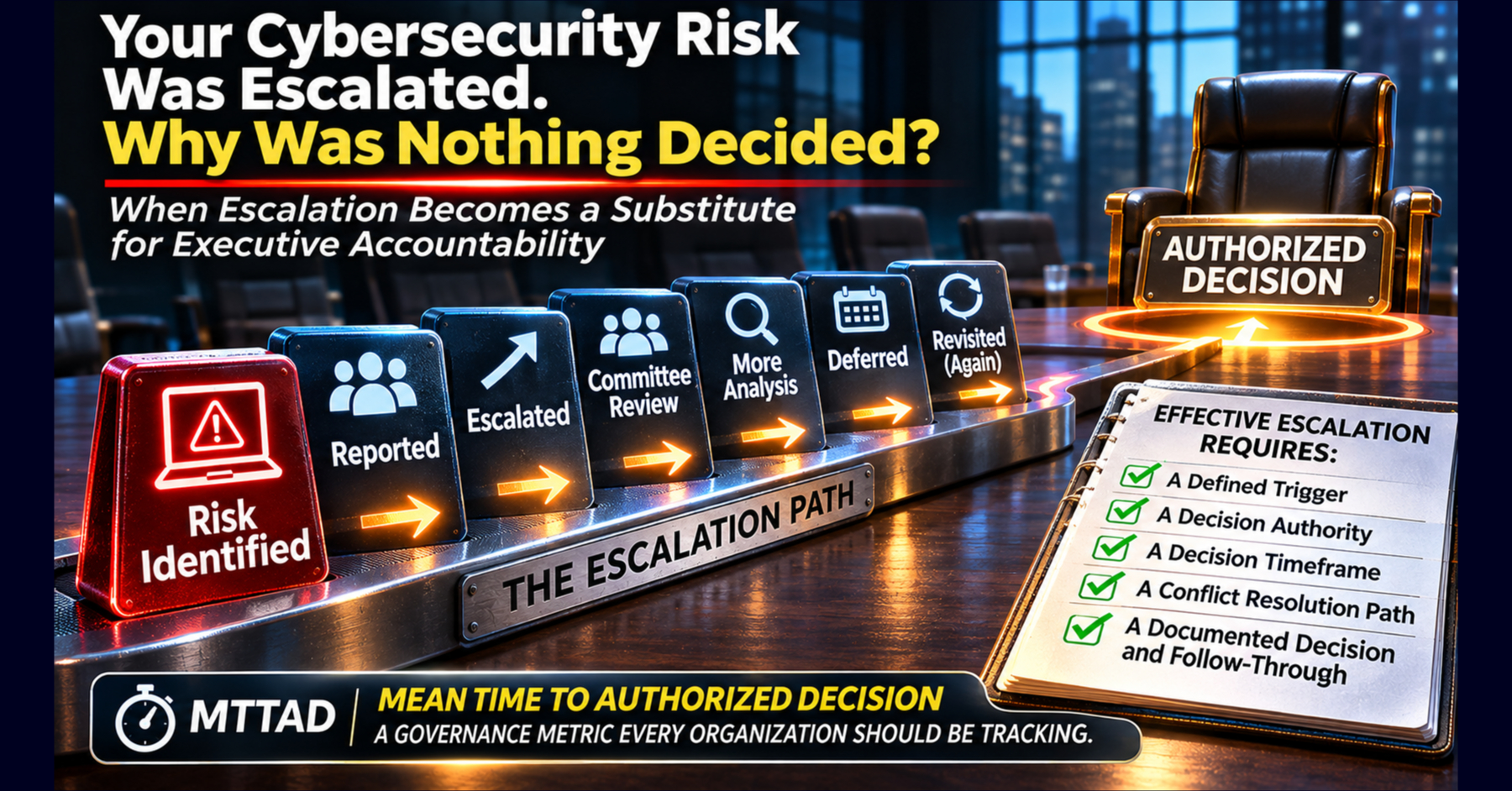
Your Cybersecurity Risk Was Escalated. Why Was Nothing Decided?
Victor Font — Keynote Speaker | Strategic Technology Leader | Fractional CIO | IT & Cyber Governance Expert | Published Author | FedRAMP Readiness | Board-Level Advisor | Digital Transformation | Enterprise WordPress/Formidable Forms
When Escalation Becomes a Substitute for Executive Accountability
A security engineer discovers a serious vulnerability affecting a business-critical application.
The vulnerability cannot be remediated without disrupting an essential operational process.
The engineer reports the issue to the security manager.
The security manager escalates it to the CISO.
The CISO raises the matter with the CIO.
The CIO refers it to the enterprise risk committee.
The committee requests additional analysis.
The business unit challenges the proposed remediation schedule.
Finance questions the funding requirements.
The issue returns to the next committee meeting.
Six weeks later, the vulnerability remains unresolved.
But the organization has an impressive record of activity.
The issue was identified.
The risk was documented.
The appropriate stakeholders were notified.
The escalation procedures were followed.
The committee discussed the matter.
Meeting minutes were recorded.
And the risk register was updated.
Everyone can demonstrate that the issue was escalated. Nobody can demonstrate that an accountable decision was made.
That is not an incident management problem.
It is a cybersecurity governance failure.
Escalation Is Not a Decision
Organizations frequently treat escalation as evidence that a risk is being governed.
A security issue exceeds an operational team's authority.
The issue moves to management.
Management determines that the matter requires executive attention.
The issue moves to a committee.
The committee requests further evaluation.
Each transition appears reasonable.
Each participant may be acting within established procedures.
But escalation has a specific purpose.
It should transfer a matter to an authority capable of making a decision that the previous level could not legitimately make.
If the receiving authority cannot decide, lacks the necessary information, or has no obligation to resolve the matter within an appropriate timeframe, escalation may accomplish little more than transferring responsibility.
Moving a risk upward through the organization is not the same as moving it toward resolution.
That distinction becomes especially important when the risk continues to evolve while management deliberates.
The Committee That Cannot Decide
Consider an enterprise cybersecurity risk committee.
Its membership includes representatives from security, IT, legal, compliance, finance, operations, and business leadership.
The committee meets monthly.
It reviews material risks, evaluates exceptions, and monitors remediation progress.
The structure appears appropriate.
But what authority does the committee actually possess?
Can it direct a business unit to suspend an unsafe activity?
Can it approve funding?
Can it require a remediation deadline?
Can it reject a proposed risk acceptance?
Can it resolve disagreements between security and operations?
Or can it only discuss the matter and recommend that someone else take action?
There is nothing inherently wrong with an advisory committee.
The problem arises when the organization treats an advisory body as though it possesses decision authority.
A committee may provide valuable analysis, coordination, and recommendations.
But unless its charter establishes binding decision rights—or identifies the executive who must act on its recommendations—the organization may create an elaborate process without an accountable decision-maker.
A governance committee without clear decision authority can become a sophisticated mechanism for distributing indecision.
And the more departments represented, the easier it may become for everyone to assume that accountability belongs somewhere else.
The Hidden Cost of Waiting
Cybersecurity risks do not remain static while organizations deliberate.
A vulnerability may become easier to exploit.
Threat intelligence may reveal active attacks.
An affected application may become more business-critical.
A compensating control may deteriorate.
A temporary exposure may become permanent.
Yet governance reporting often measures escalation activity rather than decision latency.
The dashboard may show that a critical issue was escalated within the required service-level agreement.
That metric tells leadership something useful.
It establishes that the notification process operated within its defined timeframe.
But it does not establish whether the organization made a timely decision.
Consider two measurements:
Time to Escalation: How long did it take to bring the issue to the appropriate level of management?
Time to Authorized Decision: How long did it take for an appropriately empowered decision-maker to approve a course of action, accept the risk within established authority, or direct further treatment?
These measurements describe different capabilities.
An organization may excel at the first and perform poorly at the second.
And when the underlying exposure is significant, the difference can have material consequences.
A risk that is escalated immediately but remains undecided for weeks is still an unresolved risk.
The organization should not mistake the speed of notification for the effectiveness of governance.
When Everyone Wants More Information
One of the most common reasons for delayed decisions is the request for additional analysis.
Sometimes that request is entirely appropriate.
Executives should not make consequential cybersecurity decisions without sufficient information.
But there is a difference between obtaining information necessary for a defensible decision and repeatedly requesting analysis because nobody wants to accept responsibility for the outcome.
Consider a critical vulnerability affecting a revenue-generating platform.
Security recommends immediate remediation.
Operations estimates that remediation will require six hours of downtime.
Finance calculates the potential revenue impact.
Legal identifies contractual obligations.
The business owner asks for alternative approaches.
Security evaluates compensating controls.
The committee requests another assessment.
At some point, the organization must decide.
The available information may never eliminate uncertainty.
Every option may involve consequences.
Remediation may disrupt operations.
Delay may increase exposure.
Compensating controls may reduce risk without eliminating it.
The absence of a perfect solution does not eliminate the obligation to make a decision.
Governance exists precisely because consequential decisions must often be made under uncertainty.
If management continually postpones a decision until all uncertainty disappears, it may be making an implicit decision to preserve the current exposure.
That implicit decision deserves the same scrutiny as an explicit risk acceptance.
Five Characteristics of Effective Escalation
An effective cybersecurity governance operating model should establish five elements.
1. A defined escalation trigger
The organization must identify which conditions require elevation beyond operational management.
Triggers may include potential business impact, risk appetite thresholds, regulatory consequences, unresolved ownership disputes, or the failure of required controls.
2. An identifiable decision authority
Every escalation pathway should terminate at an individual or formally empowered body with authority to resolve the matter.
The authority must be appropriate to the business consequences of the decision.
3. A decision timeframe
Material cybersecurity risks should not remain indefinitely pending simply because the next committee meeting has not occurred.
Decision deadlines should reflect the severity, urgency, and potential consequences of continued exposure.
4. A mechanism for resolving disagreement
Security, operations, finance, and business leadership may reasonably disagree about the appropriate treatment.
The governance model must establish who can resolve those disagreements and under what authority.
5. A documented decision and follow-through
The process should preserve the decision rationale, assigned obligations, implementation requirements, and verification evidence.
An escalation should not be considered successfully resolved merely because a committee discussed it.
The measure of effective escalation is not whether the issue reached senior leadership. It is whether the appropriate authority made a timely, informed, and actionable decision.
The Risk Committee's Uncomfortable Question
Imagine reviewing the minutes from the last six meetings of an enterprise risk committee.
A particular cybersecurity issue appears repeatedly.
In the first meeting, management requests additional analysis.
In the second, the business unit raises operational concerns.
In the third, finance requests a cost estimate.
In the fourth, the committee reviews alternative treatments.
In the fifth, remediation is deferred pending budget approval.
In the sixth, the issue remains open.
The records demonstrate that the organization was aware of the risk.
They demonstrate that stakeholders discussed it.
They may even demonstrate that the committee followed its charter.
But they raise a troubling question.
Did the governance process reduce uncertainty sufficiently to support a decision, or did it merely create a defensible-looking record of prolonged indecision?
That distinction matters.
Meeting minutes can establish that a discussion occurred.
They do not necessarily establish that the organization exercised effective decision authority.
And if a significant incident occurs, a lengthy history of discussion may reveal that leadership understood the exposure but repeatedly failed to resolve it.
Evidentiary Architecture™ and the Decision Chain
This is another area where Evidentiary Architecture™ can strengthen cybersecurity governance.
Traditional governance documentation often emphasizes policies, committee structures, escalation procedures, and meeting records.
Those artifacts establish important aspects of the governance framework.
But the more consequential question is whether the framework produces accountable decisions and verified outcomes.
A defensible escalation record should connect:
Risk identified → Escalation threshold met → Appropriate authority engaged → Alternatives evaluated → Decision recorded → Obligations assigned → Actions verified → Evidence preserved.
The critical transition occurs between escalation and decision.
If that transition does not occur, the governance process remains incomplete.
The evidence should also preserve unresolved status, decision deadlines, material changes in exposure, and the authority responsible for continued delay.
This creates visibility into risks that have entered the governance process but have not yet received an actionable disposition.
It also makes it harder for unresolved issues to disappear into committee agendas or management reporting cycles.
The objective is not to accelerate every decision regardless of consequences.
It is to ensure that delays themselves remain visible, justified, and accountable.
Decision Latency Should Be a Governance Metric
Cybersecurity organizations measure many forms of operational latency.
Mean Time to Detect.
Mean Time to Contain.
Mean Time to Respond.
Mean Time to Recover.
These indicators help evaluate operational performance.
But how many organizations measure the time required to make an authorized governance decision?
Consider a metric such as Mean Time to Authorized Decision (MTTAD) .
For material escalations, it would measure the elapsed time between a defined escalation trigger and a recorded decision by the appropriate authority.
The metric would require careful design.
Different risk categories demand different decision timeframes.
An urgent containment decision should not be compared indiscriminately with a long-term capital investment decision.
Averages can also conceal dangerous outliers.
For that reason, organizations should examine decision latency by risk severity, decision category, and required response window.
They should also distinguish genuine decisions from administrative closure.
Nevertheless, the underlying concept deserves attention.
If an organization measures how quickly its security team detects risk but never measures how long management takes to decide what to do about it, its performance model is incomplete.
Governance effectiveness should include the ability to produce timely decisions—not merely evidence that concerns were communicated.
What Boards Should Be Asking
Boards should not become the default destination for unresolved operational cybersecurity decisions.
That would create unnecessary bottlenecks and confuse oversight with management.
But directors should expect management to establish clear decision rights, effective escalation pathways, and mechanisms for resolving material disagreements.
Several questions deserve attention.
How many material cybersecurity risks are currently awaiting an authorized decision?
How long have they remained pending?
Which decision authorities are responsible?
Are any unresolved risks outside established risk appetite?
What happens when a committee cannot reach agreement?
Who has authority to resolve a conflict between cybersecurity requirements and business priorities?
And how does management distinguish an issue that has been escalated from one that has actually been governed?
These questions reveal whether the organization's governance structure is capable of producing decisions when they matter.
A sophisticated committee structure is not sufficient.
A comprehensive risk register is not sufficient.
A well-documented escalation procedure is not sufficient.
The system must work.
The Decision Nobody Made
There is a final dimension to this problem that executives should consider.
When a cybersecurity risk is repeatedly escalated but never resolved, the organization may still be making a decision.
It is deciding, through inaction, to continue operating under the existing exposure.
But that decision may lack the safeguards normally associated with formal risk acceptance.
No authorized individual explicitly accepts responsibility.
No rationale establishes why continued exposure is reasonable.
No conditions define when the decision must be reconsidered.
No accountable owner may be assigned to monitor the consequences of delay.
The organization has effectively accepted risk without completing the governance process required to accept it.
Indecision can become an unauthorized form of risk acceptance.
That should concern every executive responsible for enterprise cybersecurity governance.
Because risk does not disappear while management waits.
And accountability does not disappear simply because nobody formally approved the decision to continue.
The Question I Would Ask Every CISO
Find the most significant cybersecurity risk currently awaiting executive action.
Not the highest-ranked vulnerability.
Not the oldest audit finding.
The material issue that has been escalated but remains undecided.
Then ask:
Who has the authority to resolve it?
What information is still required?
When must the decision be made?
What happens if that deadline passes?
And who is accountable for the exposure while the decision remains pending?
If those questions cannot be answered, the organization may have discovered a weakness in its governance operating model.
Not because the risk was hidden.
Not because the escalation procedure failed.
But because the organization successfully transferred the issue through its management structure without ensuring that anyone exercised the authority to decide.
The purpose of cybersecurity escalation is not to prove that leadership was informed. It is to ensure that leadership makes the decisions its authority requires.
Discussion
Consider a critical cybersecurity risk that has been escalated through every appropriate management channel but remains unresolved because security, operations, and finance cannot agree on a course of action.
Everyone has participated.
Everyone has documented their concerns.
Nobody has made the final decision.
Who should be accountable for the continued exposure?
And should organizations begin measuring executive decision latency with the same seriousness that they measure technical incident response times?
#CybersecurityGovernance #ExecutiveAccountability #CyberRisk #DecisionAuthority #RiskManagement #BoardOversight #GRC #EvidentiaryArchitecture
2 reactions · 0 comments
Topics: #cyberrisk, #decisionauthority, #cybersecuritygovernance, #executiveaccountability, #evidentiaryarchitecture, #riskmanagement, #boardoversight, #grc